Malacca and the Maritime Silk Road — A Harbor That Waits for the Wind
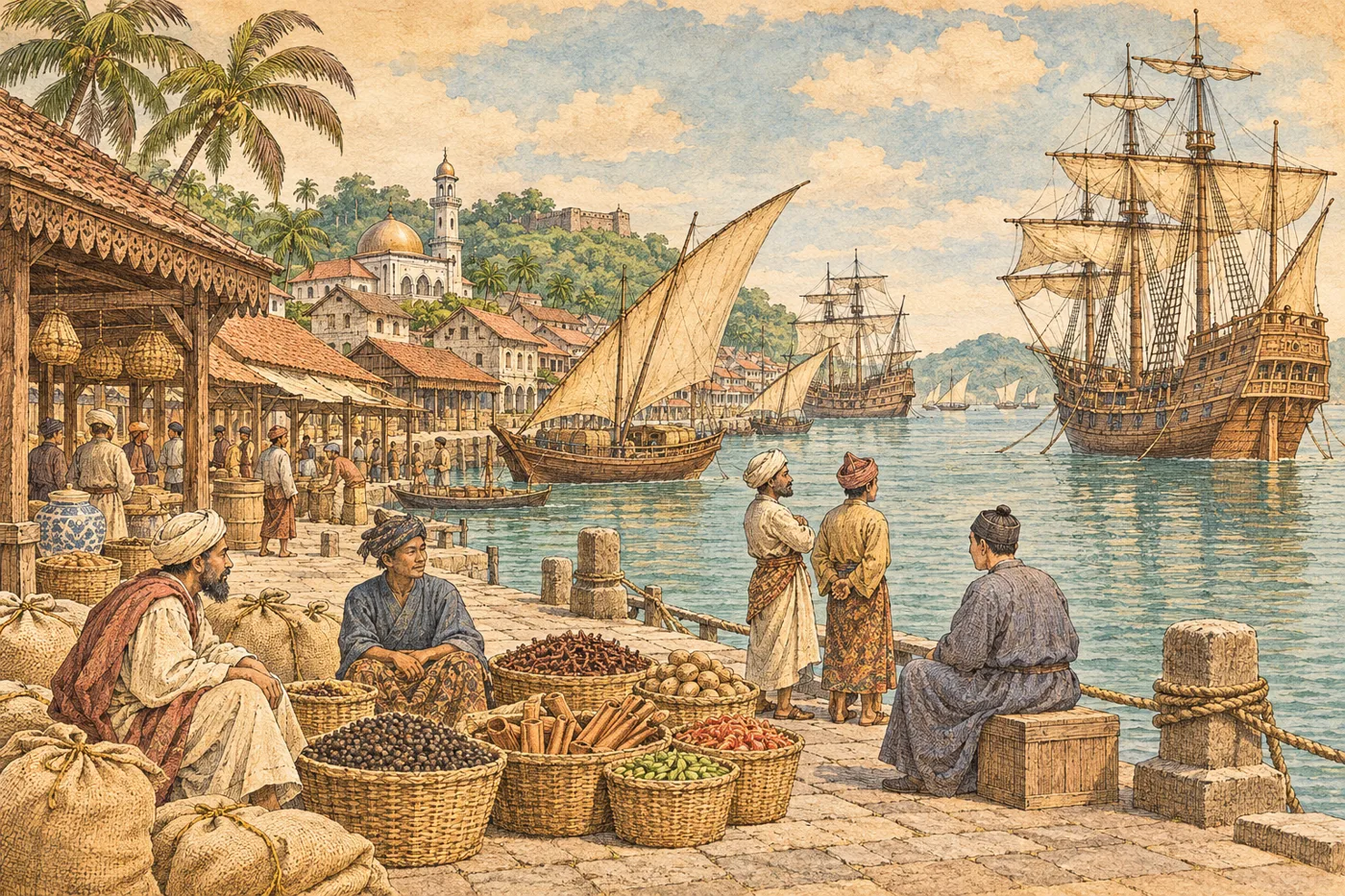
How did Malacca, once a tiny fishing village, become a global port?
In the seas of Southeast Asia, the wind changes direction every six months. Ships arriving from the Indian Ocean had to wait in these waters until the wind shifted. Thus, people and cargo gathered at the port. At the end of the 13th century, the Samudra Pasai Kingdom emerged in northern Sumatra, becoming one of the earliest Islamic kingdoms in Southeast Asia. The network of Muslim merchants connected the maritime routes.
From the late 14th to early 15th century, Malacca was founded on the west coast of the Malay Peninsula. According to tradition, it was established around 1400 (some say 1402) by a prince named Parameswara. It was ideally located on the narrow, calm waters of the Strait of Malacca.
From 1405, the Ming dynasty's Zheng He led a large fleet into the southern seas. The voyages are said to have lasted until 1433, with seven expeditions in total. Malacca became a port of call for his fleet and paid tribute to the Ming, receiving protection. Protected by a strong power, Malacca became a safe port for commerce.
Merchants speaking various languages gathered at Malacca's port—from India, Arabia, China, Java, and elsewhere. Later, the Portuguese Tomé Pires wrote in his 'Suma Oriental' that dozens of languages were spoken there. Tax regulations and the role of the port master (shahbandar) were well organized. The royal family eventually adopted Islam, and Malay spread as a common language among the people.
Goods traded included pepper, cloves, nutmeg, sandalwood, Chinese silk and porcelain, and Indian cotton cloth. Cloves and nutmeg, in particular, were precious spices that grew only on the distant eastern islands. Malacca was the transshipment port where these goods departed east and west.
In 1511, Albuquerque of Portugal led a fleet and captured Malacca. The king fled to places such as the east coast of the peninsula and Bintan Island, and his family later founded the Johor Sultanate to rebuild the country. Port trade scattered to various places such as Aceh, Banten, and Johor. The next chapter will follow the struggle over the more distant 'Spice Islands.'
Mini timeline
- End of 13th centurySamudra Pasai Kingdom appears in northern Sumatra
- Around 1400Malacca is said to have been founded
- 1405–33Zheng He's fleet sails to the southern seas seven times
- 15th centuryMalaccan royal family adopts Islam
- 1511Portugal captures Malacca
People in this chapter
Said to be a Muslim from Yunnan, he led a large fleet that reached Southeast Asia, the Indian Ocean, and the coast of East Africa.
He stayed in Malacca and recorded the port's conditions in his 'Suma Oriental.'
Meanwhile, elsewhere
Connection to Japan
Ships from the Ryukyu Kingdom also sailed to Malacca in the 15th century to trade.
Why it still matters
Malay is the basis of the common language in present-day Malaysia, Brunei, and Indonesia (as Indonesian). The city of Malacca was inscribed as a UNESCO World Heritage site in 2008 as 'Malacca and George Town.'
Perspectives differ
- Founding year and founder of Malacca
- The founding story is based on traditions such as the later 'Malay Annals,' so there are various theories about the exact year and details of the figures.
- Timing and reasons for adopting Islam
- It is believed to have occurred between the early and mid-15th century, but the exact date varies by historical source. Some views emphasize the trade advantages, while others highlight religious factors.
- Purpose of Zheng He's voyages
- The prevailing theory is that they aimed to increase tributary states and demonstrate Ming prestige, but other theories exist. The fleet's size (said to be over 60 ships with more than 20,000 crew) is based on records and is not certain.
- Did "Portugal destroy the port"?
- After the 1511 capture, trade continued as nearby Aceh and Johor took over, and maritime commerce persisted. It is considered simplistic to attribute Malacca's decline solely to Portuguese rule.
Facts checked (5, verified by AI on the web)
- Confirmed Malacca was founded around 1400 (some say 1402) by Parameswara Melaka State Government Official Portal: Sejarah Melaka
The Malacca state government's timeline states that Parameswara, of Palembang royalty, fled to Temasek (Singapore) after defeat by Majapahit and founded Malacca in 1400. The 1402 theory is not found on this page. - Confirmed Zheng He's voyages were from 1405 to 1433, seven expeditions Encyclopaedia Britannica: Zheng He
Britannica states the first voyage was in 1405, and he died on the return from the last voyage in 1433 (some sources say 1435). - Confirmed The Samudra Pasai Kingdom was an early Islamic kingdom in Southeast Asia at the end of the 13th century (king's tombstone from 1297) Encyclopaedia Britannica: Islamic influence in Indonesia
There is a theory that the Perlak Kingdom was older; the text expresses it as 'one of the earliest,' which is consistent. - Corrected & confirmed In 1511, Albuquerque captured Malacca; the sultan fled and later founded the Johor Sultanate Encyclopaedia Britannica: Mahmud Shah
Text revised: the king first fled to Pahang and Bintan, then later founded the Johor Sultanate, clarifying the sequence. - Confirmed Tomé Pires' 'Suma Oriental' records that dozens of languages were spoken in Malacca The Suma Oriental of Tomé Pires(Hakluyt Society 1944年版、Internet Archive所蔵スキャンの全文)
Full English translation of the original text read. The Malacca entry states: 'It is commonly said by the inhabitants of Malacca that 84 languages are spoken in the port of Malacca.' Confirms the text's 'dozens of languages' (originally 84).
Sources
Melaka State Government Official Portal: Sejarah Melaka
Encyclopaedia Britannica: Zheng He
Encyclopaedia Britannica: Islamic influence in Indonesia
Encyclopaedia Britannica: Mahmud Shah
Britannica: Tomé Pires
The Suma Oriental of Tomé Pires(Hakluyt Society 1944、Internet Archive)
* AI-drafted and cross-checked; human review is in progress. Status: