Majapahit and the Seas of Java — A Kingdom That Linked the Islands
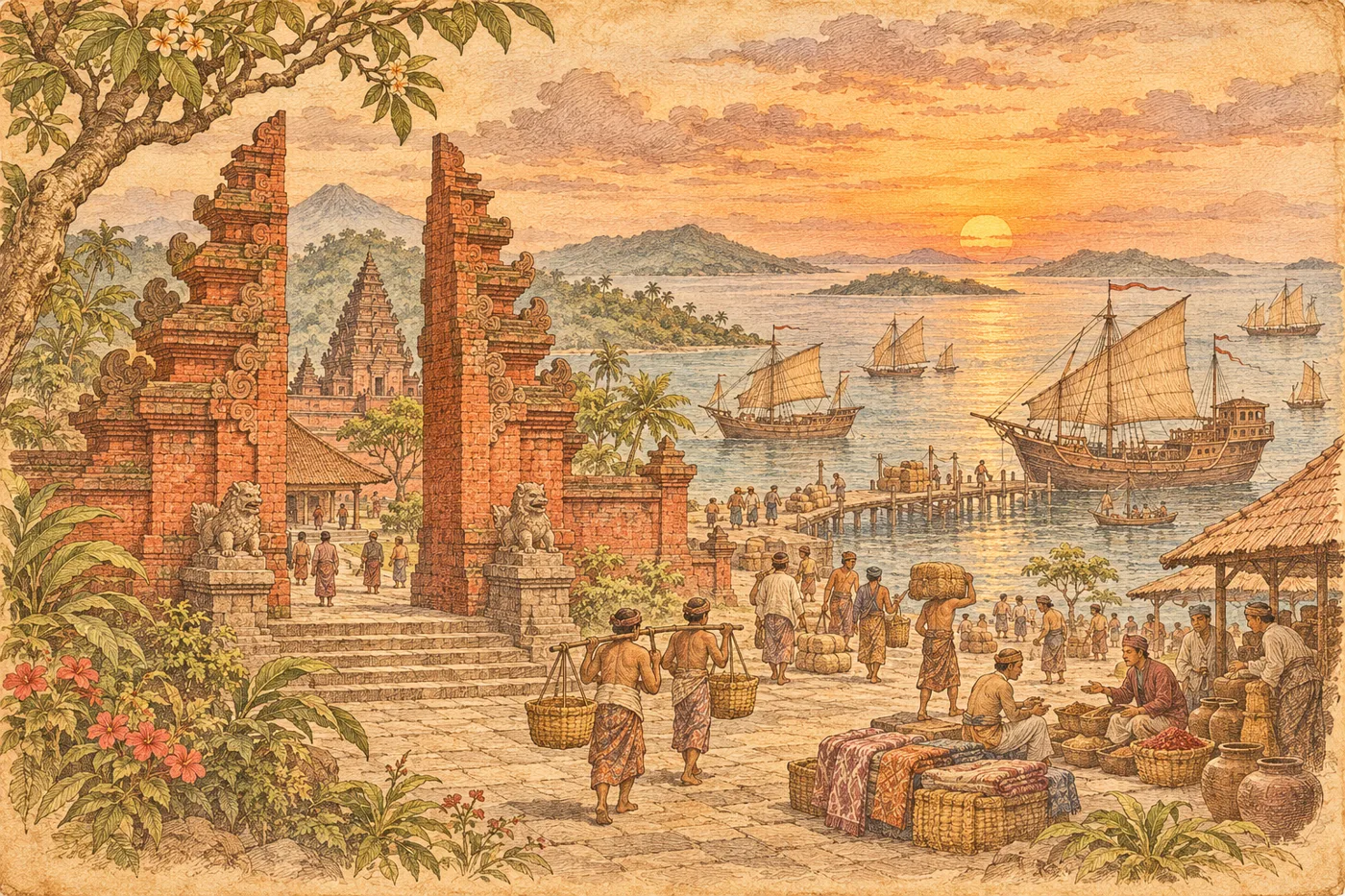
How did a kingdom whose capital was inland on Java connect with islands across the sea?
At the end of the 13th century, conflict continued in eastern Java. Kertanagara, king of Singhasari, is said to have been killed in 1292 by Jayakatwang, a former vassal lord of Kediri. A large Mongol fleet arrived the following year, in 1293. Raden Wijaya, Kertanagara’s son-in-law, is said to have allied with the Mongol forces temporarily and then persuaded them to withdraw. However, this account relies heavily on later records, and the details are subject to various interpretations.
Wijaya is said to have founded a new kingdom, Majapahit, in 1293. The capital was placed not on the coast but inland in eastern Java, near present-day Trowulan. The riverine plain was good rice-growing land, and from there one could go downstream to ports on the north coast. Majapahit is often described as lasting until around 1527, though the exact start and end years differ slightly depending on the source.
The kingdom is said to have reached its peak in the mid-14th century under King Hayam Wuruk (r. 1350–1389). The chief minister Gajah Mada also left his mark in this period. The poem *Nagarakretagama*, written around 1365 by the poet Prapanca, praises the king and lists many lands outside Java. However, whether all those named lands were under the kingdom’s direct control is a matter of scholarly debate.
The kingdom’s power was underpinned by maritime trade. On the north coast of East Java, ports such as Tuban, Gresik, and Surabaya flourished, sending inland products and spices from the eastern islands out to sea. However, trade was not entirely free; some studies note that the court had officials who oversaw foreign merchants. Ports and rivers linked arriving ships with the inland palace.
In the early 15th century, Ming China’s Zheng He sent large fleets to Southeast Asia. Six of his seven voyages are said to have called at Java. Around that time, Majapahit was experiencing a succession conflict (the Paregreg War, 1404–1406). In 1406, an incident in the eastern part of the kingdom reportedly cost the lives of about 170 of Zheng He’s men, and Chinese records state that the Ming emperor demanded compensation.
In the late 14th century, Islamic grave markers were made at a site called Troloyo near the capital. A gravestone dated 1368 is known, suggesting the presence of Muslims close to the court. As the kingdom weakened through dynastic strife, the north-coast port towns gradually became independent. In the early 16th century, the north-coast Islamic state of Demak expanded into eastern Java, and the era shifted. The details of this transition are subject to various interpretations.
Mini timeline
- 1292The king of Singhasari is said to have been killed.
- 1293Raden Wijaya founds Majapahit.
- 1350Reign of King Hayam Wuruk begins.
- 1365The poem *Nagarakretagama* is written.
- 1404–1406The Paregreg War over succession occurs.
- c. 1527The kingdom is often described as ending around this time.
People in this chapter
Son-in-law of the Singhasari king, said to have founded the kingdom in 1293.
Spoken of as a figure who supported the kingdom’s expansion, though the details of his activities are subject to various interpretations.
Meanwhile, elsewhere
Connection to Japan
In 1293, Japan was in the late Kamakura period. After the Mongol invasions of Japan (1274 and 1281), the Mongols also sent a fleet to Java. The early 15th century corresponds to the Muromachi period, when trade with Ming China flourished.
Why it still matters
In Indonesia, Majapahit is often spoken of as a symbol of the islands being connected by sea. Ruins remain at Trowulan in East Java today. Excavation and research will continue.
Perspectives differ
- Founding date and foundation story
- The founding is commonly placed in 1293, but some sources count the coronation year or date differently. The relationship with the Mongol forces also relies heavily on later records, and details are subject to various interpretations.
- Actual extent of territory
- Scholars disagree on whether the lands listed in the *Nagarakretagama* were directly ruled or were regions that acknowledged the kingdom’s prestige. We take no side on which is correct.
- Gajah Mada and the Palapa Oath
- The story of his vow to unify the islands is recorded in later texts. There is debate over the wording of the oath and its historicity.
- Spread of Islam
- Some views hold that the Islamization of Java proceeded gradually through trade, while others emphasize political conflict. The end of Majapahit is also described differently in various sources.
Facts checked (7, verified by AI on the web)
- Confirmed Raden Wijaya founded Majapahit in 1293, and the kingdom lasted until around 1527. Anita (2023) Jejak Budaya Maritim dan Perdagangan Kerajaan Majapahit(Santhet 7(2)・インドネシアの大学紀要)
Papers state '1293–1527'. Since the founding and end years vary by source, the text uses 'approximately' and 'is said to'. - Confirmed The *Nagarakretagama* was completed in 1365 and lists lands outside Java, but this does not mean direct control. Munandar (2020) Majapahit and the Contemporary Kingdoms: Interactions and Views(Berkala Arkeologi 40(1)・インドネシア大学の考古学者による論文)
A Munandar paper states they were lands that acknowledged prestige, not necessarily ruled. Other views exist; the text notes that opinions differ. - Confirmed The north coast ports of East Java—Tuban, Gresik, Surabaya—thrived, and the court had officials who managed foreign merchants. Basundoro & Nugroho (2024) The role of Eastern Java in the global spice trade network during the ancient period to the 17th century(Kasetsart Journal of Social Sciences 45・アイルランガ大学)
Port descriptions are from an Airlangga University paper; officials (rakryan kanuruhan) managing foreign merchants are confirmed in a Santhet paper. - Confirmed Zheng He called at Java on 6 of his 7 voyages, and during the Paregreg War (1404–1406), about 170 of his men were killed in 1406. Munandar (2020) Majapahit and the Contemporary Kingdoms: Interactions and Views(Berkala Arkeologi 40(1)・インドネシア大学の考古学者による論文)
A Munandar paper cites Chinese sources. The compensation amount (60,000 liang of gold) is also cited in the same paper, but the text does not include that figure. - Confirmed A gravestone at Troloyo bears the date 1368, and there are 21 graves in total. Masyhudi (2007) Menjelang Masuknya Islam di Ujung Timur Pulau Jawa(Berkala Arkeologi 27(1)・ジョグジャカルタ考古学研究所)
The same paper notes the Saka year 1290 = 1368 AD. It suggests the possible presence of Muslims near the court. - Unverified The Mongol fleet came to Java in 1293, and Wijaya temporarily allied with them before driving them away. WarHistory.org: Java Wars: Rise of Singosari and the Mongol Invasion(一般向けの歴史サイト・出典注なし)
No academic/official source texts could be opened (BRIN PDF text extraction failed, World History Encyclopedia Majapahit entry returns 403). Only WarHistory.org, with no source notes. - Corrected & confirmed Gajah Mada swore to unify the islands (the Palapa Oath). Bambang Budi Utomo (2009) Majapahit dalam Lintas Pelayaran dan Perdagangan Nusantara(インドネシア国立考古学研究センター『Berkala Arkeologi』29(2))
Gajah Mada's 'Palapa Oath' is recorded in the *Pararaton* (compiled 15th–16th century). A paper notes that the concept of unification dates back to Singhasari king Kertanagara (inscription of 1292). The oath is treated as a story recorded in the *Pararaton*.
Sources
Munandar (2020) Majapahit and the Contemporary Kingdoms: Interactions and Views(Berkala Arkeologi 40(1)・インドネシア大学の考古学者による論文)
Masyhudi (2007) Menjelang Masuknya Islam di Ujung Timur Pulau Jawa(Berkala Arkeologi 27(1)・ジョグジャカルタ考古学研究所)
Basundoro & Nugroho (2024) The role of Eastern Java in the global spice trade network during the ancient period to the 17th century(Kasetsart Journal of Social Sciences 45・アイルランガ大学)
Anita (2023) Jejak Budaya Maritim dan Perdagangan Kerajaan Majapahit(Santhet 7(2)・インドネシアの大学紀要)
WarHistory.org: Java Wars: Rise of Singosari and the Mongol Invasion(一般向けの歴史サイト・出典注なし)
Bambang Budi Utomo (2009) Majapahit dalam Lintas Pelayaran dan Perdagangan Nusantara(インドネシア国立考古学研究センター『Berkala Arkeologi』29(2))
* AI-drafted and cross-checked; human review is in progress. Status: