The Spice Wars — How the Fruit of a Tiny Island Moved the World
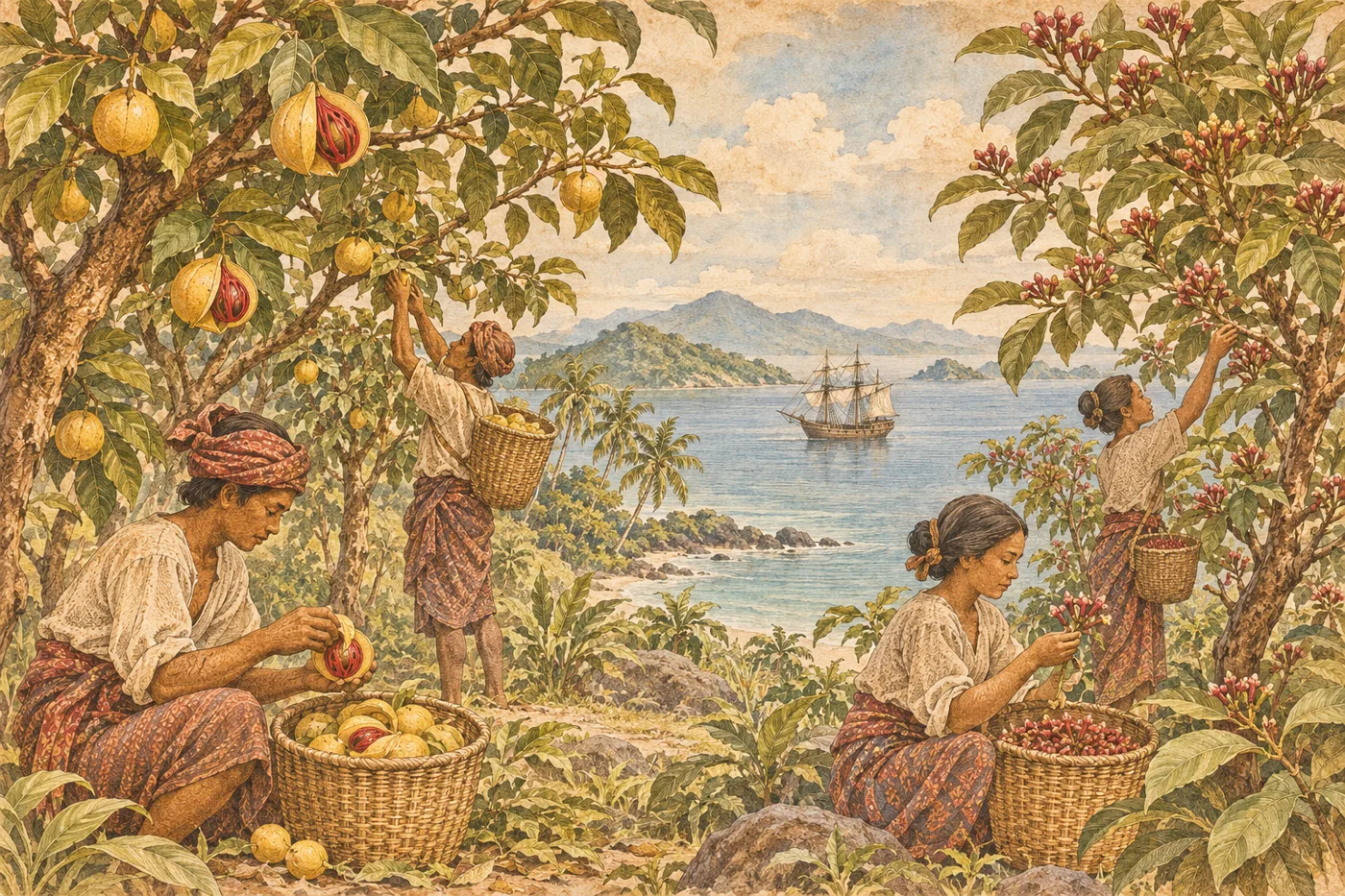
Why did European ships fight over the tiny fruit of a distant island?
Cloves grew only in the northern Moluccas, and nutmeg only in the Banda Islands — both very small, limited island groups. In Europe, these were prized for cooking, medicine, and fragrance, and sold at high prices. The idea that 'spices were used to mask the smell of rotten meat' is now regarded with skepticism.
After capturing Malacca in 1511, the Portuguese sent ships to the spice-producing islands around 1512. Spain crossed the Pacific from the Americas, establishing a settlement in Cebu in 1565 and Manila in 1571. From Manila, galleons carrying American silver and Chinese silk began crossing the Pacific back and forth.
In the 17th century, the Dutch took center stage. The Dutch East India Company (VOC) was founded in 1602, and Batavia (present-day Jakarta) was built on Java in 1619. In 1621, they militarily conquered the Banda Islands, the source of nutmeg. Many of the islanders were killed, taken away, or died while fleeing.
After the Amboyna Massacre of 1623, in which people at the English trading post were executed, it is said that England withdrew from the spice islands and shifted focus to India. The 1667 Treaty of Breda is often described as swapping the nutmeg island of Run for New Amsterdam (later New York), though there is a view that the treaty was essentially a 'status quo' agreement, making this story an oversimplification.
To monopolize the spice trade, the Dutch restricted cultivation to certain islands and forced the felling of trees elsewhere. But in the 18th century, France's Pierre Poivre secretly smuggled seedlings to Mauritius and other places, breaking the monopoly. The price of a tiny fruit had shaped the order of the world's seas.
During this period, many kingdoms in Southeast Asia maintained their independence: the Mataram Kingdom on Java, Aceh in northern Sumatra, Ayutthaya on the mainland, and others. They allied with or clashed with Europeans, choosing their trading partners. But by the 18th century, the Dutch East India Company began to involve itself in Java's interior as well. In the next chapter, the era of colonialism truly begins.
Mini timeline
- 1571Spain establishes Manila
- 1602Dutch East India Company founded
- 1619Dutch build Batavia
- 1621Dutch conquer the Banda Islands
- 1667Treaty of Breda: Run Island and New Amsterdam reportedly exchanged
People in this chapter
Builder of Batavia. However, his actions in the Banda Islands lead to sharply divided assessments.
He is said to have transferred spice seedlings to islands in the Indian Ocean, breaking the Dutch monopoly.
Meanwhile, elsewhere
Connection to Japan
In the early 17th century, Japanese red-seal ships sailed to Southeast Asia, and Japanese towns were established in places like Ayutthaya. Yamada Nagamasa was also active around this time. In the Amboyna Massacre, it is said that nine to ten Japanese employed by the English trading post were executed (the number varies by source).
Why it still matters
Nutmeg and cloves are still cultivated in Indonesia today. In Jakarta's old town (Kota), buildings from the Batavia era remain.
Perspectives differ
- Assessment of Coen
- In the Netherlands, he was long seen as a 'builder of the colony,' but in recent years his assessment has been reconsidered due to the violence in the Banda Islands.
- Casualties in the Banda Islands
- Historical sources on the population and number of victims at the time are limited, and estimates vary widely.
- Impact of the Amboyna Massacre
- There is a view that it was the main reason England withdrew from the spice islands, and another view that the withdrawal was already underway.
- Run Island and New York
- The story of 'Run Island being swapped for Manhattan' is famous, but the actual negotiations were complex, and the story has been simplified.
Facts checked (7, verified by AI on the web)
- Views differ Number of Japanese executed in the Amboyna Massacre (1623) Britannica: Amboina Massacre
Text corrected: '9' → 'about 9 to 10 (varies by source)'. Britannica says 10 English, 10 Japanese, 1 Portuguese; WHE says 9 Japanese. - Views differ Same (Britannica) Encyclopaedia Britannica: Amboina Massacre
Clulow's study (Itinerario) also gives the number of Japanese mercenaries as '10'. - Corrected & confirmed In 1621, the Dutch (Coen) subdued the Banda Islands; many islanders were killed, enslaved, or died while fleeing. Cambridge World History of Genocide: Genocide in the Spice Islands (abstract)
A chapter summary from Cambridge University Press states that in 1621 Coen ordered the subjugation of the entire Banda Islands, many of the leading men were killed or enslaved, and survivors who fled to the mountains or sea mostly died. Since it does not say 'the majority,' the text was corrected to 'many.' - Views differ The story of exchanging Run Island and New Amsterdam in the 1667 Treaty of Breda. Britannica: Treaty of Breda
Text corrected: Treaty dated July 31, 1667. Britannica says the Dutch kept Suriname and Run Island (Pulo Run), while England got New Netherland. A note added that 'Run for New Amsterdam' is a popular simplification. - Confirmed Poivre smuggled over 3,000 nutmeg seedlings from Timor to Mauritius and Réunion. Encyclopaedia Britannica: Pierre Poivre
Some sources give the clove smuggling date as 1770; details vary by source. - Confirmed Dutch East India Company 1602, Batavia 1619. Encyclopaedia Britannica: Dutch East India Company
There was a pre-existing settlement (Jayakarta) on the site of Batavia. - Confirmed Spain established Cebu in 1565, Manila in 1571. Encyclopaedia Britannica: Miguel López de Legazpi
Sources
Britannica: Amboina Massacre
Cambridge World History of Genocide: Genocide in the Spice Islands (abstract)
Britannica: Treaty of Breda
Encyclopaedia Britannica: Pierre Poivre
Encyclopaedia Britannica: Dutch East India Company
Encyclopaedia Britannica: Miguel López de Legazpi
* AI-drafted and cross-checked; human review is in progress. Status: