Colonization — Lines Were Drawn, Fields Were Changed
Why did so many countries in Southeast Asia that had maintained independence become colonies in the 19th century?
In the 19th century, Europe, having advanced through the Industrial Revolution, sought raw materials for factories and markets for its products. With steamships running and the Suez Canal opening in 1869, Southeast Asia moved much closer. The European powers, once merely 'trading partners,' transformed into 'rulers.'
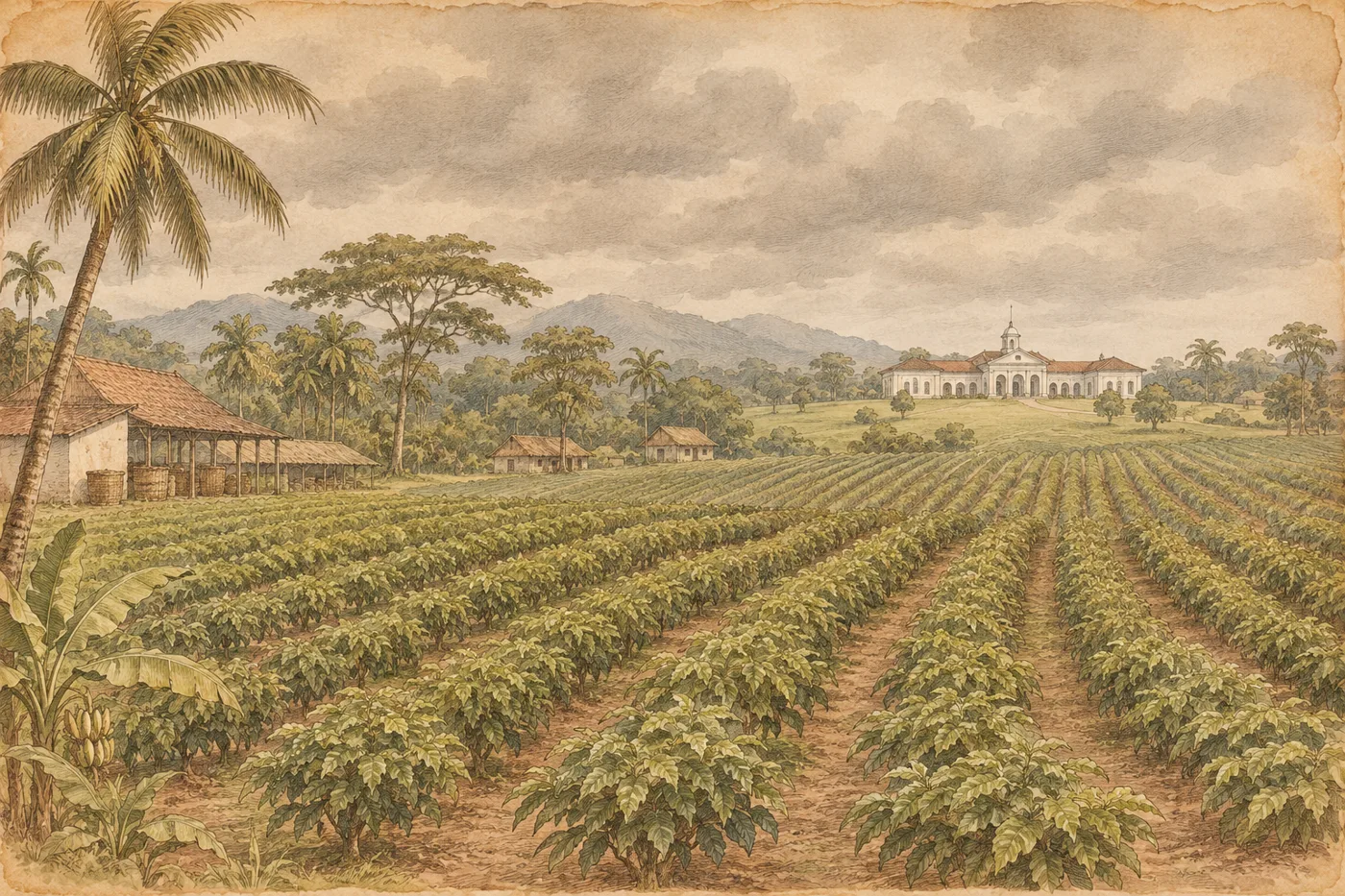
On the island of Java, a major war (the Java War) led by Prince Diponegoro broke out from 1825 to 1830. The Dutch suppressed it and around 1830 began the 'Cultivation System.' Under this system, farmers were forced to grow indigo, coffee, sugarcane, and other crops, with the profits going to the Netherlands. It is said that this caused famine in many areas.
Britain, with Raffles founding a port on Singapore in 1819 (later developed as a free port), established the Straits Settlements in 1826, combining it with Penang and Malacca. On the Malay Peninsula, tin and rubber production expanded, and many people came from China and India to work. There were three wars with Burma (present-day Myanmar), which was annexed into British India in 1886.
France attacked Da Nang in 1858 and gained southern Vietnam through the Treaty of Saigon in 1862. It extended its control over all of Vietnam and Cambodia, forming the French Indochina Federation in 1887, to which Laos was later added. The Philippines, after long Spanish rule, became a U.S. territory through the Spanish-American War of 1898, and a war of resistance (the Philippine-American War) followed from 1899 for several years.
Thailand (then called Siam), on the other hand, maintained its independence. Kings Rama IV and V (King Chulalongkorn) are said to have pursued reforms that adopted Western systems and skillfully navigated diplomacy between Britain and France. However, they did cede some peripheral territories.
In the colonies, plantations and mines expanded, immigration increased, and people's lives changed greatly. At the same time, intellectuals educated in schools began movements seeking national pride and freedom. José Rizal of the Philippines was executed in 1896, but he left a lasting impact on people's hearts. In Indonesia, the movement spread from Budi Utomo in 1908 to the National Party of Sukarno and others in 1927.
Mini timeline
- 1819Raffles establishes Singapore
- c. 1830Dutch begin the Cultivation System in Java
- 1858–62France advances into southern Vietnam
- 1887French Indochina Federation established
- 1898Spanish-American War; Philippines becomes a U.S. territory
People in this chapter
A king who promoted modernization, including the abolition of slavery and the development of a bureaucratic system.
He criticized Spanish rule in his novels and was executed in 1896. He is still regarded as a national hero of the Philippines.
Meanwhile, elsewhere
Connection to Japan
Japan's victory in the Russo-Japanese War (1904–05) also inspired nationalist movements in Southeast Asia. Vietnamese activist Phan Boi Chau, through the Dong Du (Eastward Travel) movement, tried to send many young people to study in Japan.
Why it still matters
The borders of countries like Vietnam, Laos, and Cambodia were largely solidified during the French Indochina period. Many borders in Southeast Asia still bear the influence of the colonial era.
Perspectives differ
- Evaluation of colonial rule
- On one hand, infrastructure like railroads and ports and education were developed; on the other hand, resources and labor were used for the home country, causing suffering for local people. Evaluations differ on which aspect is given more weight.
- Impact of the Cultivation System
- While it brought great profits to the home country, it is said that in rural Java, the burden was heavy and led to famine. There is a range of views among researchers on the scale of the suffering.
- Reasons Thailand maintained independence
- One view emphasizes the diplomatic skill and reforms of the kings; another stresses that Britain and France desired a buffer zone between them.
- Casualties of the Philippine-American War
- Estimates of civilian casualties, including from combat, famine, and disease, vary widely, and no precise figures are known.
Facts checked (6, verified by AI on the web)
- Confirmed The Cultivation System began under van den Bosch in 1830, and famines increased in Java in the 1840s Encyclopaedia Britannica: Culture System
The Java War was 1825–30. - Corrected & confirmed Raffles landed in Singapore in 1819, it became a free port around 1823, and the Straits Settlements were formed in 1826 Encyclopaedia Britannica: Sir Stamford Raffles
Text correction: 'founded as a free port' → 'founded a port (later developed as a free port)'. - Confirmed The 1862 Treaty of Saigon ceded the three eastern provinces of Cochinchina; the French Indochina Federation was formed in 1887 (Laos added in 1893) Library of Congress Country Study(countrystudies.us): Cambodia, The French Colonial Period 1887-1953
The Library of Congress Country Studies notes the establishment of the French Indochina Federation (Cambodia, Tonkin, Annam, Cochinchina) in October 1887, and Laos was detached from Siamese suzerainty and added to the Federation in 1893 (some sources give formal incorporation as 1899). The 1862 Treaty of Saigon cession of Bien Hoa, Gia Dinh, and Dinh Tuong is recorded by Dickinson College's website. - Confirmed Third Anglo-Burmese War in 1885; Burma annexed into British India on January 1, 1886 Encyclopaedia Britannica: Thibaw
- Confirmed José Rizal was executed on December 30, 1896 Encyclopaedia Britannica: José Rizal
- Confirmed The 1898 Treaty of Paris made the Philippines a U.S. territory; the Philippine-American War began in 1899 Encyclopaedia Britannica: Philippine-American War
The Battle of Manila on February 4, 1899, marked the start of the war.
Sources
Encyclopaedia Britannica: Culture System
Encyclopaedia Britannica: Sir Stamford Raffles
Library of Congress Country Study(countrystudies.us): Cambodia, The French Colonial Period 1887-1953
Encyclopaedia Britannica: Thibaw
Encyclopaedia Britannica: José Rizal
Encyclopaedia Britannica: Philippine-American War
Britannica: Treaty of Saigon
Dickinson College(House Divided): Treaty of Saigon 1862
* AI-drafted and cross-checked; human review is in progress. Status: