Indonesian Independence — The Birth of a Nation of 17,000 Islands
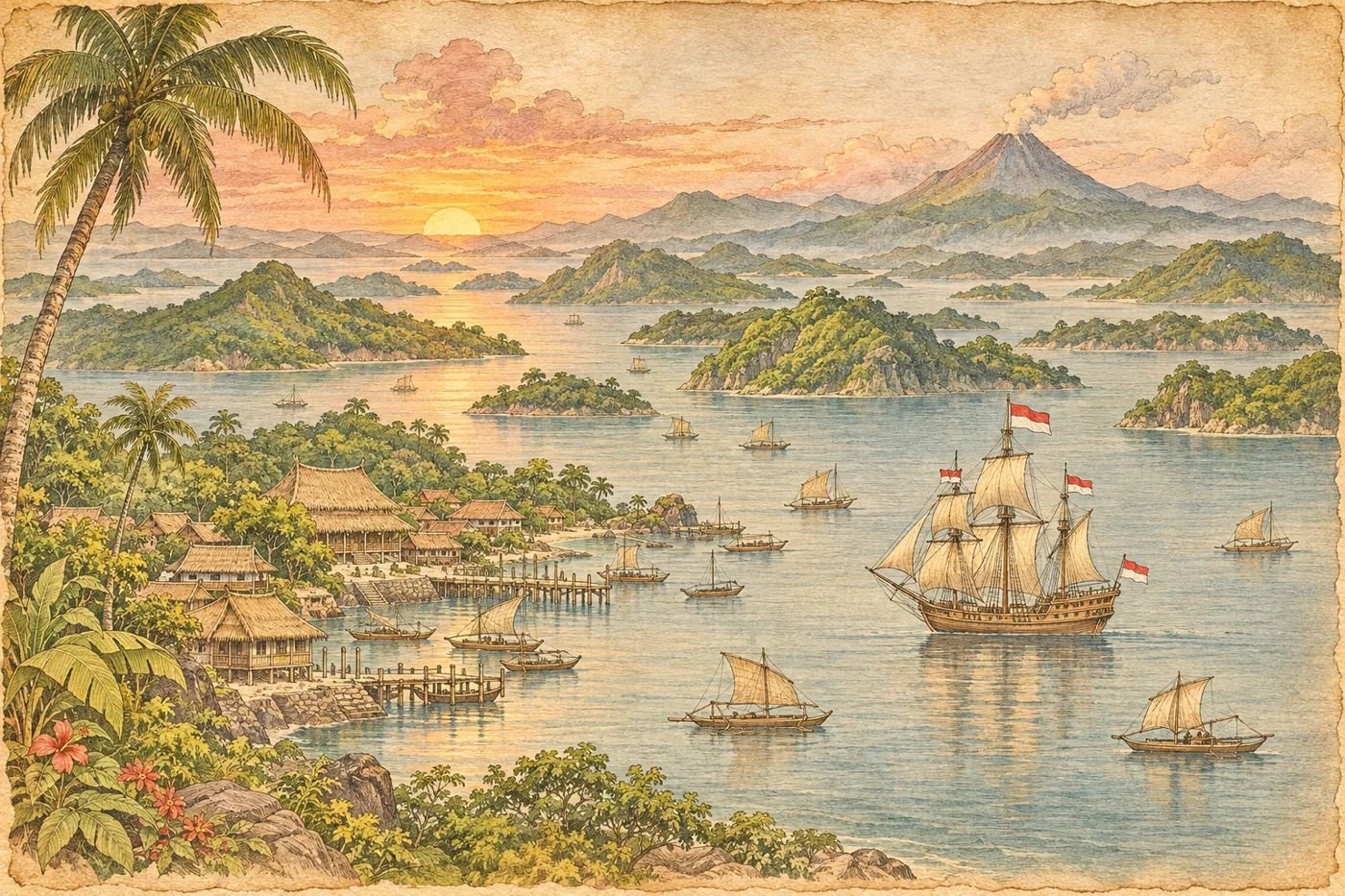
How did the islands of the Dutch East Indies become a single country called 'Indonesia'?
Indonesia is said to be a country of about seventeen thousand islands. European traders began arriving in earnest among these islands in the early 16th century with the Portuguese, and in the 17th century the Netherlands seized control. In 1602, the Dutch East India Company (VOC) was founded, and in 1619 it established a base called Batavia (present-day Jakarta) on Java. The company was dissolved in 1799, but even after that, the region was called the 'Dutch East Indies' and colonial rule continued.
A major turning point came in 1942. Japanese forces invaded, and Dutch rule collapsed in no time. The three years that followed are described as a time of hunger, harsh controls, and shortages of supplies, when many people were drafted as laborers (romusha) and many died of hunger and other causes. On the other hand, it is also said that through youth organizations and the Defenders of the Homeland Army (PETA) set up by the Japanese military for mobilization, military training spread, which later became a foundation for the war of independence. The occupation is also explained as having left the independence movement with organization and military training experience, as an unintended result.
In August 1945, when Japan agreed to surrender, the situation moved rapidly. Two days later, on August 17, Sukarno and Mohammad Hatta proclaimed the independence of the Republic in Jakarta. The word 'Merdeka' (freedom) became a rallying cry. There is also a well-known account that young activists pushed them to make the decision. The Netherlands did not recognize this proclamation.
From here, the war of independence (1945–49) began. The Netherlands tried to regain control, with help from the Allied powers, and guerrilla warfare continued in various areas. Among the leaders, opinions were divided between proceeding through negotiation or through fighting (there was also a stance called '100% Merdeka'). In July 1947 and December 1948, the Dutch military launched major offensives, and the United Nations called for ceasefires and created forums for negotiation.
The stage for the final settlement was The Hague in the Netherlands. From August to November 1949, a Round Table Conference was held, at which the Netherlands, the Republic, and Dutch-backed states within the federation held talks with help from the United Nations Commission for Indonesia. Then, on December 27, 1949, the Netherlands transferred sovereignty to the Republic of the United States of Indonesia. After that, the federal system was abandoned, and it is said the country became a single republic.
So, when was independence? In Indonesia, August 17, 1945—the date independence was proclaimed—is celebrated as Independence Day. The Netherlands, on the other hand, long regarded the year 1949, when sovereignty was transferred, as the year of independence. In 2005, Dutch Foreign Minister Bot stated that the Netherlands accepted August 17, 1945, 'morally and politically.' In 2023, Prime Minister Rutte told parliament that in a political and moral sense, he recognized 1945 as the beginning of independence 'fully and without reservation.'
Mini timeline
- 1602Dutch East India Company (VOC) is founded
- 1619Batavia is established on Java
- 1942–45Japanese occupation
- August 17, 1945Sukarno and Hatta proclaim independence
- July 1947 and December 1948Dutch military launches major offensives; UN mediates
- August–November 1949Round Table Conference held in The Hague
- December 27, 1949Netherlands transfers sovereignty
People in this chapter
On August 17, 1945, he proclaimed independence together with Hatta. It is also known that during the Japanese occupation, he took a cooperative stance, and assessments of him vary.
He co-signed the proclamation with Sukarno. He is said to have served as the Republic's representative at the Round Table Conference in The Hague.
Meanwhile, elsewhere
Connection to Japan
Japan moved its forces into the Dutch East Indies in 1942 (Showa 17) and occupied the territory until its surrender in 1945 (Showa 20). Indonesia declared its independence on August 17, 1945, two days after Japan agreed to surrender. The occupation itself is covered in detail in another chapter (se-asia-07). This chapter focuses on the narrative from the Indonesian side.
Why it still matters
Even today, Indonesia holds an independence day ceremony every year on August 17. Jakarta is a vast metropolis built on the site of the former Batavia. The question of whether independence dates to 1945 or 1949 still comes up when the two countries confront their history.
Perspectives differ
- When was independence? (1945 or 1949)
- The Indonesian side considers August 17, 1945, the day of the proclamation, to be the date of independence. The Netherlands long regarded 1949—when sovereignty was transferred on December 27—as the year of independence. Foreign Minister Bot's 2005 statement took the cautious form of accepting the 1945 date 'morally and politically,' and was explained as carrying no legal implications. In 2023, Prime Minister Rutte stated that in a political and moral sense, he fully recognizes 1945. A spokesman for the prime minister is reported to have said the legal meaning does not change, and the UN continues to use 1949 as well. This book does not decide which is correct.
- Names for the war of independence and wartime violence
- In the Netherlands, the military actions of this period were long called 'police actions.' In Indonesia, the conflict is called the 'revolution' or the 'war of independence.' In 2022, three Dutch research institutes published a study stating that there had been 'structural and excessive violence' by the Dutch military. A 2017 study recounting figures from Dutch military records puts Indonesian deaths at no fewer than about 97,000 (civilians and combatants together, most likely a lower limit) and Dutch military deaths at about 4,700. Estimates of Dutch and Eurasian civilian deaths range widely, from about 5,000 to 30,000.
- Meaning of the Japanese occupation
- The occupation brought hunger and harsh controls. At the same time, it is also explained that nationalist organizations and armed youth groups grew, becoming a force for independence. Assessments of the occupation differ depending on the person and their perspective.
- The figure '17,000 islands'
- The number of islands varies depending on the counting method. It is often said to be 'about seventeen thousand,' but the figure differs by survey. Here, it is used as a rough figure.
Facts checked (15, verified by AI on the web)
- Confirmed The Dutch East India Company was founded in 1602, established Batavia in 1619, and was dissolved in 1799 World History Encyclopedia: Dutch East India Company(事典)
Confirmed in encyclopedia entries (founded 1602, Coen built Batavia 1619, dissolved December 31, 1799). The process of the East Indies coming under direct government rule after dissolution is not found on the same page; the main text does not go into detail. - Confirmed Japanese forces invaded in 1942, overthrew Dutch rule, and the three years of occupation were a time of hunger, controls, and shortages; they energized the nationalist movement and also created armed groups UNC Asia (INSITE Asia): Indonesia in the 1940s
Confirmed on UNC page and MIT CASCON page (armed local militias created, per MIT). Evaluation of the occupation varies by perspective. - Confirmed Sukarno and Hatta proclaimed independence on August 17, 1945; the Netherlands did not recognize it and tried to reassert control with help from the Allies UNC Asia (INSITE Asia): Indonesia in the 1940s
Confirmed by UNC and an Australian government page. That it was two days after Japan accepted defeat confirmed by BenarNews article. - Confirmed Leaders were divided between diplomacy and fighting; the latter was also called '100% Merdeka' UNC Asia (INSITE Asia): Indonesia in the 1940s
Confirmed by UNC page. - Unverified Young activists (pemuda) pressured the leaders to proclaim independence UNC Asia (INSITE Asia): Indonesia in the 1940s
US State Department Office of the Historian page returns 404; source text from other materials also unconfirmed. - Confirmed Dutch military attacked in July 1947; UN called for ceasefire; Renville Agreement in January 1948; attack again in December 1948; UN called for return of Republic government to Yogyakarta in January 1949 70 Years of Indonesia-Australia (Australian Government project): Australia's role in Indonesia's independence and transfer of sovereignty
Confirmed by Australian government page and MIT CASCON. Date of attack is July 20 (Australia) and July 21 (MIT) depending on source, so main text says 'July 1947.' The term 'police actions' did not appear in sources I could read (unverified), so in debates it is cautiously phrased as 'were long called.' - Unverified On the Dutch side, the military actions at the time were called 'police actions' 70 Years of Indonesia-Australia (Australian Government project): Australia's role in Indonesia's independence and transfer of sovereignty
US State Department Office of the Historian page returns 404; source text from other materials also unconfirmed. - Confirmed The Round Table Conference in The Hague from August to November 1949 included the Netherlands, the Republic, and states within the federation; the UN Commission for Indonesia assisted; sovereignty was transferred on December 27 70 Years of Indonesia-Australia (Australian Government project): Australia's role in Indonesia's independence and transfer of sovereignty
Confirmed by Australian government page. The recipient is also given as 'Republic of the United States of Indonesia' on the same page. - Unverified After that, the federal system was abandoned and it became a single republic 70 Years of Indonesia-Australia (Australian Government project): Australia's role in Indonesia's independence and transfer of sovereignty
US State Department Office of the Historian page returns 404; source text from other materials also unconfirmed. - Confirmed In 2005, Foreign Minister Bot stated that August 17, 1945, is accepted 'morally and politically' (not legally) Dawn (AFP, 2005): Netherlands accepts date of Indonesian independence(報道)
Confirmed by AFP article dated August 16, 2005 (said he accepts 'morally and politically' that de facto independence began on August 17, 1945). Explanation that it did not include legal implications not clearly stated in that article; supplemented by BenarNews description (2005 as de facto only) and search result summaries. Primary government source not confirmed. - Confirmed In 2023, Prime Minister Rutte told parliament he accepts 1945 independence 'fully and without reservation.' The Dutch research institutes' study pointed to 'structural and excessive violence' BenarNews (2023): Indonesia welcomes Netherlands recognizing its independence was in 1945, not 1949(報道)
Confirmed by news reports (three research institutes' study, prime minister's statement). Official government documents not confirmed. The article also says this is the first official recognition by the former colonial power, but views differ on its relation to the 2005 statement. - Unverified Indonesia consists of 'about seventeen thousand islands' UNC Asia (INSITE Asia): Indonesia in the 1940s
US State Department Office of the Historian page returns 404; source text from other materials also unconfirmed. - Corrected & confirmed Japanese occupation of the Dutch East Indies was 1942–45 (Showa 17–20); Japan accepted defeat two days before the independence proclamation BenarNews (2023): Indonesia welcomes Netherlands recognizing its independence was in 1945, not 1949(報道)
Surrender two days prior confirmed by BenarNews. 1942 invasion confirmed by UNC. Era dates based on calendar. Surrender date generally given as August 15. - Unverified Events in East Asia, the Middle East, and Europe in 1945 (meanwhile section) MIT CASCON: Indonesian Independence 1945-49
US State Department Office of the Historian page returns 404; source text from other materials also unconfirmed. - Unverified Sukarno took a stance of cooperation under Japanese occupation; Hatta served as the Republic's representative at the Round Table Conference UNC Asia (INSITE Asia): Indonesia in the 1940s
US State Department Office of the Historian page returns 404; source text from other materials also unconfirmed.
Sources
World History Encyclopedia: Dutch East India Company(事典)
UNC Asia (INSITE Asia): Indonesia in the 1940s
MIT CASCON: Indonesian Independence 1945-49
70 Years of Indonesia-Australia (Australian Government project): Australia's role in Indonesia's independence and transfer of sovereignty
Dawn (AFP, 2005): Netherlands accepts date of Indonesian independence(報道)
BenarNews (2023): Indonesia welcomes Netherlands recognizing its independence was in 1945, not 1949(報道)
* AI-drafted and cross-checked; human review is in progress. Status: