The Beginning of the Middle Ages — A World of Kings, Knights, and Monasteries
When states became smaller, how did people protect themselves and live their lives?
After Roman power weakened, several Germanic kingdoms emerged in Western Europe. The longest-lasting and most powerful of these was the Frankish Kingdom. Around the end of the 5th century to the beginning of the 6th, King Clovis converted to the Catholicism of the Romans (said to be around 496). Allying with the Church sustained the kingdom.
In the 8th century, the Frankish Kingdom is also known for its fight against Islamic forces (732). Then, on Christmas Day 800, the king Charlemagne received the crown of 'Roman Emperor' from the Pope. For the first time in about 300 years since the western Roman Empire had vanished, an 'emperor' appeared in Western Europe.
After Charlemagne's death, the kingdom was divided, forming the basis for later France, Germany, and Italy (divided by the Treaty of Verdun in 843, among others). In 962, Otto I of East Francia received the imperial crown; this is considered the beginning of the later Holy Roman Empire. Also, from the late 8th century, Vikings (Norsemen) from the north sailed across the seas and up rivers, raiding, trading, and settling in various places.
With state defenses weak, people relied on powerful figures close at hand. Kings and great lords granted land to vassals in exchange for loyalty, such as military service. Among the vassals were knights who fought on horseback. Peasants worked the lord's land (the manor), paying rent and labor in return for protection. This system of relationships is called 'feudalism'.
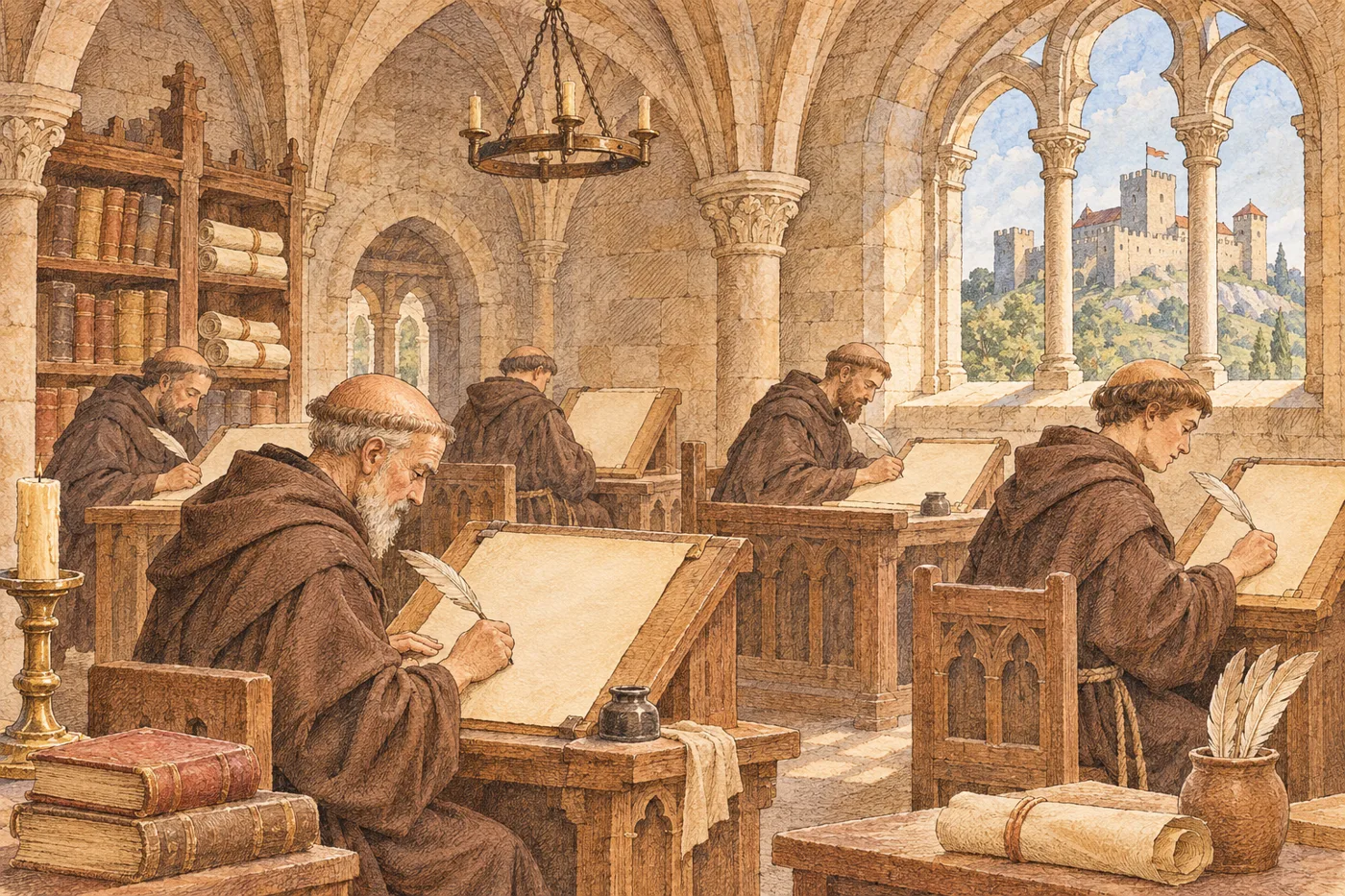
The Church and monasteries were the centers of knowledge in this era. In the 6th century, the rule established by Benedict emphasized prayer and labor (later summed up in the phrase 'pray and work'). Monks cleared farmland and copied old manuscripts by hand. In this way, the knowledge of Rome and Greece was carried forward to the next age.
In 1066, William, Duke of Normandy in France, crossed the sea and conquered England (the Norman Conquest). The descendants of the Vikings became the founders of the English royal line. Western Europe was taking shape as the 'Middle Ages' — a complex web of small states, lords, and the Church.
Mini timeline
- About 496Clovis is said to have converted to Catholicism
- 800Charlemagne receives the crown of Roman Emperor
- 843Treaty of Verdun divides the Frankish Kingdom
- 962Otto I receives the imperial crown
- 1066Norman Conquest
People in this chapter
He united a vast territory and patronized learning. He is sometimes called the 'Father of Europe'.
In the 6th century, he established a rule for monastic life, which became a model for monasteries in Western Europe.
Meanwhile, elsewhere
Connection to Japan
In Japan, this period spans from the Asuka and Nara periods to the Heian period. The coronation of Charlemagne (800) occurred shortly after the capital was moved to Heian-kyō (794).
Why it still matters
The German word 'Kaiser' and the Russian word 'Tsar' both derive from the Roman 'Caesar'. The foundations of France, Germany, and Italy as nations were also laid in this era.
Perspectives differ
- The term 'Dark Ages'
- The early Middle Ages were once called the 'Dark Ages', but today they are being re-evaluated as a period of ongoing cultural and technological change.
- What is feudalism?
- Critics argue that the term 'feudalism' oversimplifies diverse actual relationships, and its usage is debated among scholars.
- The coronation of 800
- Whether Charlemagne himself desired the coronation is debated; his biographer wrote that 'if he had known beforehand, he would not have entered the church'.
- The year of the conversion
- Clovis's conversion is said to be around 496, but theories also place it in 498 or 508.
- Timing of agricultural development
- Scholars disagree on the period and extent of the spread of the three-field system (dividing fields into three parts).
Facts checked (6, verified by AI on the web)
- Views differ Clovis's conversion is said to be around 496, but some studies place it around 508 Britannica: France – The Merovingians
Mentioned in the debates section with 498 and 508 theories. The text's 'around 496' is appropriate. - Confirmed Charlemagne was crowned emperor on Christmas Day 800 Britannica: Treaty of Verdun
- Confirmed The Carolingian Empire was divided into three parts by the Treaty of Verdun in 843 Britannica: Treaty of Verdun
- Confirmed Otto I received the imperial crown from Pope John XII in 962 Britannica: Otto I summary
The phrase 'beginning of the Holy Roman Empire' is a later view; the text says 'is considered'. - Confirmed In 732, the Frankish army defeated Islamic forces (the Battle of Tours-Poitiers) Britannica: Battle of Tours
Britannica warns against overstating the significance of the victory. The text states only the fact. - Corrected & confirmed Benedict's Rule (6th century) and the motto 'pray and work' Britannica: Benedictine Rule
Text amended: the Rule was established around 535–540. The motto is a later summary, so the phrasing was changed to 'later summed up in the words'.
Sources
Britannica: France – The Merovingians
Britannica: Treaty of Verdun
Britannica: Otto I summary
Britannica: Battle of Tours
Britannica: Benedictine Rule
* AI-drafted and cross-checked; human review is in progress. Status: