The Frankish Kingdom and Charlemagne — Foundation of Western Europe
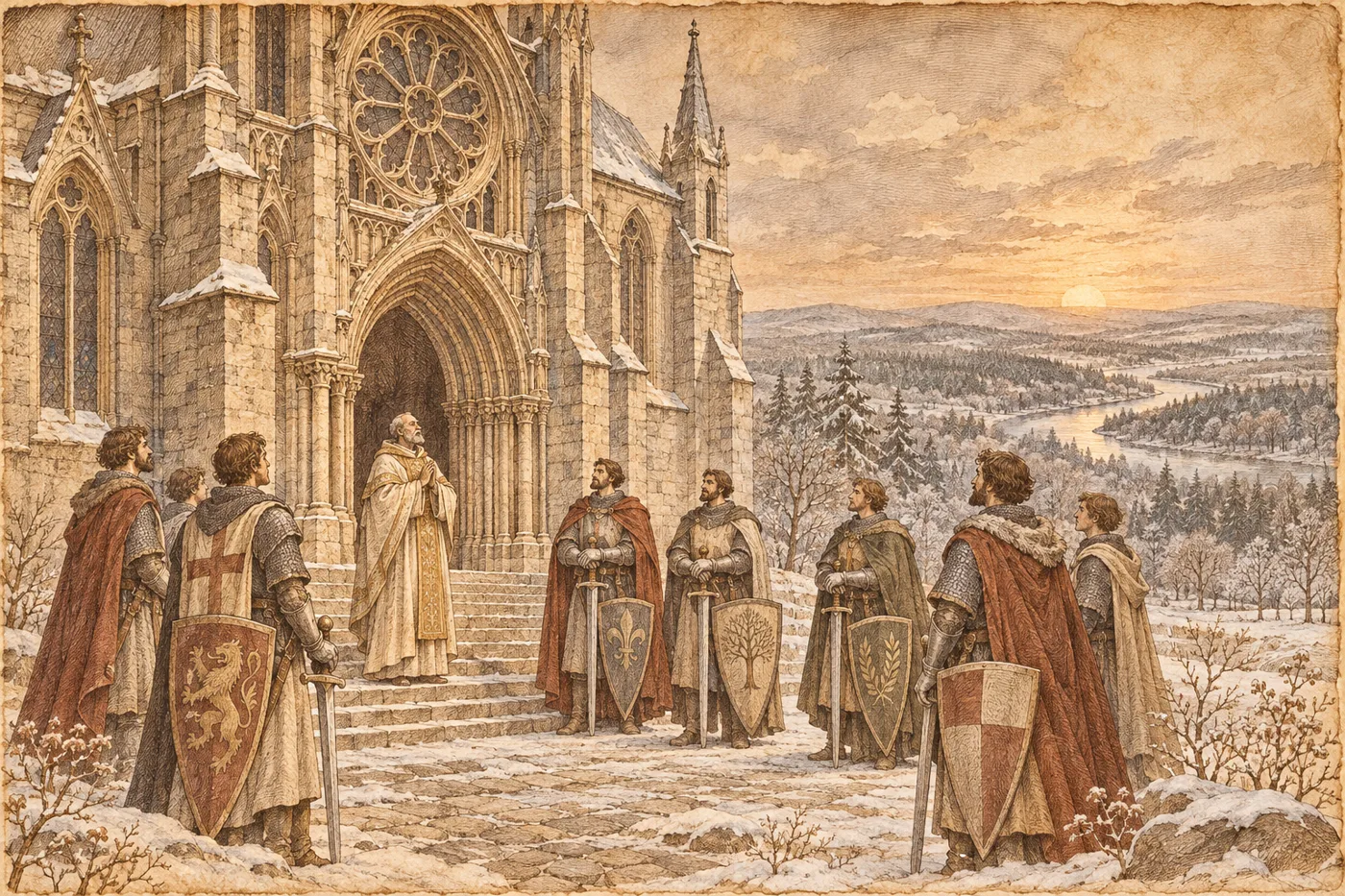
After the fall of the Roman Empire, how did Western Europe regain a sense of unity?
The Franks were a Germanic people who lived near the lower Rhine and appear in Roman records from around the 3rd century. As the Western Roman Empire declined, they grew in power. In 481, Clovis became king and began unifying various Frankish groups. Around 507, he defeated the Visigothic kingdom at the Battle of Vouillé and is said to have later made Paris his base.
Clovis is also known for accepting the Athanasian branch of Christianity (the orthodox line that led to Catholicism). His baptism is traditionally dated to around 496, but in recent years, a date around 508 has also gained support. The main record comes from a history written by the 6th-century bishop Gregory, but since it was composed later, it cannot be taken entirely at face value. This choice is thought to have strengthened ties with the Roman Church.
After Clovis's death, the kingdom was divided among his sons, and the Merovingian royal family gradually weakened. Power shifted to the family of a high official called the mayor of the palace. In 732, the mayor Charles Martel turned back an Islamic force from the Iberian Peninsula at the Battle of Tours-Poitiers. Whether this battle was a decisive turning point, however, is debated.
In 751, Charles Martel's son Pepin (Pepin the Short) became king in place of the last Merovingian king, with the support of Pope Zachary. This marked the beginning of the Carolingian dynasty. His son Charles (Charlemagne) became king together with his brother Carloman in 768 and ruled the Frankish kingdom alone from 771. In 774 he subdued the Lombard kingdom in Italy, and after a long campaign also conquered the lands of the Saxons. The Saxon wars are said to have involved harsh repression.
On Christmas Day 800, Pope Leo III is said to have placed the imperial crown on Charles's head in Rome. According to his biographer Einhard, Charles said that if he had known of the pope's plan, he would not have entered the church that day. But how sincere this was is unclear. Charles invited scholars such as Alcuin and promoted learning and education. His capital was Aachen.
After Charles died in 814, his son Louis the Pious succeeded him, and when Louis died in 840, the empire was divided after a struggle. The Treaty of Verdun in 843 is said to have split it into three kingdoms: West, Middle, and East. The West later became France, the East became Germany, and the Middle kingdom led to regions including Italy. The foundation of later Western Europe was laid in this period.
Mini timeline
- 481Clovis becomes king of the Franks
- c. 496Clovis is said to have been baptized (alternative theories exist)
- 732Battle of Tours-Poitiers
- 751Pepin the Short becomes king; Carolingian dynasty begins
- 800Charles receives the imperial crown in Rome
- 843Treaty of Verdun divides the empire into three
People in this chapter
A king who unified the Frankish groups and is said to have received Catholic baptism.
Ruled the Franks from 768 to 814 and received the imperial crown in 800. Also known as a patron of learning.
Meanwhile, elsewhere
Connection to Japan
Around 800, Japan had just moved its capital to Heian-kyō (794) and was in the era of Emperor Kanmu. Around 496, when Clovis is said to have been baptized, Japan was in the Kofun period.
Why it still matters
The outlines of France, Germany, and Italy as nations took shape over a long period from the division of the Frankish kingdom. Charlemagne's name still comes up when discussing European integration.
Perspectives differ
- Year and circumstances of Clovis's conversion
- The tradition places his baptism around 496, but some accounts give 503, and some scholars suggest he was already close to Christianity earlier. There are various theories.
- Significance of the Battle of Tours-Poitiers
- Some see it as a decisive battle that saved Western Europe, while other studies downplay its importance, noting that raids continued afterward.
- Whose intention was the coronation of 800?
- The biography records that Charles himself was surprised, but some argue that the pope was trying to assert control. The true intent is debated.
- Evaluation of Charlemagne's empire
- Some call him the Father of Europe, while others emphasize his military campaigns against the Saxons, and still others note that the empire depended heavily on his personal authority.
Facts checked (6, verified by AI on the web)
- Confirmed Clovis was baptized by Remigius, bishop of Reims, around 496 (alternative theories exist) Fordham University Internet Medieval Sourcebook: The Conversion of Clovis, 496
Fordham University's source collection gives 496. World History Encyclopedia (entry 'Clovis I') gives 503 in its timeline and questions the reliability of Gregory of Tours' account (citing Collins). This text notes both 'around 496' and 'some give 503'. - Confirmed In October 732, Charles Martel defeated Islamic forces at Tours-Poitiers. The significance is debated. World History Encyclopedia(事典): The Legacy of Charles Martel & the Battle of Tours
The encyclopedia gives October 10, 732, and notes that raids continued, arguing it may not have been a turning point. This text avoids a definitive statement. - Confirmed In 751, Pepin became king in place of the last Merovingian king with the support of Pope Zachary. World History Encyclopedia(事典): Franks
Confirmed in the encyclopedia ('Franks'). - Confirmed Pope Leo III placed the imperial crown on Charles on December 25, 800. Einhard records Charles saying he would not have entered the church that day had he known of the plan. Fordham University Internet Medieval Sourcebook: Einhard, Life of Charlemagne (excerpts)
Fordham's excerpt (chapter 28) records Charles's remark and the title of Emperor Augustus; December 25 is confirmed in World History Encyclopedia ('Charlemagne'). Whether he was truly surprised is debated. - Confirmed The Treaty of Verdun in 843 divided the empire into three parts, with the West becoming later France and the East becoming later Germany. World History Encyclopedia(事典): Charlemagne
The encyclopedia ('Charlemagne') states that after Louis's death in 840, the empire was divided by the Treaty of Verdun in 843. The connection of the three kingdoms to later France, Germany, and Italy is confirmed in the encyclopedia ('Franks'). - Confirmed Charles conquered the Lombards in 774 and fought the Saxon Wars (772–804). World History Encyclopedia(事典): Charlemagne
Confirmed in the encyclopedia. The Saxon Wars' onset and the massacre at Verden (782) are debated; this text simply notes 'harsh repression'.
Sources
World History Encyclopedia(事典): Clovis I
World History Encyclopedia(事典): Franks
World History Encyclopedia(事典): Charlemagne
World History Encyclopedia(事典): The Legacy of Charles Martel & the Battle of Tours
Fordham University Internet Medieval Sourcebook: Einhard, Life of Charlemagne (excerpts)
Fordham University Internet Medieval Sourcebook: The Conversion of Clovis, 496
Fordham University Internet Medieval Sourcebook: Gregory of Tours, History of the Franks (excerpts)
* AI-drafted and cross-checked; human review is in progress. Status: