Venice — A Republic of Merchants Built on the Sea
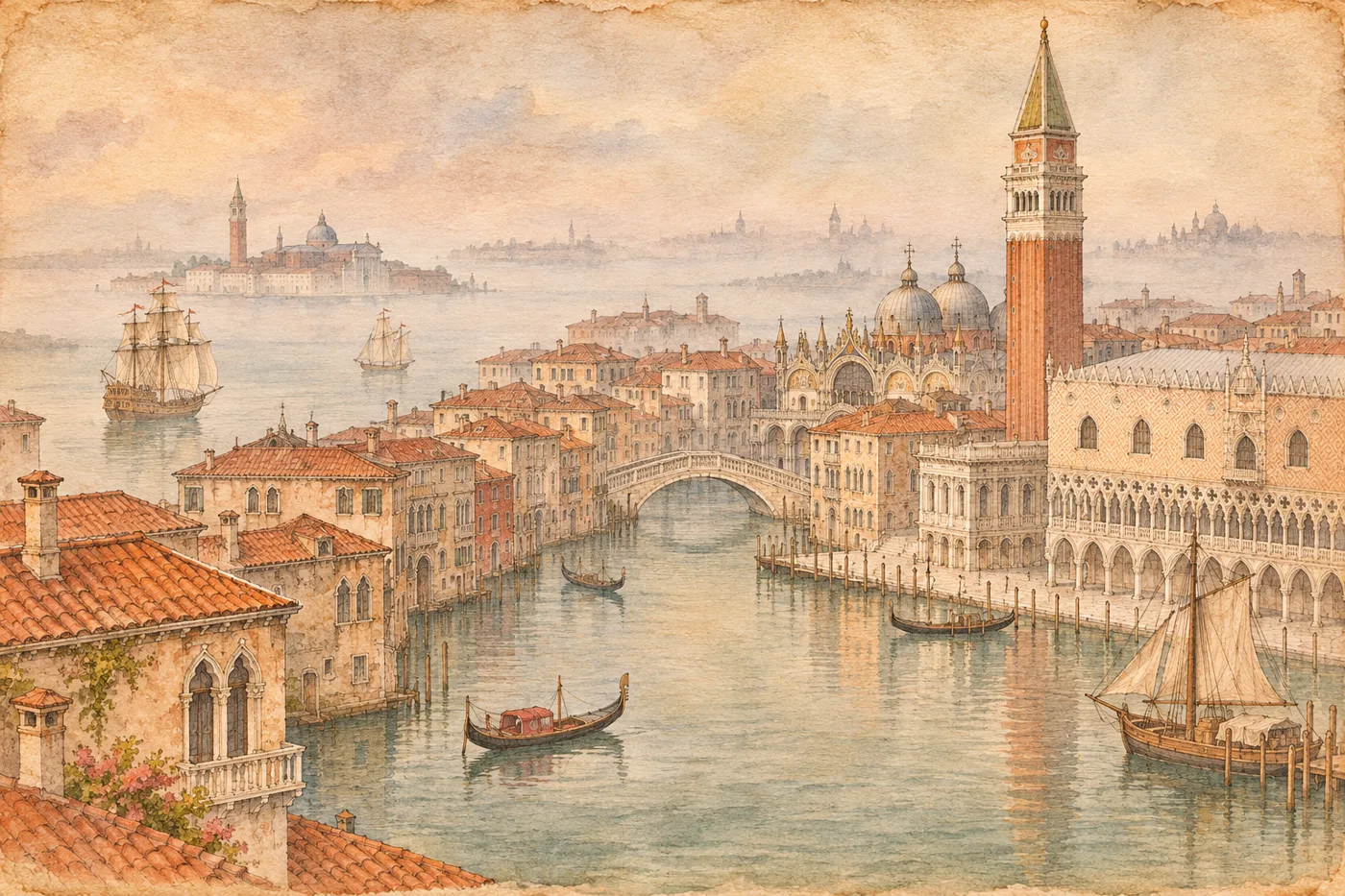
How could a small town on the water remain a major Mediterranean power for a thousand years?
Venice is a city built on the shallow lagoon at the head of the Adriatic Sea. Around the 5th–6th centuries, people fleeing invaders in northeastern Italy are said to have settled on the islands of the lagoon. The city sits on about 118 small islands, and the Cathedral of Torcello, one of the oldest church buildings in the lagoon, was founded in 639 (the current building was largely rebuilt in the 11th century). The republic’s beginning is traditionally placed in 697.
This town lay between Rome and Constantinople, in a convenient location on the maritime route, and it gained power as an intermediary linking East and West. By the 14th century, it is said to have become the most powerful Western counterpart in the trade that connected to the Silk Road. Silk and luxury goods came from the East, and the influence of Byzantine and Asian art and textiles can be seen in the city’s art.
In 1202, Doge Dandolo became involved in the Fourth Crusade. In 1204, the Crusaders attacked and sacked Constantinople, a fellow Christian capital. Dandolo is said to have sought trading ports rather than territory, and Venice acquired many of the best harbors of the Byzantine Empire. It reportedly bought Crete, and the statues of the four horses of St. Mark's Basilica are also said to have been brought back at this time.
The city’s power was supported by the state-run shipyard, the Arsenal. It is said to have begun in 1104, and with later expansions it covered dozens of hectares, enclosed by high walls and towers. Ropes, sails, oars, and weapons were all produced in-house, and it is said that a kind of assembly-line method was used, with parts prefabricated and assembled all at once when needed. In 1571, when Venice joined the Holy League and fought in the Battle of Lepanto, more than half of the League’s fleet is said to have come from here.
Glass was also a specialty of the city. Around the end of the 13th century (1291), glass workshops are said to have been gathered on Murano Island, partly to prevent fires. Around the mid-15th century, a crystal-clear glass (cristallo) is said to have been created by the Murano craftsman Barovier. The artisans’ skills were reportedly guarded as a national treasure so that they would not be leaked abroad.
Even a prosperous city faces decline. The plague of 1348 is said to have reduced the population by about half, and in 1453 the Ottoman Empire conquered Constantinople. In 1571, Venice effectively lost control of Cyprus (formally ceded in 1573), and countries emerged that sailed directly to Asia via new maritime routes. On May 12, 1797, with Napoleon’s army approaching, the Great Council is said to have decided on the end of the republic. The city was ceded to Austria, bringing an end to a republic that had lasted about 1,100 years.
Mini timeline
- 639Cathedral built on Torcello in the lagoon
- 697Traditionally considered the founding year of the republic
- 1104State-run Arsenal is said to have begun
- 1204Crusaders attack Constantinople; Venice gains many harbors
- 1348Plague is said to have drastically reduced the population
- 1797The republic ends before Napoleon's army; city ceded to Austria
People in this chapter
He is said to have been deeply involved in the Fourth Crusade and to have secured many harbors for Venice.
He is known as the doge at the end of the republic in 1797.
Meanwhile, elsewhere
Connection to Japan
In 1204, Japan was in the early years of the Kamakura shogunate. When the republic ended in 1797, it was the late Edo period, the 9th year of Kansei.
Why it still matters
"Venice and its Lagoon" is said to have been inscribed as a World Heritage site in 1987. The city still preserves its appearance as a town built on water, and glassmaking continues to be passed down on Murano Island.
Perspectives differ
- The founding year of the republic
- Traditionally it is placed in 697, but some timelines date the election of the first doge, Orso, to around 727. Views differ on when it took shape as a state.
- The Fourth Crusade and Venice's role
- Scholars disagree on whether the Crusaders’ diversion to Constantinople was due to Venetian intent or to circumstances such as lack of funds.
- Was the Arsenal an 'assembly line'?
- The method of prefabricating parts and assembling them is often described as an early example of an assembly line. However, some are cautious about whether it can be equated with modern factory assembly lines.
- Causes of decline
- Various factors are cited: the plague, wars with the Ottoman Empire, the rise of new trade routes. Which factor was decisive is a matter of scholarly debate.
- Length of the republic
- Many explanations say it lasted about 1,100 years (697–1797), while some sources give '1,200 years.' The count varies depending on when one places the beginning.
Facts checked (8, verified by AI on the web)
- Confirmed Refugees settled in the lagoon in the 5th–6th centuries, the Cathedral of Torcello dates from 639, the city sits on about 118 islands, and the republic’s traditional founding year is 697. Smithsonian Folklife Festival 2002 (Silk Road): Venice, Geography and History
Confirmed on Smithsonian page (118 islands, about 3 square miles, 697 as 'traditional founding year'). - Corrected & confirmed The first doge, Orso, was elected in 727. Purdue University (HONR 299 Making the Human in Venice): Timeline
Purdue University timeline places Orso as first doge in 727. This differs from the 697 date, so the main text calls 697 'traditional' and introduces the 727 date in the debates. - Confirmed In the 14th century, Venice was the most powerful Western partner in Silk Road trade. In 1202 Dandolo became involved in the Fourth Crusade, and in 1204 Constantinople was taken and Venice gained good harbors. Smithsonian Folklife Festival 2002 (Silk Road): Venice, Geography and History
Confirmed on Smithsonian page. Purchase of Crete and removal of the four horses are from Purdue timeline. The main text says 'became involved in' rather than definitively stating Dandolo led the crusade. - Confirmed The Arsenal began in 1104, covered about 24 hectares, had walls about 15 meters high, used prefabricated parts, and supplied more than half the Holy League fleet at Lepanto in 1570 (Lepanto was 1571). World History Encyclopedia: Arsenale: The Shipyard and Arsenal of Venice
Confirmed in encyclopedia article. The article does not give the year of Lepanto, and the main text does not include the year. The burning of the Bucintoro during Napoleon's occupation is also in that article. - Confirmed The plague of 1348 reduced the population by half; Cyprus was lost in 1571. Purdue University (HONR 299 Making the Human in Venice): Timeline
Confirmed in Purdue timeline. The fall of Constantinople in 1453, naval defeats in 1465–79, and new trade routes are confirmed in the Smithsonian article. - Corrected & confirmed On May 12, 1797, the Great Council decided on the end of the republic, and it was ceded to Austria by the Treaty of Campo Formio. World History Encyclopedia: Napoleon's Italian Campaign
The May 12 decision is from the Purdue timeline. Treaty dates differ (Purdue: October 12; encyclopedia: October 17), so the main text only says 'the same year.' Austrian rule beginning in 1798 and transfer to Italy in 1866 are from Smithsonian. - Confirmed Glass workshops were moved to Murano in 1291. Around the mid-15th century, Barovier created cristallo. ビクトリア国立美術館(NGV): Portrait of Venice, majestic Murano
Text confirms: 1291 decree moved glass furnaces to Murano due to fire risk; mid-15th century Angelo Barovier created cristallo. Another article (finestresullarte) also records the 1291 relocation. - Unverified Ludovico Manin was the last doge. Venice was registered as a World Heritage site in 1987. Glassmaking continues on Murano today. Smithsonian Folklife Festival 2002 (Silk Road): Venice, Geography and History
The point about Manin being the last governor could only be read on a personal blog (Italy on this day). 1987 World Heritage inscription: UNESCO page returns 403 (text unread). Continuation of glassmaking in Murano indirectly confirmed by NGV and finestresullarte (Barovier family continuity), but overall unverified.
Sources
Smithsonian Folklife Festival 2002 (Silk Road): Venice, Geography and History
World History Encyclopedia: Arsenale: The Shipyard and Arsenal of Venice
Purdue University (HONR 299 Making the Human in Venice): Timeline
World History Encyclopedia: Napoleon's Italian Campaign
* AI-drafted and cross-checked; human review is in progress. Status: