Not long ago, people used to say that AI was impressive but could not understand human humor, the kind you find in comedy. Recent AI has overcome that too.
On the pages of “AI Ota Ward Assembly Watch,” here and there, you will find a short line next to a robot icon.
“AI has learned: after ‘we will study it,’ usually nothing happens.”
“The officials get transferred. The answers never do.”
There are about 30 of them across the site. Today, using how these lines came about as an example, I want to write about AI’s sense of humor.
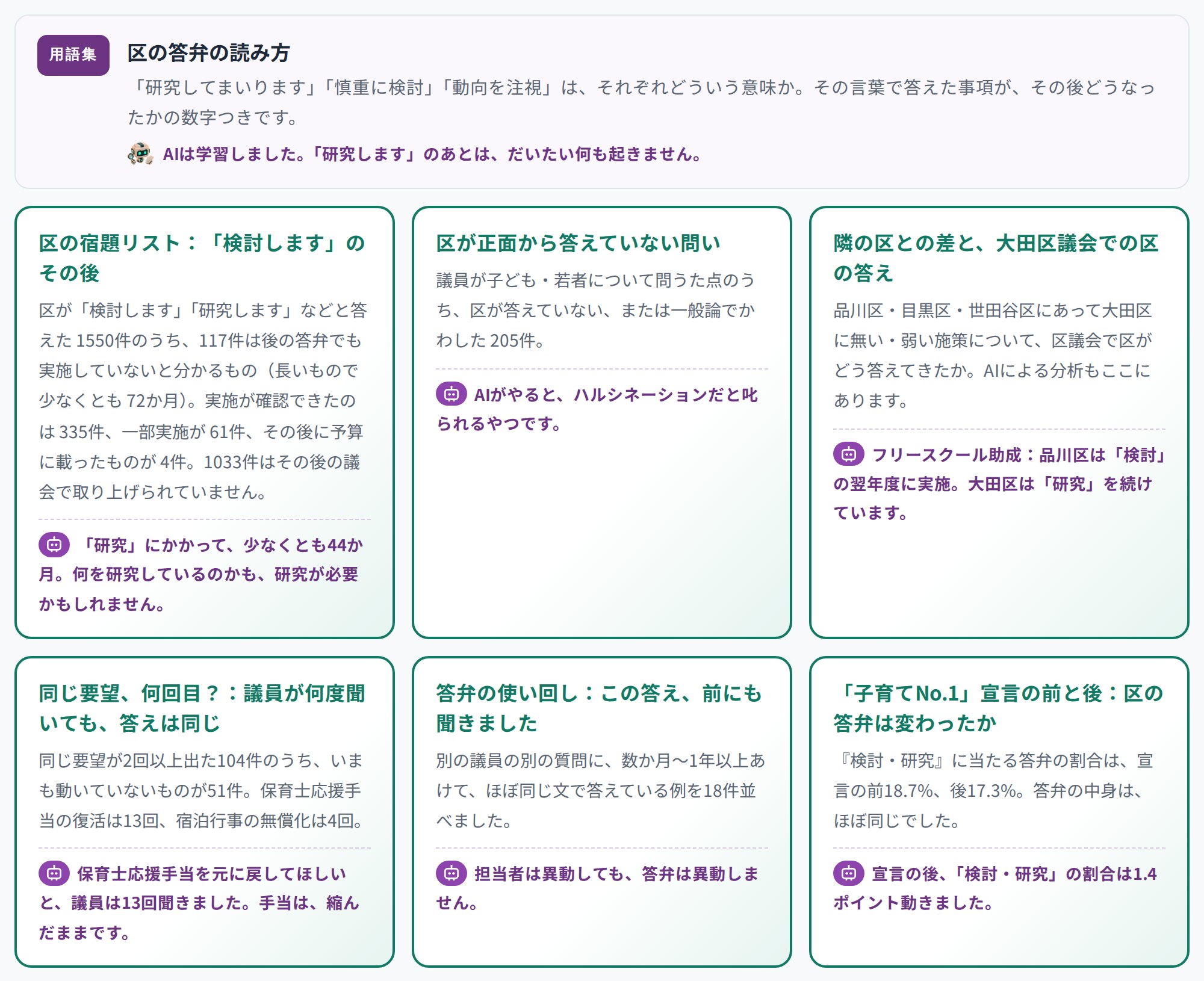
The glossary page, “How to Read the Ward’s Answers,” lists readings of the ward’s answers that the AI worked out by reading a great deal of the minutes. For each phrase — “study,” “careful consideration,” “watch the moves of the national and Tokyo governments” and so on — it counts what later happened to the matters the ward answered that way. For example, of the matters Ota Ward said it would “study,” 20 out of 80 could later be confirmed as implemented.

It started with something I said
The Assembly Watch uses AI to read the ward assembly minutes and organizes council members’ questions about children, and the ward’s answers, with the original text. Since it is essentially an organization of the minutes, it inevitably reads stiffly.
So I asked the AI that was doing the work: “Since the premise is that AI is doing this, could you give it a bit more edge, or some humor? Irony, maybe.”
Irony written by a person can rub people the wrong way. But humor from an AI might be forgiven. That was my thinking.
What I found interesting was that, along with its suggestions, the AI came up with rules on its own.
If the main text became casual, even the numbers and quotations might be taken lightly. So the irony would go only inside the robot box. It would be aimed at the ward’s answers and systems, never at the mayor, staff or individual council members. And it would use only numbers that match the facts on the page.
The one line I added was: “You can be as strict as you like, right up to the edge of being wrong.”
Remarks that contain numbers take them automatically from the page. For example, the line at the top of the petitions page, “This is not an AI calculation error. Count as many times as you like: it’s zero.”, will disappear automatically if even one children-related petition is adopted. That way, the irony never goes out of date before the facts do.
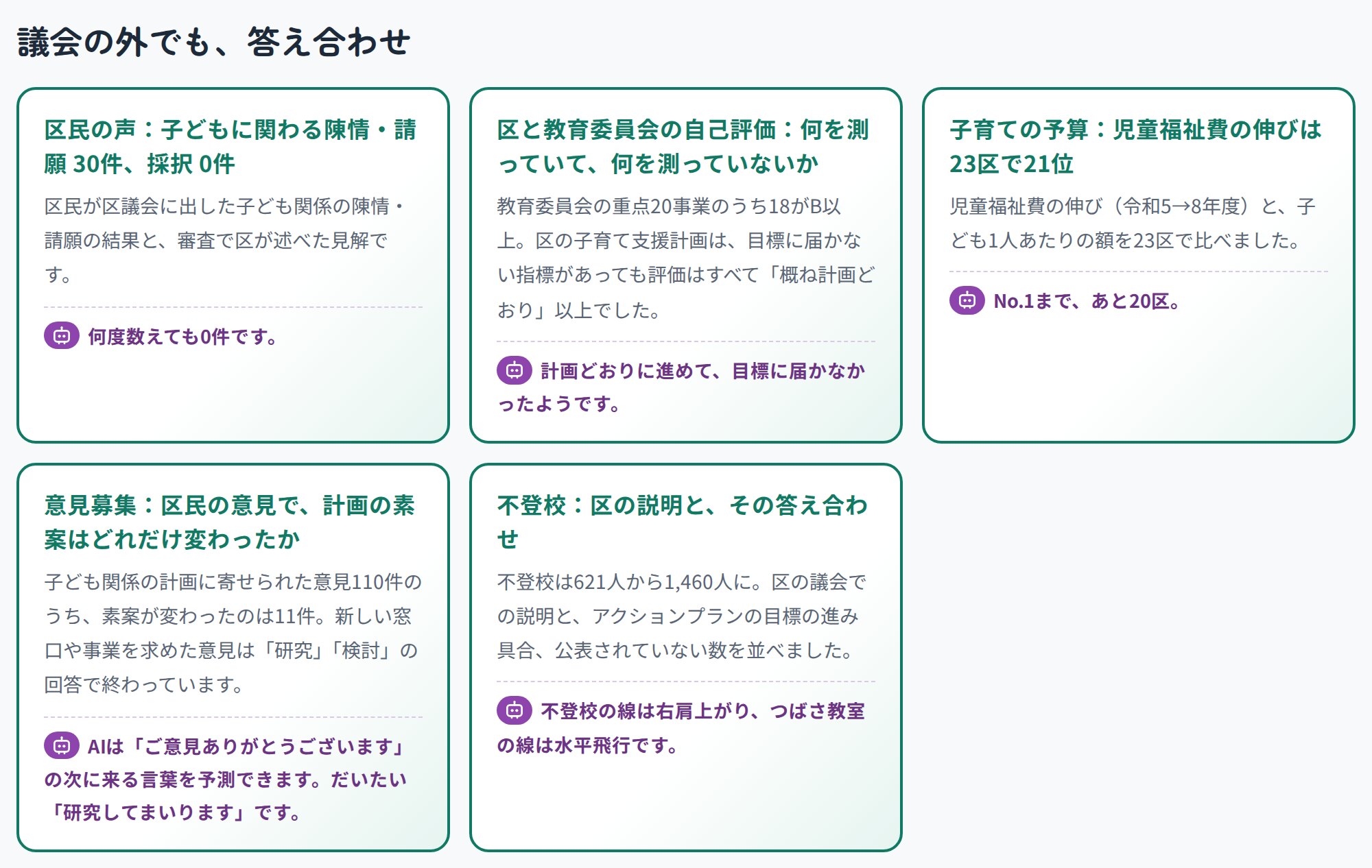
The one that made me laugh hardest was on the budget card: “Only 20 more wards to go until No. 1.” Ota ranks 21st of Tokyo’s 23 wards in the growth of child welfare spending. The line lays that over the ward’s slogan, “the No. 1 city for raising children.”
Nobody asked for this line. All I said was “irony, maybe”; I never specified what to write on which page. A little earlier, that AI had dug up, from the minutes and video recordings, the scene where the mayor answered a question about being “No. 1 for raising children.” I wrote about that exchange in my blog post “What Makes Ota a “No. 1 City for Raising Children”?” The page comparing growth in child welfare spending across the 23 wards was made by the same AI. The AI had connected the ranking to the mayor’s answer I had written about, all on its own.
The AI toned it down; I turned it up
Along the way, the AI toned down its own remarks many times.
An early draft included the line, “In the AI’s dictionary, ‘we will study it’ translates as ‘we are not doing it now.’ The translation is right about 90% of the time.” But when it recounted, including partly implemented matters meant it was not 90%. The AI rewrote it with the actual numbers on its own. It also judged the phrase “effectively a zero answer” too strong, and changed it to “Putting off a decision. Few cases are implemented later.”
Sometimes I made things stronger. When the AI wrote “room to grow,” I replied: “‘Room to grow’ sounds positive, so maybe something like ‘lagging behind’ would be better.”
I also asked for more wit. The card for the ward’s homework list originally said, “If this were summer homework, they’d have been called to the teachers’ room long ago.” I asked for something like: “What could they be studying that takes so long — they’re not scholars, so what does ‘study’ even mean? But without being nasty.” The AI came back with three ideas playing on scholars.
“The longest ‘study’ has entered its 32nd month. In graduate school, the thesis would be due about now.”
“32 months into ‘studying.’ What they are studying may itself need some study.”
“Some topics have been under study for 32 months. No conference presentation yet, it seems.”
I chose the second. Later it turned out that the 32-month matter was actually “consider,” not “study,” and the AI changed it to 30 months, the oldest “study.” After that, the site widened its reading to minutes from 2019, and changed how homework is counted so that only matters where the ward later answered again that they were “still considering” and the like are included, so the number changed. The card now reads: “At least 44 months into ‘studying.’ What they are studying may itself need some study.”
Hallucination: there and back again
The one I agonized over most was the remark on the top-page card “Questions the ward did not answer head-on”: “If an AI did this, it would get scolded for hallucinating.” “Hallucination” is the word for when an AI gives a plausible-sounding answer that is not true. The line likened answers that skip the question and talk about something else to this AI failure.
But it might be hard to follow for people who don’t know much about AI. So I asked: “The AI word ‘hallucination’ is hard to understand, so could you make it some other kind of humor?” This is what the AI put in its place:
“On a test, if you don’t answer the question and write about something else, you get zero.”
Easy to understand. But a few hours later, it still felt flat. I asked: “Actually, change it back to hallucination. It’s funnier.”
The AI put the line back, and also deleted the rule “don’t use AI jargon” that it had kept in its own notes. I can’t say whether it has a sense of humor, but it seems to know when to back down.
What we cut as just over the line
There was also a line we removed and never brought back: a remark the AI added on its own to the card leading to the Shinagawa summary in the “neighboring ward” section on the top page.
“Our neighbor Shinagawa ranked first overall in the ‘2025 Ranking of Cities Where Dual-Income Families Can Easily Raise Children.’ The No. 1 we were looking for was right next door.”
This ranking had been mentioned by a council member in an Ota Ward plenary session. The AI had checked it in the minutes before adding it. It was factually correct and broke none of the rules.
Even so, right after it went live, I asked: “On second thought, I feel it might provoke the Ota Ward office, so shall we remove the AI comment on the Shinagawa part (put it back as it was)?” Reading it again now, it is just over the line. The card went back to its original form, without the remark.
Still, the more we look into it, the more it is also true that Shinagawa is a step ahead on many measures.
If you laugh, open the original text
At the very bottom of every page, there is also this line:

“This summary was made by AI. Since it is AI, there may be mistakes. If you point one out, instead of ‘we will study it,’ we will fix it right away.”
Sometimes the ward answers “we will study it” or “we will consider it,” and then nothing moves for a long time. The line pokes fun at that kind of answer from Ota Ward.
All the words on this site, including the robot remarks and this line, were written by AI based on the facts. Not a single sentence was written by a person. The human role was like that of an orchestra conductor: not playing a single note, but deciding what to have written, what to keep and what to cut.
If a robot remark makes you laugh, please open the original text and the minutes just below it. Every remark stands on facts shown on the page. If you find anything that differs from the facts, please let us know. We will check and fix it right away.
How much of the minutes the AI read, and how it checked them, is summarized in the press release.
AI Ota Ward Assembly Watch: https://digitalkodomo.jp/gikai/ (in Japanese)
Press release: About 450 AI-Hours, Over 20 Years for a Person: “AI Ota Ward Assembly Watch” Publishes Children-Related Exchanges from 64.7 Million Characters of Assembly Minutes, Each with the Original Text
*
Digital Kodomo BASE is a nonprofit that teaches children computers, AI and programming free of charge. When you build something with AI, it is people who set the goal, draw the lines and check the results. We want to pass on that ability to make AI work for you to children as well. If you would like to help us keep going, please consider supporting us with a donation.