A Donated Computer
Opens a Child's Future
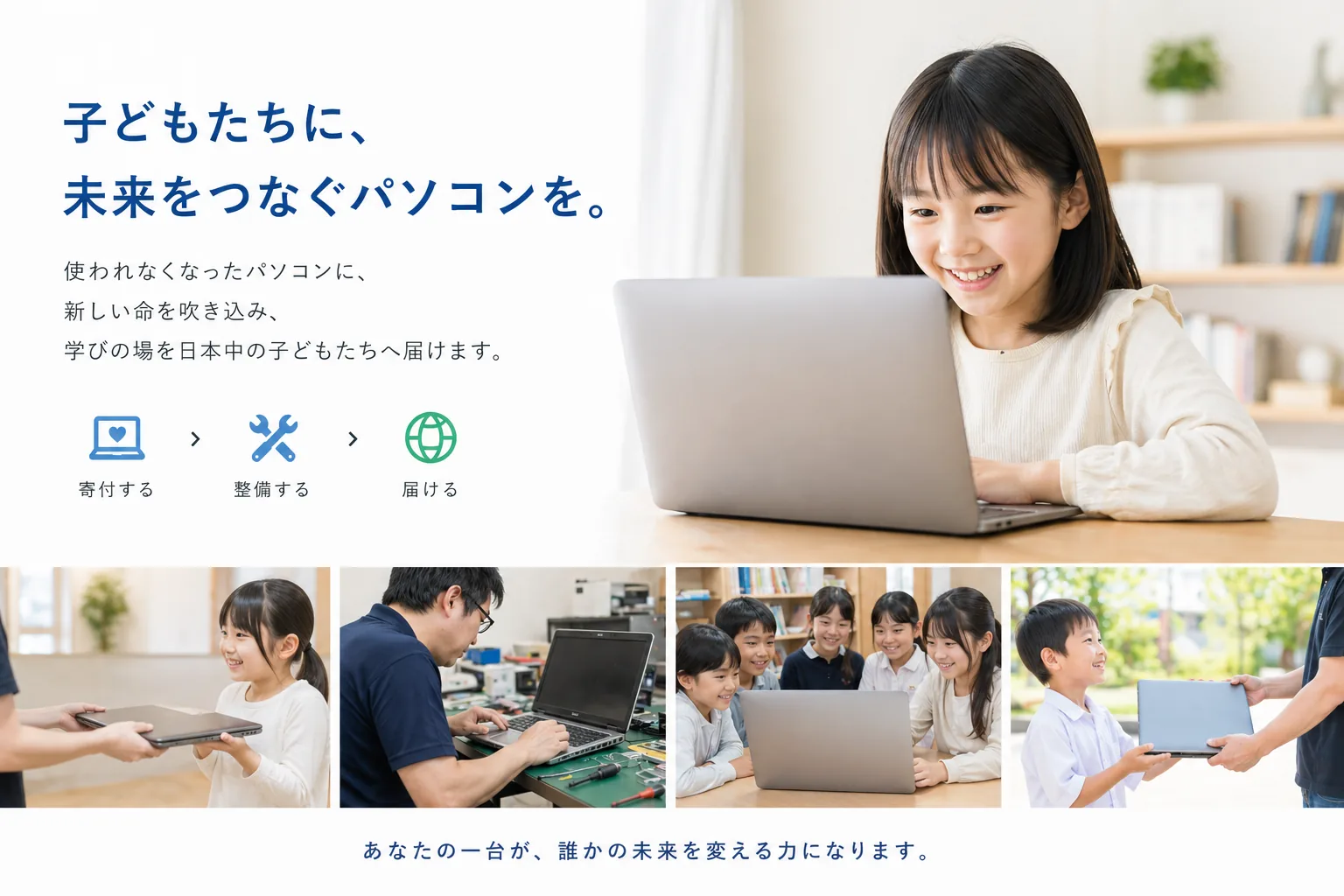
The Kids PC Bank collects used computers from companies and individuals, refurbishes them, and provides them free of charge to children who don't have a PC at home. One laptop changes a child's after-school hours — and their future.
Whether a child has a computer at home is now a key factor in their learning opportunities and future prospects. According to Japan's Ministry of Internal Affairs and Communications, PC ownership rates vary dramatically by household income.
earning under ¥2 million/year
earning ¥10–15 million/year
learning after school
Smartphones are widely available across all income groups — but programming, video editing, and document creation require a PC. A smartphone is a tool for consuming content; a PC is a tool for creating it.
Japan's GIGA School Program delivered one device per student to every public elementary and junior high school. Yet this policy has not resolved the after-school divide.
by elementary school students (MEXT survey)
no digital learning at home
School-issued tablets are designed primarily for viewing, reading, and confirming — not for open-ended exploration. Many schools also restrict children from taking devices home. Free, curiosity-driven tinkering — the kind that builds real digital skills — is simply not possible on a supervised school tablet.
When a child receives a PC, their after-school life changes — not just how much they study, but what they can learn and create.
in shortage by 2030 (METI)
projected short by 2040 (METI)
A PC with internet access gives children — regardless of where they live or how much their family earns — access to world-class learning content. Free coding platforms, open university courses, AI-powered personalized learning tools: all available through a browser.
More importantly, a PC enables creation: writing code, making games, editing videos, building AI projects. This active, creative experience is what nurtures the problem-solving ability, critical thinking, and creativity that the AI era demands.
Manufacturing a new PC generates approximately 200 kg of CO₂. By refurbishing and reusing existing hardware, we eliminate that environmental cost entirely.
A computer that would have been discarded is restored, placed in a child's hands, and used every day. The PC reuse industry as a whole is estimated to reduce CO₂ emissions by approximately 30,000 tons per year — making this both a social and environmental initiative.
We collect donated computers, restore them to working condition, and distribute them free of charge to children in need.
- ✓Children (elementary through high school) without a PC at home
- ✓Nonprofit organizations supporting children — children's cafeterias, learning support groups, community spaces
- ✓PTAs, schools, and community groups working to improve children's learning environments
- ✓Families or organizations supporting school-refusing or homebound children (see also Digital Kodomo BASE Furatto Lab)
See the PC List page for available models. To request a PC, please contact us via LINE or the inquiry form.
The next PC, for a child who has none.
A donated PC reaches a child only after data wiping, a fresh OS, new parts, and setup. Donations are our only source of funding.
JPY 30,000 delivers one refurbished PC to one child.
References
- Ministry of Internal Affairs and Communications — Communications Usage Trend Survey 2023 (PC ownership by income bracket)
- Children and Families Agency — FY2024 Survey on Internet Usage Environment for Youth
- Ministry of Education, Culture, Sports, Science and Technology — Survey on Information Utilization Ability (keyboard input data)
- Ministry of Economy, Trade and Industry — IT Human Resource Supply and Demand Survey (projected 790,000-person shortage by 2030)
- METI — Revised Employment Structure Projection for 2040 (3.4M AI/robot talent shortage)
- Inversenet Co., Ltd. — CO₂ Reduction through PC Reuse and Recycling Operations
- Kumon Institute of Education — KUMON Home Learning Survey 2025