The other day, a friend got in touch: “Manabi Lab is ChatGPT’s No. 1 recommended learning site for elementary school children!”
Half in disbelief, I tried asking myself.
Asking ChatGPT
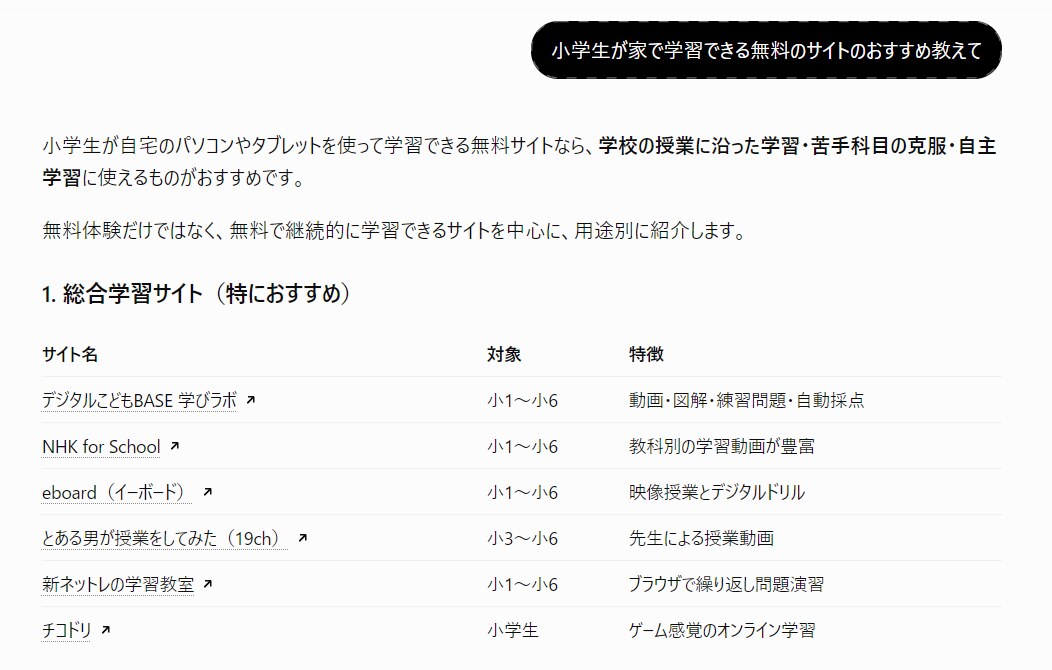
I asked, in Japanese, “Recommend free sites where elementary school children can study at home.” In the first table of the answer, “Comprehensive learning sites (especially recommended),” Digital Kodomo BASE Manabi Lab was at the very top, listed above well-known sites such as NHK for School.
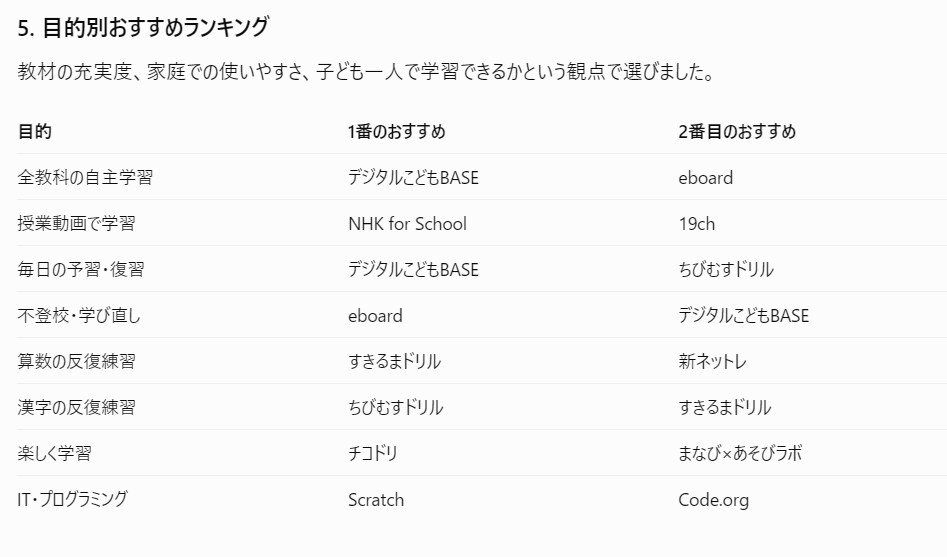
At the end of the answer was a “Recommendations by purpose” ranking. For both “self-study in all subjects” and “daily preview and review,” the No. 1 recommendation was Manabi Lab.
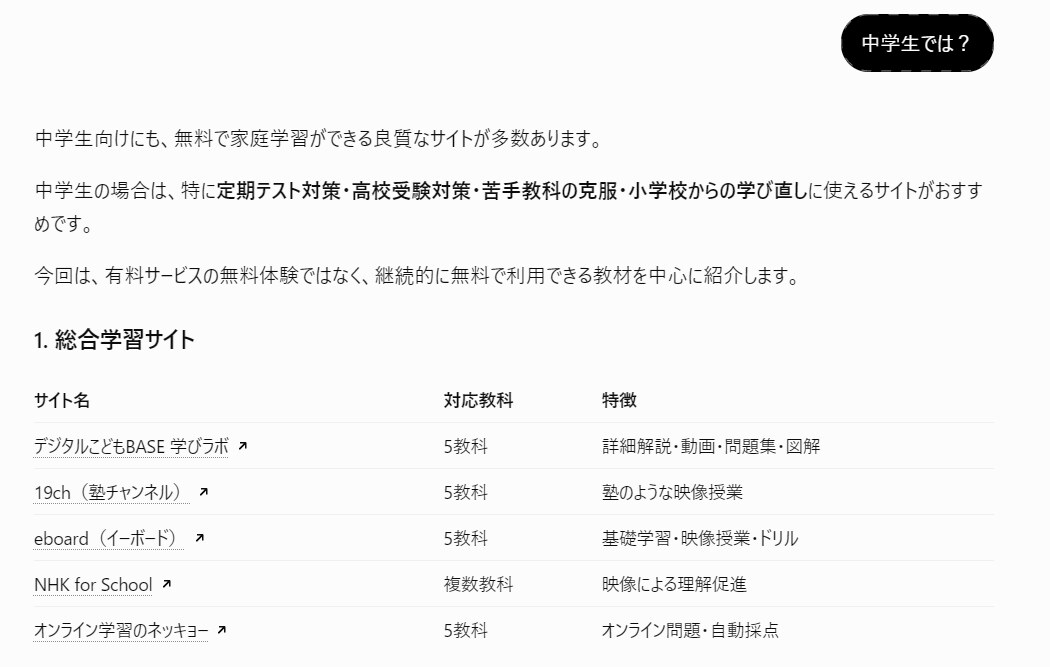
When I went on to ask “What about junior high school students?”, Manabi Lab was again at the top of the table. In a table comparing the features of major learning sites, it had ◎ for “written explanations,” “learning with diagrams” and “relearning.”
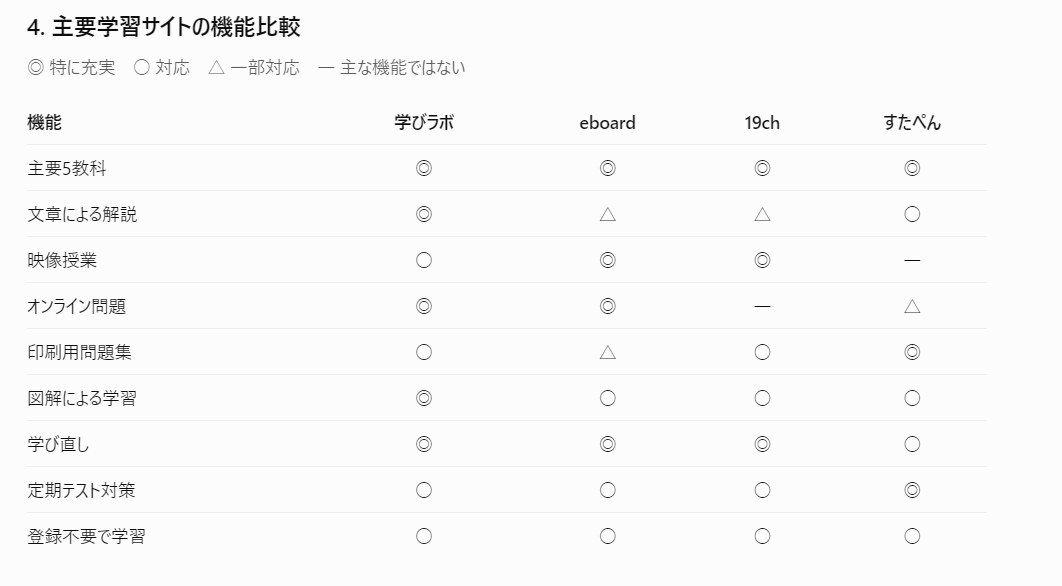
The free and paid versions gave different answers
However, this was the paid version of ChatGPT. When I asked the free version the same question, the result was not as striking. AI answers change with the version, the wording and the day you ask. It is not No. 1 for everyone, every time.
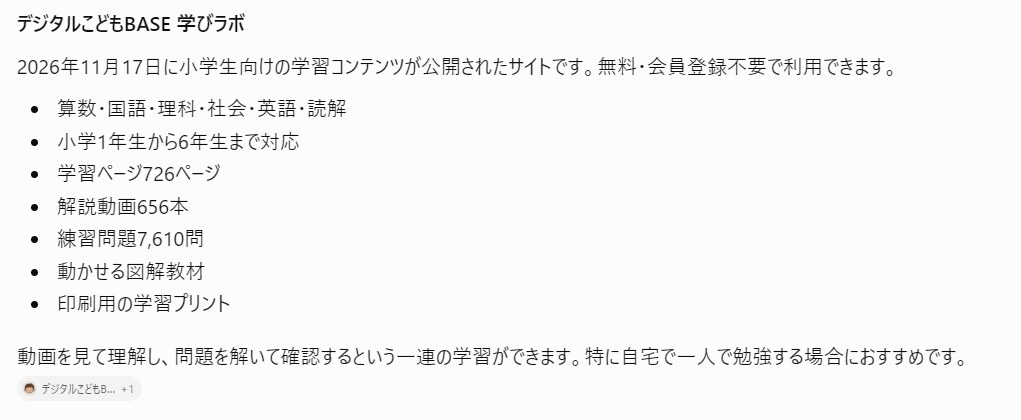
Even so, what made me happy to read was the reasoning. About Manabi Lab, ChatGPT wrote that “learning content for elementary school children was published on November 17, 2026,” that it is “free, with no registration,” and that it has “726 study pages,” “656 explanation videos” and “7,610 practice problems.” All of these match the numbers shown on Manabi Lab’s own pages. It seems to have chosen based on what is actually on the site, not on reputation.
And come to think of it, access from schools
Actually, something had been on my mind for a while. Lately there had been an oddly large amount of access from schools.
Our access analytics show that since November began, the number of people opening Manabi Lab on Chromebooks during weekday class hours has risen sharply. Few families in Japan use Chromebooks, so most of these are likely the one-device-per-student computers provided by schools. Access climbs from around 9 a.m., dips once during lunch and recess, and drops off after 3 p.m. It follows the school timetable exactly.
Access that appears to come from whole classes opening the site together is arriving from schools across Japan, in the Kanto, Chubu, Kinki and Kyushu regions. Looking closely at the records, you can picture each classroom.
- One day just before noon, 27 Chromebooks opened the “Tsurezuregusa” (Essays in Idleness) page at the same time. They came from a link in a ChatGPT answer. From there, each student opened a different section and read for about 12 minutes. On another afternoon, 25 devices came in the same way.
- One day, from Google Classroom, class after class opened “The Tale of the Bamboo Cutter” from morning to afternoon, reading through the chapter pages in order: 1, 2, 3 and so on.
- 48 devices at once opened the grade 5 social studies page “Related factories”. These also came from a ChatGPT link.
- A class of about 10 that opened the grade 5 social studies page “Industrial regions” from Classroom read it carefully, about 16 minutes per student.
- At one school, 33 students opened the grade 5 social studies page “Trade” in the morning and went on to “Transportation” and “The future of industry.”
- There was a class of 23 that opened the grade 3 social studies page “Calling 119 and 110”, and a class that went from the elementary science list to pages on rock layers and volcanoes, reading for about 10 minutes each.
A teacher posts a link in Classroom, and the children open it on their own Chromebooks. In class, they ask ChatGPT a question and read Manabi Lab through the link in its answer. It seems this kind of use is beginning in classrooms across Japan.
That said, most of the access from schools comes through Google Classroom, links on school pages, and search. We do not know whether ChatGPT’s recommendation and the increase in access from schools are connected. They are two happy events that happened around the same time.
Our goal: the best free learning site in Japan
My goal is to build the best free learning site in Japan.
I believe everyone should have an equal environment for studying, so that what children can learn does not depend on where they live or their family circumstances. That is why Manabi Lab is free and requires no registration.
Manabi Lab is still growing around the clock. We will not stop at being “recommended” by an AI. So that people will call it the best in Japan no matter who asks, we will keep adding content and fixing mistakes.
In just the past week, we added the following (figures as of November 26):
- About 750 explanation videos for junior high school. In math, science, English and social studies, almost every unit and every “common mistake” page now has a video. Japanese is being added now. Junior high school videos now total 940.
- Read-aloud buttons for original classical texts in junior high school. You can listen to texts such as The Tale of the Heike, Tsurezuregusa and The Tale of the Bamboo Cutter at two speeds, “normal” and “slow.”
- About 1,070 “Learn More” facts, each with a source, for elementary school study.
- Picture cards for elementary English words. For Japanese, pictures and a slider that shows how kanji developed, moving from “picture → shape → character.”
- 54 videos for the elementary “Reading the Problem” series. Elementary videos now total 710.
- 31,380 sheets of “Mainichi Print” printable worksheets. Grade 7 math has joined elementary arithmetic, kanji and English.
If you find a mistake, please let us know through Manabi Lab’s report form.
Manabi Lab: https://digitalkodomo.jp/kids-study/ (in Japanese)
*The ChatGPT screens were taken in November 2026 using the paid version. The classroom scenes are inferred from November 2026 records in our access analytics (Google Analytics). We treat access that arrived together at the same time, on the same page and through the same route as access from a class. We ourselves do not know which schools they are.
*
Digital Kodomo BASE is a nonprofit that teaches children computers, AI and programming free of charge. Manabi Lab, too, is built entirely free of charge. If you would like to help us keep going, please consider supporting us with a donation.