NPO Digital Kodomo BASE (headquartered in Ota Ward, Tokyo; President: Tomoyuki Urushidani; hereinafter "the organization") today announces that on June 1, 2026 it will begin the trial operation of Minna no Craft Kichi (https://minecraft.digitalkodomo.jp/), a children-only Minecraft multiplayer server operated on a regional gateway model that separates participation management by area. As the first gateway, applications for the Ota Gateway (https://minecraft.digitalkodomo.jp/ota) — open to elementary school students residing in or attending schools within Ota Ward, Tokyo — begin today, May 25, 2026. The service operates on a whitelist with mandatory parental consent, features continuous log analysis by a self-hosted, closed-environment AI, and supports cross-play across Java Edition, Bedrock Edition, and Nintendo Switch.

Background
The space available for children's play has been shrinking in both the physical and online worlds. In neighborhood parks, safety-driven restrictions — bans on ball games, prohibitions on loud voices, and the removal of play equipment — have steadily increased, reducing the places where children can freely gather after school to move and play together. Online, safe enclosed spaces where children can meet just among themselves are also limited; most options drop them into the same environment as anonymous adults on large commercial services. As children's space shrinks on both fronts, the organization sees the preparation of a small, locally-rooted, safe online playground as a new role worth taking on as an NPO.
Minecraft is increasingly used in schools worldwide as a tool to foster creativity, spatial reasoning, and collaborative communication. However, the general multiplayer servers children typically access from home expose them to risks including contact with anonymous strangers, verbal abuse, griefing, and aggressive monetization. On large overseas commercial servers and individually-operated volunteer servers, both the chain of responsibility and the operational structure during incidents are often unclear.
Through programming events at local elementary and junior high schools and the weekly Wednesday after-school lab, the organization has been in daily contact with children in Ota Ward. In the course of this work, repeatedly hearing from children and parents themselves, the organization came to recognize a clear gap: beyond the limited time of these events or the after-school lab, there are almost no places in the local area where children can gather and play together safely as part of their everyday lives — after they return home, on weekends, and in other unstructured hours. Minna no Craft Kichi grew out of this realization: an online space where the children the organization works with daily can gather safely on an everyday basis. By having the NPO directly operate the server, the chain of responsibility is clear, and the small-scale, locally-bounded operation is prioritized.
Service Overview
Minna no Craft Kichi is a children-only Minecraft multiplayer server operated on a regional gateway model that separates participation management by area. The first gateway, the Ota Gateway, accepts applications on a whitelist basis from elementary school students (grades 1 through 6) residing in or attending elementary schools within Ota Ward, Tokyo. After a parent submits an application form with consent, the organization's staff verifies eligibility and operational considerations, and only the registered Minecraft IDs are permitted to connect to the server.
Service Site: https://minecraft.digitalkodomo.jp/
Ota Gateway: https://minecraft.digitalkodomo.jp/ota
Launch Date: June 1, 2026 (trial operation begins) / Ota Gateway applications open: May 25, 2026
Eligibility: Elementary school students (grades 1–6) residing in or attending schools within Ota Ward, Tokyo (Ota Gateway scope)
Fee: Free during trial operation
Supported Platforms: Java Edition (Windows / Mac / Linux), Bedrock Edition (iPad / Android / Windows 10·11), Nintendo Switch
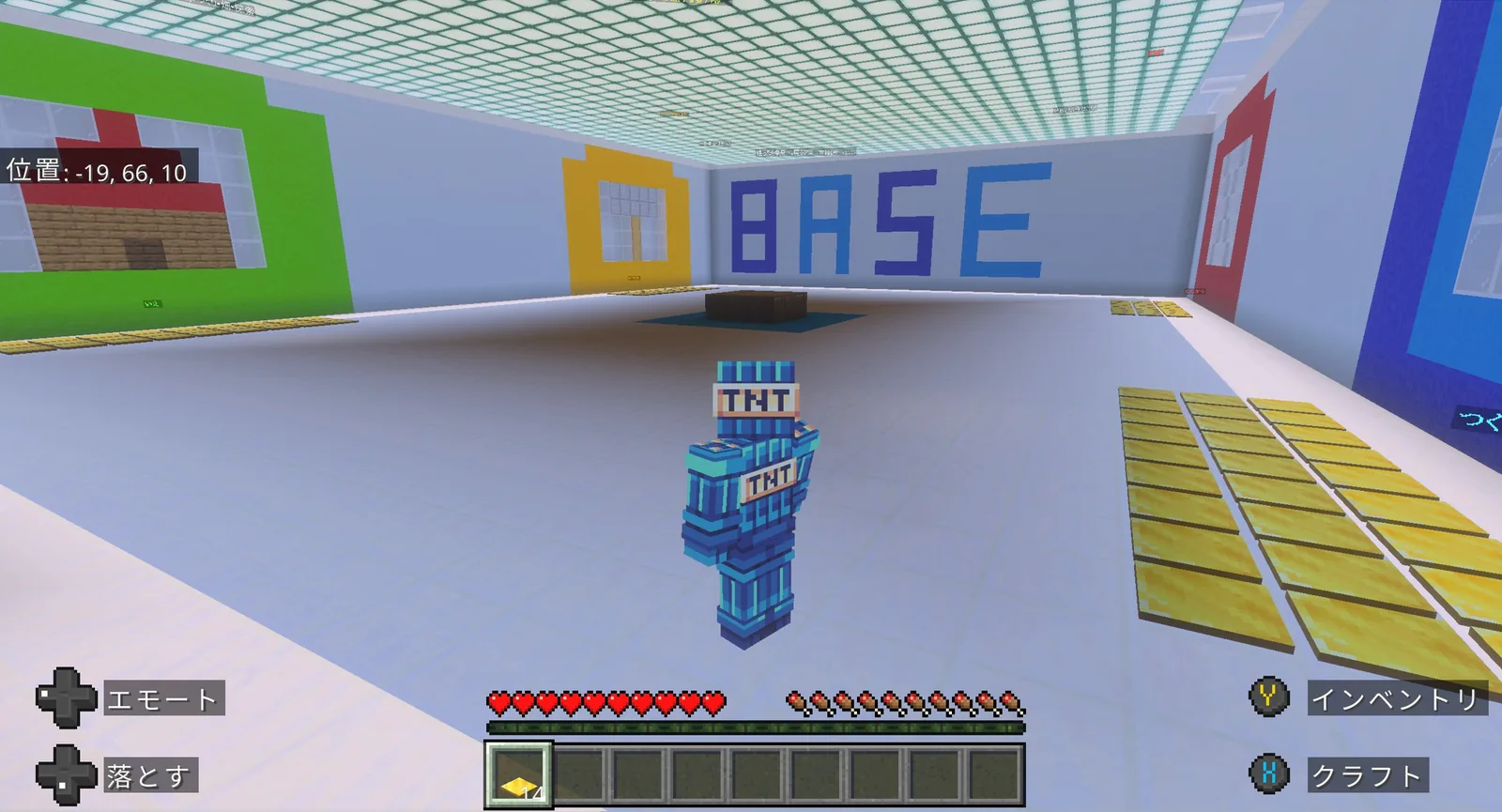
The server hosts five worlds centered on a main lobby: two survival worlds at different difficulty levels (easy and normal), a creative-mode building world with individual plots, and a small PvP arena with simplified rules. The layout is designed so children of different ages and experience levels can each find their own way to play.
Key Features
- Per-Gateway Whitelist Creates a Closed, Safe Playground At the Ota Gateway, participation is restricted to elementary school students residing in or attending schools within Ota Ward, with parental consent required. Only approved children's Minecraft IDs can connect via the whitelist, so participants never encounter unknown players from the wider internet. By keeping operations small-scale and bounded to each gateway, staff can respond to issues with locally-rooted, close familiarity with the community.
- Continuous Log Analysis by Self-Hosted, Closed-Environment AI (No External Cloud) All server logs — chat, block operations, joins and leaves, item transfers — are analyzed continuously by a self-hosted AI running in a closed, network-isolated environment maintained by the organization. No logs are sent to external cloud AI services such as OpenAI, and children's behavioral data never leaves the organization's closed environment. The system detects verbal abuse, accidental personal information leakage, impersonation, sexual content, as well as griefing, theft, and destruction of others' builds. AI judgments are not applied automatically; final decisions are always made by human staff after reviewing the flagged content.
-
Full Cross-Play Support Across All Major Platforms
Players can connect from Java Edition (PC), Bedrock Edition (tablet, smartphone, or Windows), or Nintendo Switch, and play together in the same world regardless of device. For example, an older sibling on PC, a younger sibling on Switch, and a friend on iPad can all meet up in the same place. We made the maximum technical effort to ensure no child is excluded by their family's device choice.
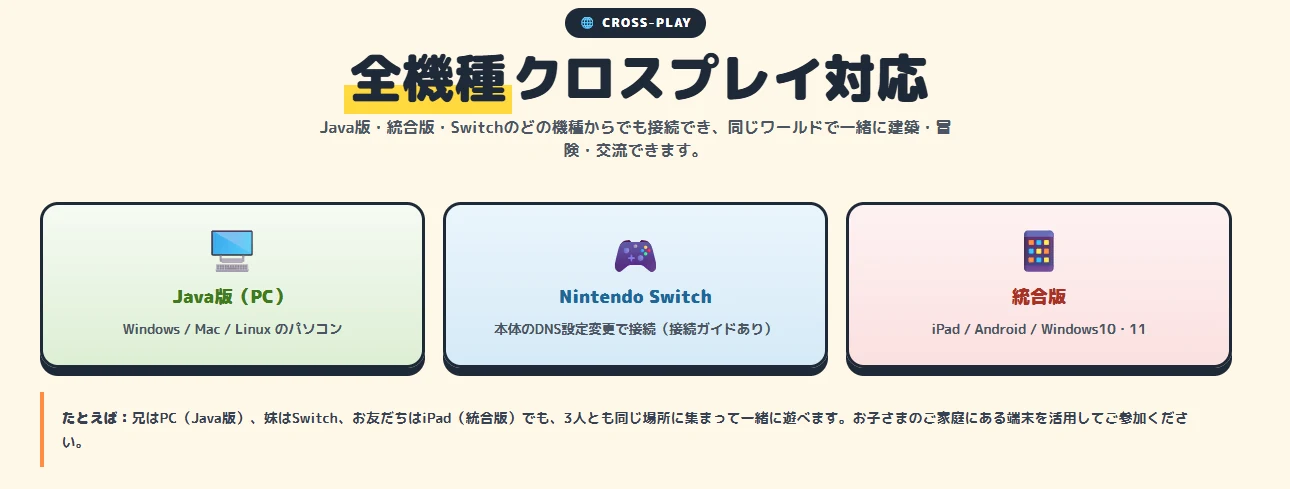
Players on Java Edition, Bedrock Edition, and Nintendo Switch can all connect to the same world - Operation Logs and Backups Enable Full Recovery from Incidents Block placement and destruction, joins and leaves, and item transfers within the server are all recorded. In the rare event of griefing, theft, or accidental destruction, staff can identify who did what and when, and roll back individual builds or specific areas as needed. World data is regularly backed up to storage separate from the main server, allowing rollback to a previous state when necessary.
- A Cross-Generational Local Community Supported by Teen Volunteers The organization also recruits middle school and high school students residing in Ota Ward as volunteer staff to support the elementary school participants. Slightly older "big brother / big sister" volunteers teach building techniques, guide first-timers, and create an atmosphere where younger children feel more at ease. For the teenage volunteers, the role offers leadership experience within their local community, with certificates of activity issued when needed. Volunteers participate at a comfortable pace of one to several times per month — with academic priorities respected — under parental consent. It should be noted that volunteer staff serve as peers supporting younger players within the play space, and also help test-play new worlds and assist with constructing minigames and the build world. However, they have no access to applicants' personal information, chat logs, closed-environment AI analysis results, or any other administrative data. Such information is handled exclusively by the organization's adult staff.
Roadmap
During the trial operation period, the organization will continuously improve both operations and safety features based on feedback from participating children and parents. Monthly events — themed building contests, seasonal events, and showcases — will be introduced progressively to give children opportunities to present their own work and learn from others' builds.
After transitioning to full operation, the organization intends to keep participation fees as low as possible and, as a guiding principle, aims to cover operational costs and staff compensation primarily through donations and grants from the local community and supporters. A minimal monthly subscription is being considered as one option in case donations alone cannot sustain ongoing operations, but no change to the fee structure would be made without advance notice to the registered email addresses. The geographic scope will remain Ota Ward initially; expansion to additional areas will be considered after the organization has accumulated sufficient operational experience.
About Digital Kodomo BASE
- Name
- NPO Digital Kodomo BASE (特定非営利活動法人デジタルこどもBASE)
- Address
- 3-3-3 Chuo, Ota-ku, Tokyo, Japan
- Representative
- Tomoyuki Urushidani, President
- Established
- Active since 2024 / NPO registered April 2026
- Corporate Number
- 5010805003266
- Activities
- Free PC / AI / programming education for children, PC distribution, after-school lab operation, Minecraft multiplayer server operation
- Website
- https://digitalkodomo.jp/
Media Contact
NPO Digital Kodomo BASE — Public Relations
E-mail: admin@digitalkodomo.jp
Service Site: https://minecraft.digitalkodomo.jp/
Organization Site: https://digitalkodomo.jp/
This service is independently operated by NPO Digital Kodomo BASE and is not officially affiliated with Mojang AB, Microsoft Corporation, or Nintendo Co., Ltd. Minecraft is a trademark of Mojang AB.