This story goes back to before we launched the junior high school pages of Manabi Lab.
When I first decided to create study materials, what I had in mind was actually elementary school material. I had even started making some.
So I talked with several people who work in education.
They all gave me the same answer.
"Elementary school kids will never study online."
I also heard this: children today lack reading comprehension, and without it, they cannot study by reading text on a screen.
We Set It Aside
Some of that rang true. A child still learning hiragana and kanji was unlikely to open a computer and find their way to a study page on their own.
So I decided not to release the elementary material I had started, and to focus on junior high school instead. The junior high pages of Manabi Lab, launched in May 2026, now number more than 2,500.
"Maybe It Is Needed"
As time passed, though, my thinking slowly changed. Maybe elementary material is needed too.
Some children do not go to cram school. Money. No school nearby. Finding crowded spaces hard. The reasons vary.
A child who is not going to school may one day think, "Maybe I'll study a little."
If, at that moment, there is something they can open at home, at a time that suits them, they have one more path to choose.
I have also heard from parents who want to relearn the material themselves before teaching their children, and from people who say it would help adults relearning the basics, or in caring for elderly people. It seems elementary school material is not only for elementary school children.
In October, we announced that we would "start with grades 5 and 6 and aim to launch in December." We moved that schedule forward and have released all grades, 1 through 6, at once: math, Japanese, science, social studies, English and "Reading Skills" — 711 pages, free and with no sign-up.
Things Paper Cannot Do
If I was going to make it, I wanted to build in the strengths of digital that paper textbooks do not have.
The first is video. Every unit in math, Japanese, science, social studies and English has a 1–2 minute explainer video: 656 videos, about 14.5 hours in total.
The characters are the teacher, Manabu-sensei, and the student, Hikaru. Hikaru says the mistakes children often make.
In grade 5 ratios, it goes like this. Tape A is 4 cm and tape B is 6 cm. Hikaru answers, "6 − 4 = 2, so it's 2 times!"
The teacher takes A as "one unit" and lays it against B. One unit, and a half. So it is 1.5 times. Because the diagram moves, you can see exactly where the thinking went off. Every mistake is corrected within the video.

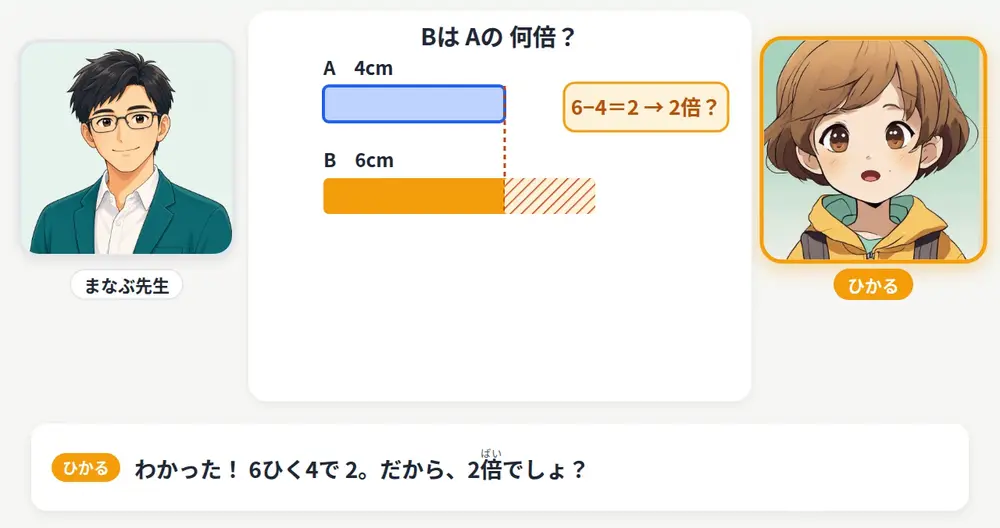
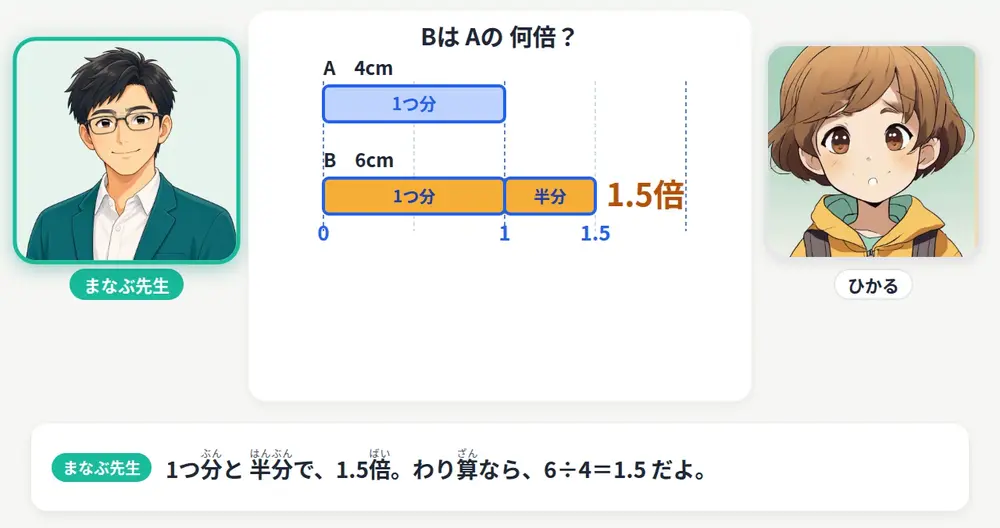
The second is audio. "Without reading comprehension, children cannot study from text on a screen." As one answer to those words, we added read-aloud audio to every sentence on every page — about 50,000 clips, with the reading speed adjusted to each grade. Children who find reading hard can move forward by listening.
The third is using your hands. In "Try It", children cut fractions into pieces, stretch tape diagrams, connect electric circuits and balance levers. There are no points or game elements.
There are 7,405 practice questions, checked instantly. When a child gets one wrong, hints appear one step at a time. If they get lost, they can jump straight back to the related unit in an earlier grade.
For the worry about reading comprehension, we prepared one more answer: "Reading Skills", a series devoted to reading word problems. Is it "altogether" or "the difference"? Who has more than whom? We made 54 lessons so children can practice from the reading itself.
Not a Replacement for Textbooks
Let me say this clearly: this is not a replacement for paper textbooks.
Textbooks and school lessons have their own role. This site is meant to sit beside them, as a place to check things by watching videos, listening and moving things with your hands. The roles are different.
The content is checked against the Ministry of Education's Courses of Study and their commentaries. We used commercial workbooks only to check that no topics were missing; every text, question and scenario was written by us. No textbook text or questions are reproduced.
If You Find a Mistake, Please Tell Us
Even so, I am sure some mistakes remain.
Every page has a "Found a mistake?" report form. If you notice anything, please let us know. We check every report and make corrections.
This is how the elementary school site we were told "would never work" came to be released. I hope it will be useful.
Elementary School Study (Japanese): https://digitalkodomo.jp/kids-study/shogaku/
Press release: https://digitalkodomo.jp/news/2026-11-17-shogaku-launch_en.html
*
Digital Kodomo BASE is an NPO that teaches children computers, AI and programming for free. All of our learning sites, including Manabi Lab, are free to use. If you would like to help us continue, a donation would mean a great deal.