NPO Digital Kodomo BASE (Ota City, Tokyo; Chairperson: Tomoyuki Urushidani) has added "Elementary School Study" to its free learning site, Digital Kodomo BASE Manabi Lab. Every unit of math, Japanese, science, social studies and English for grades 1–6 comes with an explainer video in which a teacher and a student talk through the topic with diagrams. There are 656 videos, about 14.5 hours in total. Together with "Reading Skills", a series for practicing how to read word problems, the site offers 711 pages across six subjects, free and with no sign-up.
In October 2026, the organization announced that it would start with grades 5 and 6 and aim to launch in December. It has moved the schedule forward and is releasing all six grades and all six subjects at once, with videos.
The site itself is in Japanese.
* Figures as of November 16, 2026.
Background
The organization originally planned to start its learning site with elementary school material and had begun creating it. However, several people working in education told it that "elementary school children will never study online" and that "without sufficient reading comprehension, children cannot study by reading text on a screen." Judging that children still learning hiragana and kanji would rarely open a computer and find a study page on their own, the organization went ahead with junior high school material first.
Manabi Lab launched in May 2026 as a learning site for junior high school students. Its explanations and practice questions for five junior high subjects now exceed 2,500 pages, and more and more visitors arrive by searching for a grade and a unit.
Since then, the organization has come to believe that elementary school material is needed too. Children who do not attend cram schools — for financial reasons, because there is none nearby, or because they find crowded spaces difficult — and children who are not attending school could use it at home when they decide they want to study. The organization has also heard from parents who want to relearn the material before teaching their children, and from people who see uses in adult relearning and in elderly care.
In designing the site, the organization assumed that "the people who come to this page are not the children who understand from the textbook and the lesson, but the children who are stuck, and their families." Repeating the textbook explanation in text would not reach them, so each unit starts with a video showing where mistakes tend to happen, and fixes them by moving a diagram. The site is also designed for children who find reading hard, children with developmental differences, and children not attending school to use on their own at home.
"Elementary School Study" is not a replacement for paper textbooks or school lessons. It is meant to sit alongside them, offering ways of learning that are hard to express on paper: watching videos, listening, and checking ideas by moving things with your own hands.
Overview
| Name | Digital Kodomo BASE Manabi Lab "Elementary School Study" (小学生の勉強) |
|---|---|
| URL | https://digitalkodomo.jp/kids-study/shogaku/ (Japanese) |
| For | Grades 1–6 (and their parents) |
| Fee | Free, no sign-up |
| Subject | Grades | Pages | Videos |
|---|---|---|---|
| Math | 1–6 | 159 | 159 |
| Japanese | 1–6 | 215 | 214 |
| Science | 3–6 | 126 | 126 |
| Social Studies | 3–6 | 84 | 84 |
| English | 3–6 | 73 | 73 |
| Reading Skills | 1–6 | 54 lessons | — |
| Total | 6 subjects | 711 | 656 |
Screens and Videos

Features
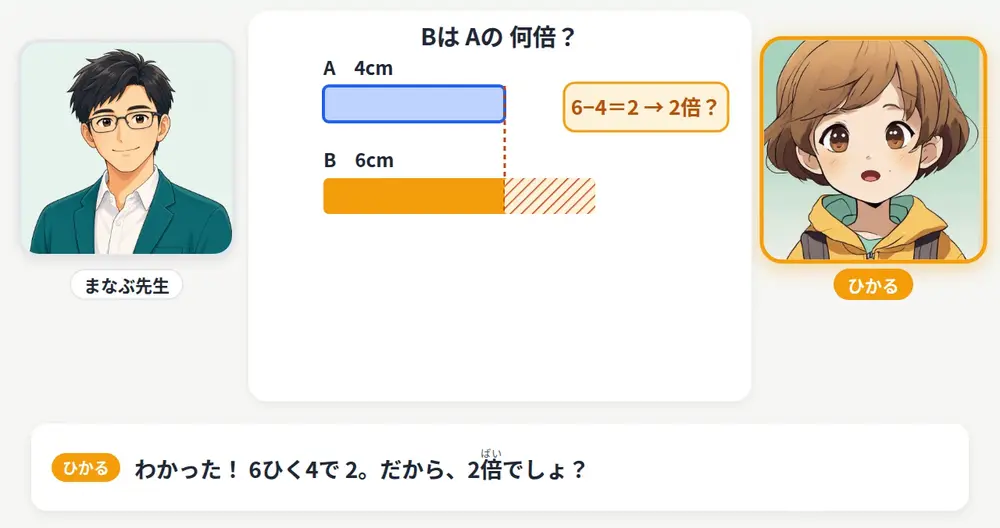
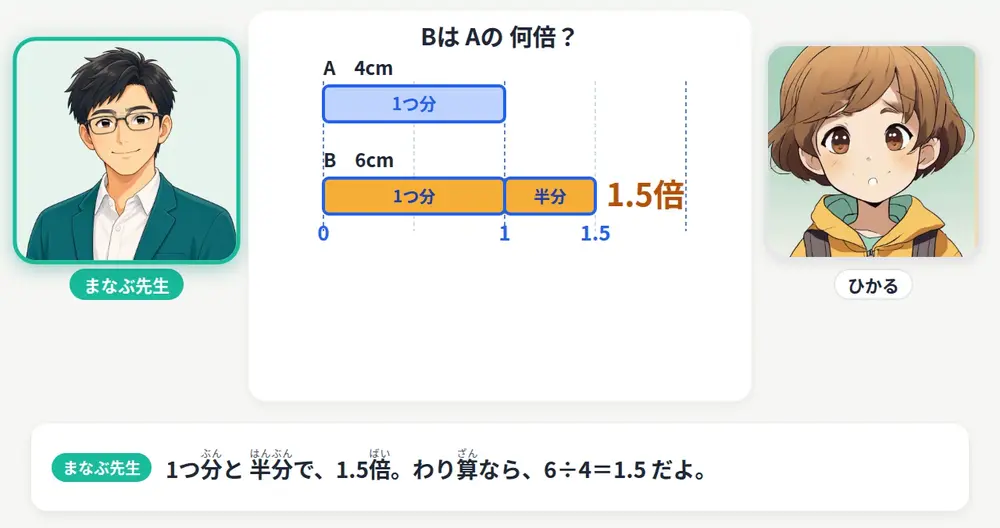
- 656 unit videos: the student makes the mistake, the teacher fixes it with a diagramEach unit page in math, Japanese, science, social studies and English has a 1–2 minute explainer video. The teacher, Manabu-sensei, and the student, Hikaru, sit on either side of the screen while a diagram moves in the middle, and the speaker's mouth moves in time with the voice.
Hikaru says the mistakes children really make. In the grade 5 "Ratios" unit, for example, comparing tapes of 6 cm and 4 cm, Hikaru answers "6 − 4 = 2, so it's 2 times!" Manabu-sensei does not scold, but lays the 4 cm tape against the other as "one unit" and shows that it is "one unit and a half: 1.5 times." Every mistake is corrected within the video, so children can follow one video from "I thought that too" to the right way of thinking.
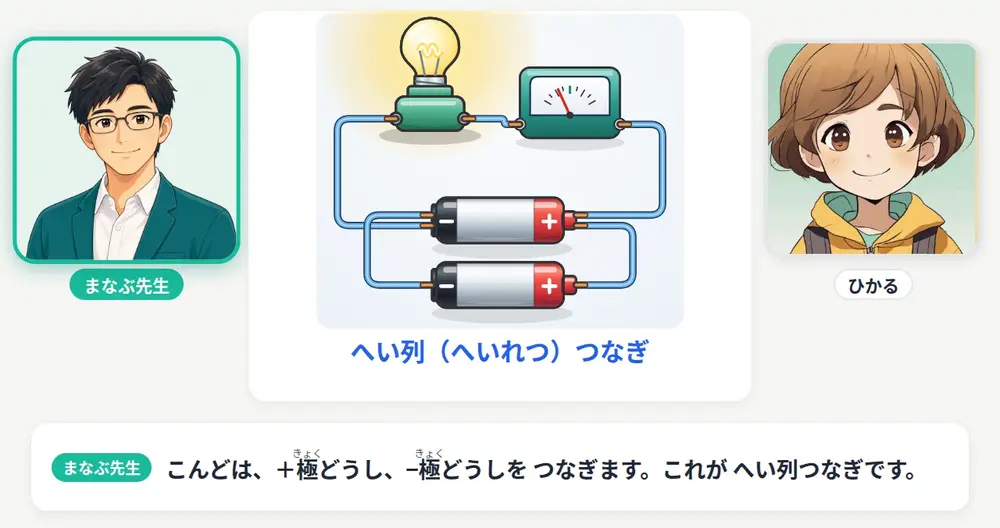
In science, the teacher explains with moving diagrams, such as comparing series and parallel circuits. Below each video is a written explanation using the same example and the same numbers, which children can reread at their own pace. - Every sentence read aloud in the teacher's voice (about 50,000 clips)Every sentence on the page has audio that plays at the press of a button, with the reading speed adjusted to the grade. Children who find reading hard can follow along by listening.
- "Try It": check ideas by moving themCutting fractions into pieces, stretching tape diagrams, connecting electric circuits, balancing levers — children move the ideas they saw in the video with their own hands on screen. There are no points or game elements.
- Go back to earlier grades as far as neededMath builds step by step. Every page links straight to the related units in earlier grades, and those units have videos too.
- "Reading Skills": practice reading word problems (54 lessons)Children who struggle with word problems are often stuck at reading the problem before they ever reach the calculation. The series practices key words such as "altogether", "difference" and "more than", how to read a sentence, short passages and word problems, following the same steps every time.
- Instant feedback, without blameWhen a child gets an answer wrong, the site gives hints one step at a time instead of revealing the answer. A "review" feature brings back questions from the same unit on a later day.
How We Check the Content
The content is checked against the Ministry of Education's Courses of Study and their official commentaries. Commercial workbooks were used only to check that no topics were missing; all text, questions and scenarios were written by the organization. No textbook text or questions are reproduced. The numbers in each video script are checked by program against the page's explanations and examples. Science illustrations were drawn with care at points where mistakes are easy to make, such as the number of legs and body segments of living things.
For Parents
Each page includes a short note for parents. Every page also has a "Found a mistake?" report form; reports are checked and corrections made.
Next Steps
The organization will keep improving the explanations, questions and videos based on reports and how the site is used.
* The story behind the elementary school site is told in the Chairperson's blog post ""Elementary school kids will never study online" — Why We Launched "Elementary School Study" Anyway".
About the Organization
- Name
- NPO Digital Kodomo BASE (特定非営利活動法人デジタルこどもBASE)
- Address
- 3-3-3 Chuo, Ota-ku, Tokyo, Japan
- Representative
- Tomoyuki Urushidani, Chairperson
- Founded
- Activities began in 2024 / Incorporated as an NPO in April 2026
- Corporate Number
- 5010805003266
- Activities
- Free computer, AI and programming education for children; PC distribution; after-school labs; operation of learning websites; certification exams
- URL
- https://digitalkodomo.jp/
Media Contact
NPO Digital Kodomo BASE, Public Relations
E-mail: admin@digitalkodomo.jp
Elementary School Study: https://digitalkodomo.jp/kids-study/shogaku/
Manabi Lab: https://digitalkodomo.jp/kids-study/
Website: https://digitalkodomo.jp/