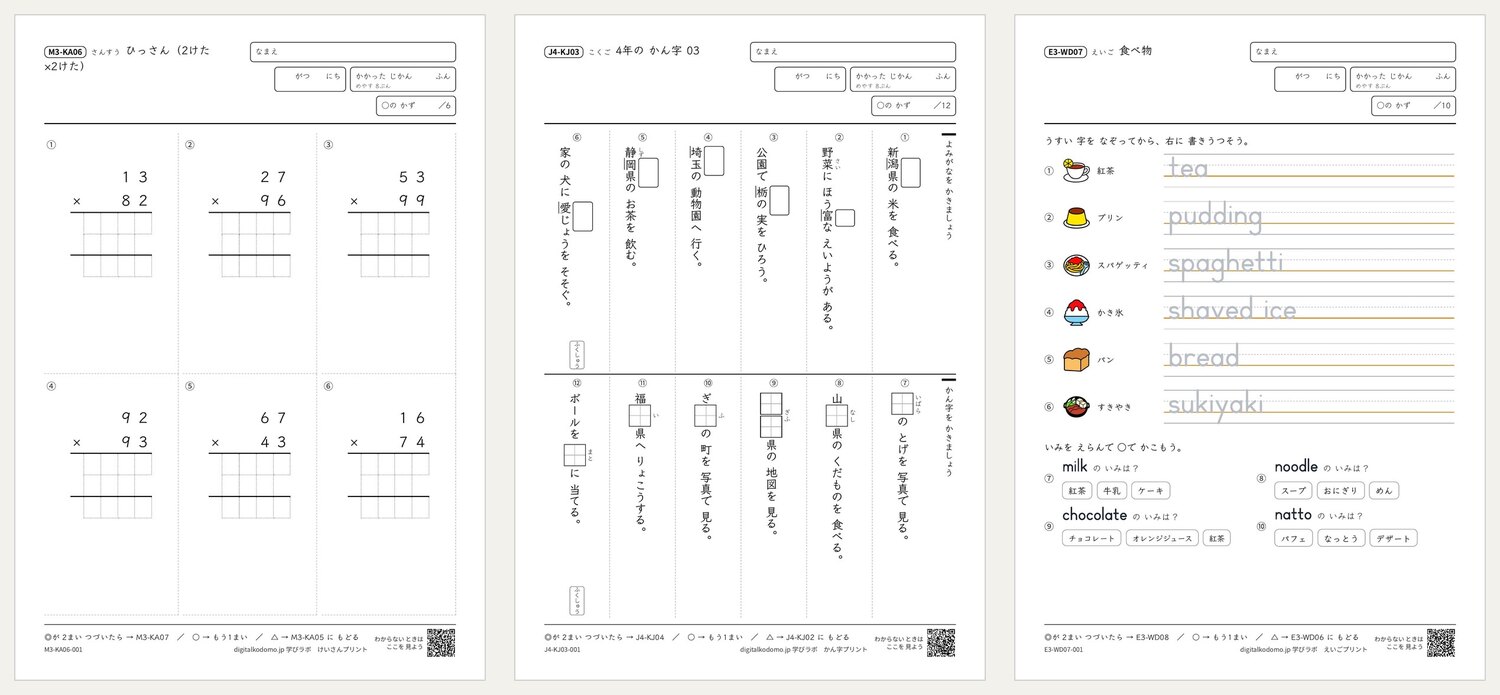
We have added “Mainichi Print” (Daily Worksheets), printable arithmetic, kanji and English worksheets for elementary school children, to Manabi Lab. There are 211 levels, each with 100 sheets: 21,100 sheets in all.
The published worksheets contain 234,000 problems in total. With every release, a program checks three times as many, about 700,000 problems.
Why did we, who have been making digital learning materials, make paper worksheets? And how did we make and check more than 20,000 of them? Today I want to share the story behind them.
Why paper, and why now
At Manabi Lab, we have been making digital materials free of charge: videos, diagrams you can move, and problems you can check on the spot. The elementary school section alone has 656 explanation videos.
Even so, I believe that elementary school children, especially in the lower grades, do well to hold a pencil and move their hands on paper. Practice in writing numbers and characters cannot be done well enough on a screen alone. Turning what children “understood” digitally into what they “can do,” by moving their hands on paper again and again: that is the role of Mainichi Print.
It is usually parents who choose and print the worksheets. So the explanations on the site are written for adults, using kanji, while the worksheets themselves use plenty of hiragana so that children can read them.
For junior high school students, we think digital materials are enough. If people ask us to make worksheets for them, we will.
Not only families but also nonprofit groups, such as schools, after-school care programs, children’s cafeterias and local study support programs, are free to print and hand them out.
What is a “different problem”?
Every level has sheets numbered 1 to 100. Each number has different problems, so children can repeat the same level as many times as they like without memorizing the answers. Opening the same number always gives the same problems.
The hard part was deciding what counts as a “different problem.”
Take “□ + 2 = 10” and “8 + □ = 10.” Only the position of the box differs; both are really 8 + 2 = 10. Before we fixed this, 94 of the 100 sheets in the “Make 10” level had pairs like this on the same sheet. In multiplication, too, 49 sheets had both “□ × 2 = 8” and “4 × □ = 8” on the same page.
So we made a rule: “Equations that differ only in where the box is count as the same equation, and only one may appear on a sheet,” and applied it to every arithmetic level. In subtraction, “10 − □ = 9” and “10 − 1 = □” are treated as the same equation as well.
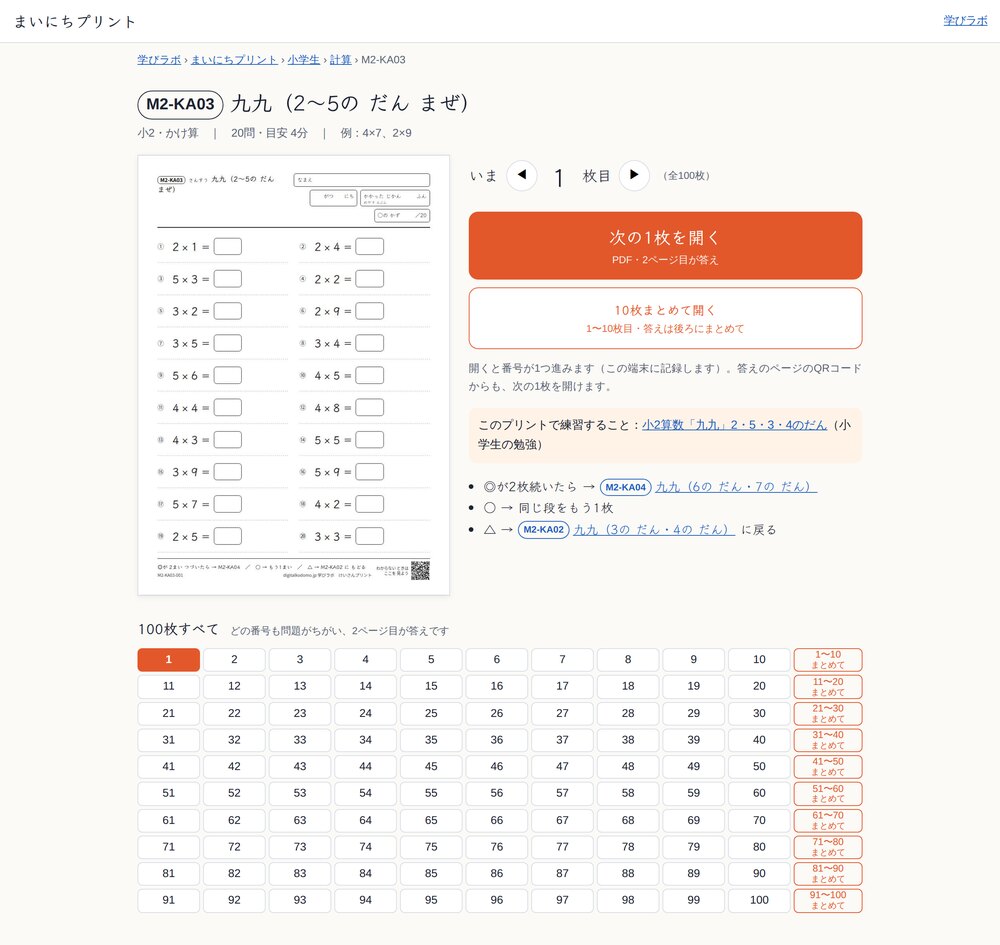
The levels are divided finely at the points where children tend to stumble, such as “Make 10” and “Addition with carrying.” At the bottom of each sheet it says: “Two ◎ in a row: go to the next level / ○: one more sheet / △: go back one level.”
On each level’s page, we lined up buttons numbered 1 to 100 so that the amount can be seen at a glance. Scanning the QR code on the answer page opens the next sheet.
A program that makes, and a program that checks
The problems and answers are made by a program. On top of that, we prepared a separate program used only for checking.
The checking side does not look at how the making side works. It rewrites the conditions from the words in the table of rules for each level (such as “with carrying” or “the remainder is smaller than the divisor”). If you make and check with the same mechanism, you miss things because of the same assumptions.
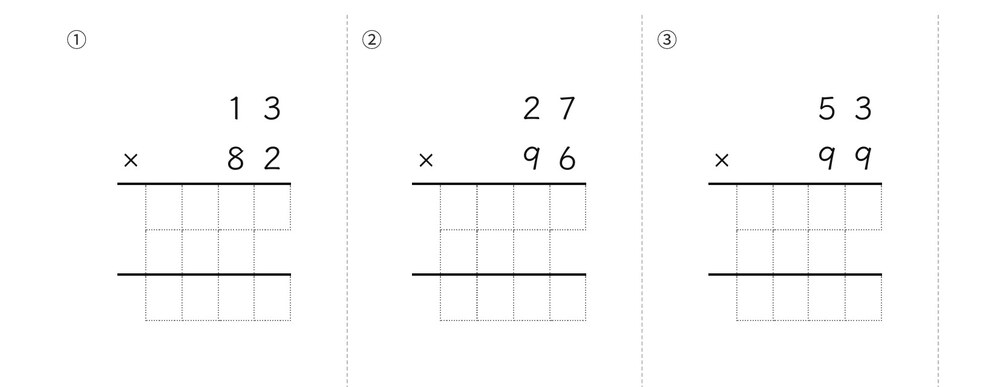
The published worksheets contain 234,000 problems across arithmetic, kanji and English. When checking, the program builds and examines three times as many, about 700,000 problems (702,000). Each level is generated not only for the published sheets 1 to 100 but up to sheet 300. Sheets beyond 100 exist only for checking and are not published.
There are two reasons for checking more than we publish. The first is so that rare mistakes do not slip through. Some overlaps between problems, or breaks in the rules, appear only very rarely. With too few sheets, they may never show up at all and go unnoticed. Checking three times as many sheets makes them that much easier to find. The “□ + 2 = 10” and “8 + □ = 10” overlap above was also counted across sheets 1 to 300. The second is in case someone asks for sheets beyond 100. By then, those problems will already have been checked.
The checks include:
- Whether each answer matches a value calculated again
- Whether the level’s conditions are followed
- Whether the same or nearly the same problem appears twice on one sheet
- Whether opening the same number gives the same problems
- Whether anything runs off the page
One more rule: AI does not decide the correct answers. AI is only a reviewer. Two separate AIs read samples from every level and picked out unnatural sentences and confusing answer choices. I listed what they found and decided on each item one by one.
Japanese is hard: “eight legs” and okurigana
One kanji problem has the sentence “たこの あしは 八ほん” (“An octopus has eight legs”). An AI reviewer asked whether 八 (eight) here should be read “hachi” or “happ.”
My answer: “We say ‘happon,’ but never ‘happhon.’ So if it is written ‘八ほん,’ the only possible reading is ‘hachi.’” We kept the problem as it was.
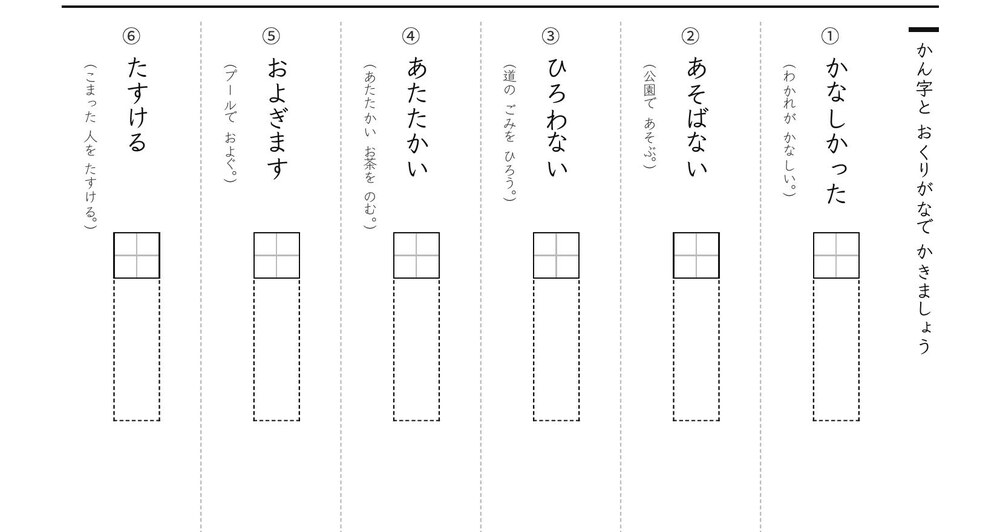
In problems that ask children to write okurigana (the kana that follow a kanji), some words had two correct answers. あう (au) can be 会う (meet) or 合う (fit); はやい (hayai) can be 速い (fast) or 早い (early); あつい (atsui) can be 熱い (hot to the touch) or 暑い (hot weather); はかる (hakaru) can be 測る or 計る (measure).
The first idea was to show the kanji to use in small print. But that would give the answer away. So I asked, “Couldn’t we do it with the flow of a sentence? Like meeting a person,” and we decided to add a short sentence showing how the word is used, such as “(ともだちに あう。)” (“meet a friend”).
We added these sentences to 131 words. A program checks that the answer kanji does not appear in the sentence, and that any kanji left in the sentence are only those learned by that grade. The readings in these sentences are not decided by AI either.
In multiple-choice problems, we made sure that spellings that cannot be called outright wrong, such as 変る, are not used as wrong choices.
In English, meeting the same word again and again
The English words are those in grade 3–6 English workbooks and in the Ministry of Education’s sample annual teaching plans: 1,037 words in all.
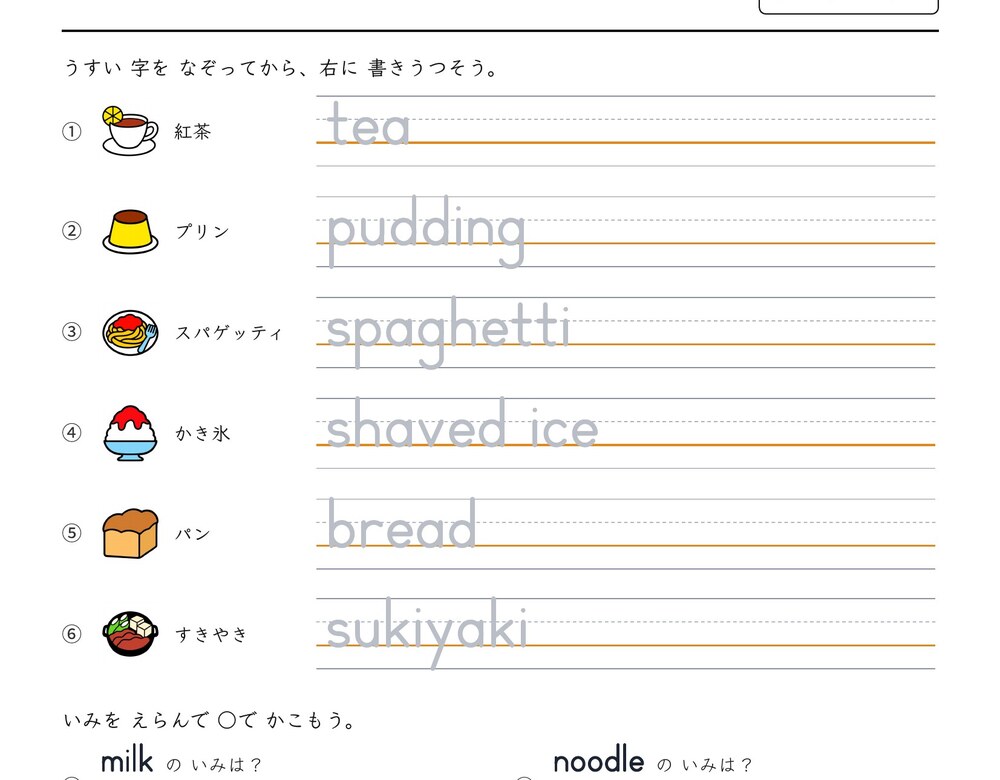
At first, the words were grouped into a small number of levels for each grade. But children remember a word better when they see it many times. With that in mind, I asked for more levels, and the English vocabulary levels were divided again into 42. Each level has 15 to 38 words, most of them 20 to 30. With fewer words per level, children meet the same words many times across the 100 sheets.
We left the kanji levels as they were, because they were already built to repeat each grade’s characters.
In multiple-choice problems, we avoid placing words with the same meaning, or confusing pairs (such as school trip and field trip), side by side. We kept 63 such pairs apart.
Pictures for 699 English words
We added color pictures to 699 of the 1,037 words. Numbers, days of the week, telling time, actions and states that are hard to draw, and set phrases have no pictures. Forcing a picture onto them would only confuse children.
The pictures are drawn simply so that they can be understood even if a home printer prints faintly. When I saw the finished pictures, I could not help replying, “The pictures are perfect!”
One sheet a day, at home
One sheet a day at home, not too hard and not too easy: that is our main aim. If you find a mistake, please let us know through Manabi Lab’s report form. We will check and fix it.
Mainichi Print: https://digitalkodomo.jp/kids-study/drill/ (in Japanese)
Press release: 21,100 Free Printable Worksheets for Elementary Arithmetic, Kanji and English: “Mainichi Print” (Daily Worksheets)
*
Digital Kodomo BASE is a nonprofit that teaches children computers, AI and programming free of charge. We want to support children’s learning by using the strengths of both digital and paper. If you would like to help us keep going, please consider supporting us with a donation.