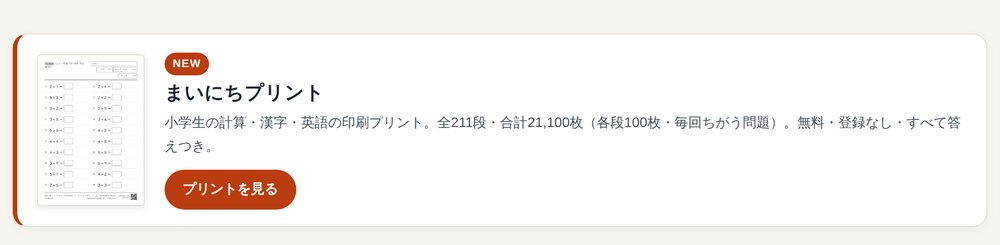
NPO Digital Kodomo BASE (Ota City, Tokyo; Chairperson: Tomoyuki Urushidani) has published “Mainichi Print” (daily worksheets), a collection of printable worksheets for elementary school children, on its free learning site, Digital Kodomo BASE Manabi Lab. Arithmetic, kanji and English for grades 1 through 6 are divided into 211 “levels” from easiest to hardest, and every level has 100 worksheets with different problems: 21,100 sheets in total. Every sheet includes an answer page and can be printed on A4 paper right away. It is free and requires no sign-up.
The site itself is in Japanese.
* Figures as of November 23, 2026.
Background
Through its learning site Manabi Lab, the organization has offered free digital learning materials such as videos, interactive diagrams and practice problems that can be checked on the spot. In November 2026 it also published “Elementary School Study” for grades 1–6, with 656 explainer videos.
At the same time, the organization believes it is important for elementary school children, especially in the lower grades, to hold a pencil and write by hand on paper. Practice in writing numbers and characters cannot be done well on a screen alone. “Mainichi Print” was created so that children can take what they understood with the digital materials and make it their own by writing it out on paper again and again, one sheet a day at home.
The worksheets are designed around doing problems of just the right difficulty, a little every day. Problems that are too hard sap motivation, and problems that are too easy do not build skill. The material is therefore divided into small levels in learning order: after a run of perfect scores, children move on to the next level, and if they make many mistakes they go back one level. For parents who are not sure where to start, a single “Where to start?” sheet shows the right level for their child.
Overview
| Name | Digital Kodomo BASE Manabi Lab “Mainichi Print” |
|---|---|
| URL | https://digitalkodomo.jp/kids-study/drill/ |
| For | Elementary school grades 1–6 (and their parents) |
| Contents | Arithmetic (grades 1–6), 78 levels: addition, subtraction, multiplication, division, decimals, fractions, order of operations, mixed calculations, and “Where to start?” (grades 1–3) Kanji (grades 1–6), 87 levels: reading and writing the kanji for each grade (1,026 characters), okurigana, look-alike characters English (grades 3–6), 46 levels: the alphabet (capital and small letters), English words (1,037 words) |
| Format | A4 PDF. The second page of each sheet is the answer page. Ten sheets can also be opened at once. |
| Fee | Free, no sign-up |
| Printing and distribution | Besides home use, non-profit organizations (schools, after-school childcare, children's cafeterias, community learning support and so on) may print and distribute the worksheets freely. |
Screens and Worksheets
Key Features
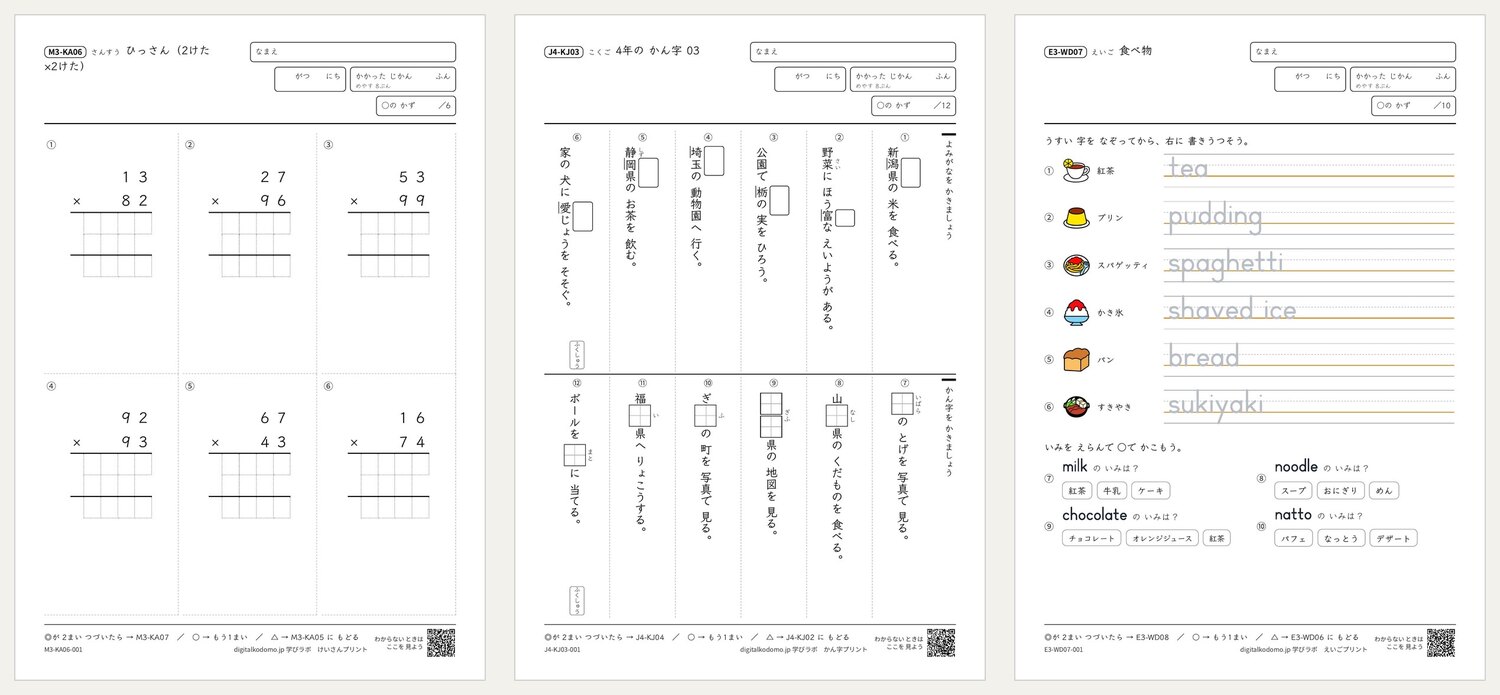
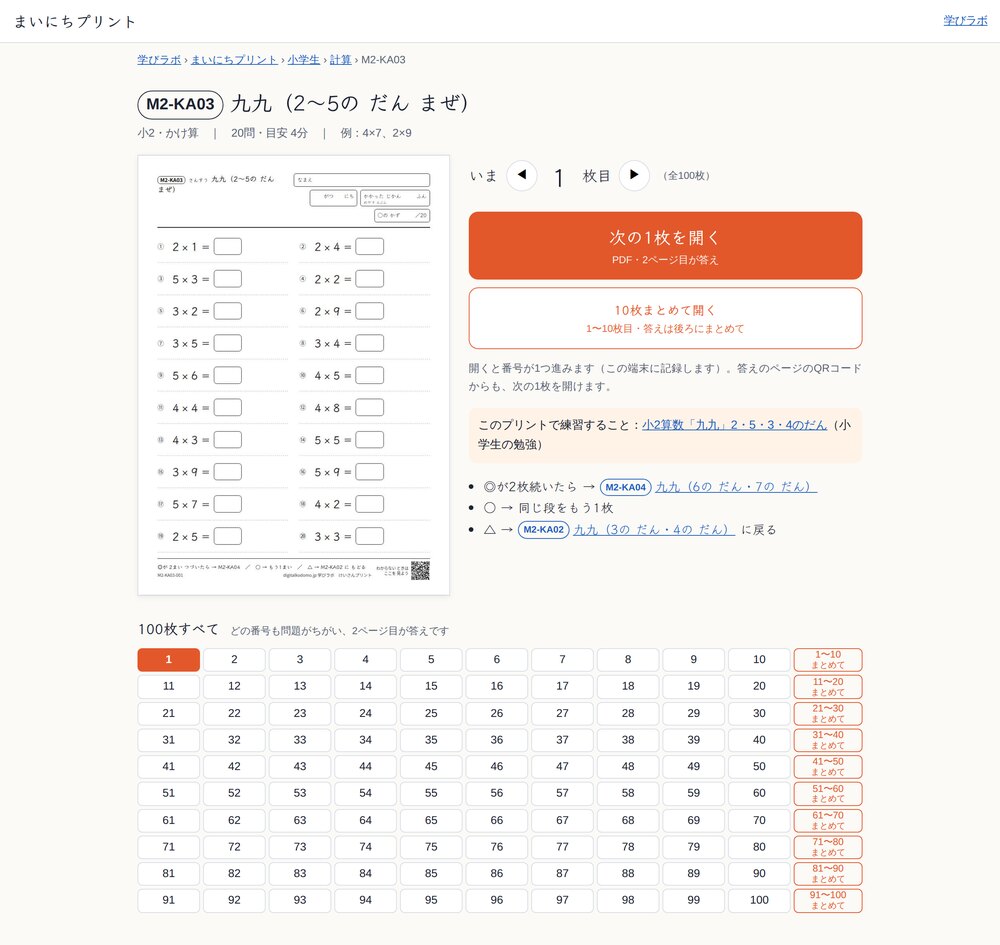
- 100 sheets at every level, with different problems each timeEach of the 211 levels has worksheets numbered 1 to 100. Because the problems differ for every number, children cannot simply memorize the answers, however many times they repeat a level. The level page lists the numbers 1 to 100, so any sheet can be opened.
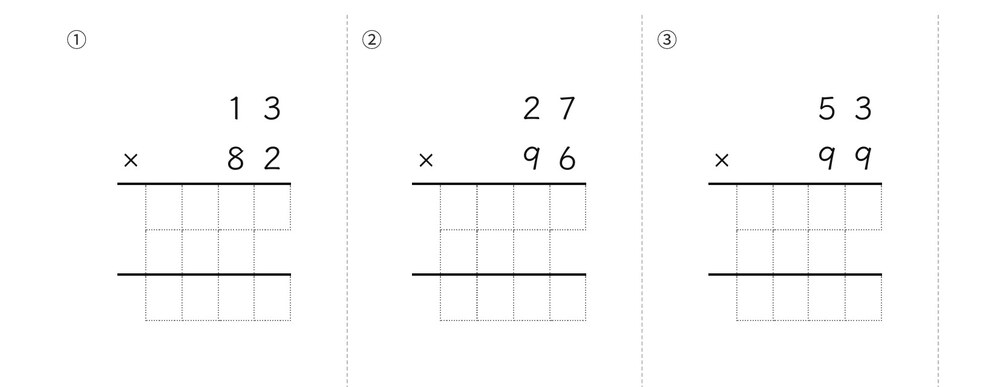
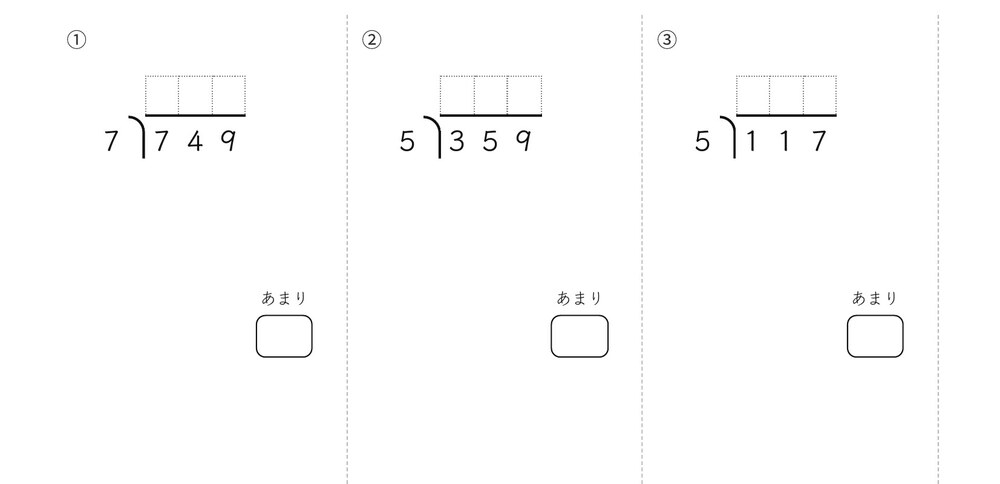
- Just the right difficulty, one small step at a timeArithmetic is divided into levels at each common stumbling point, such as “making 10” and “addition with carrying.” The bottom of each sheet says “two ◎ in a row: next level / ○: one more sheet / △: back one level,” so children can progress at their own pace.
- From the answer page to the next sheetEach answer page has a QR code; scanning it with a smartphone opens the next numbered sheet, making it easy to keep going every day.
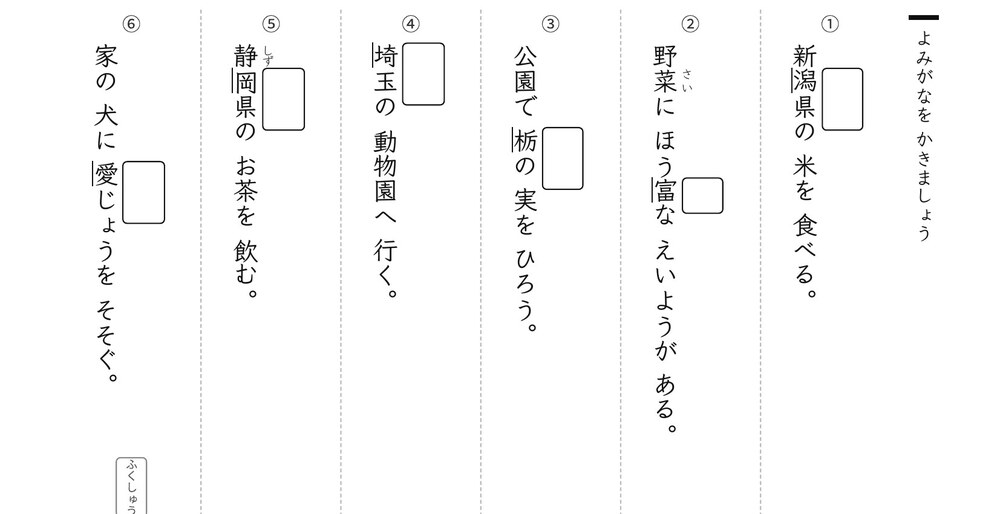
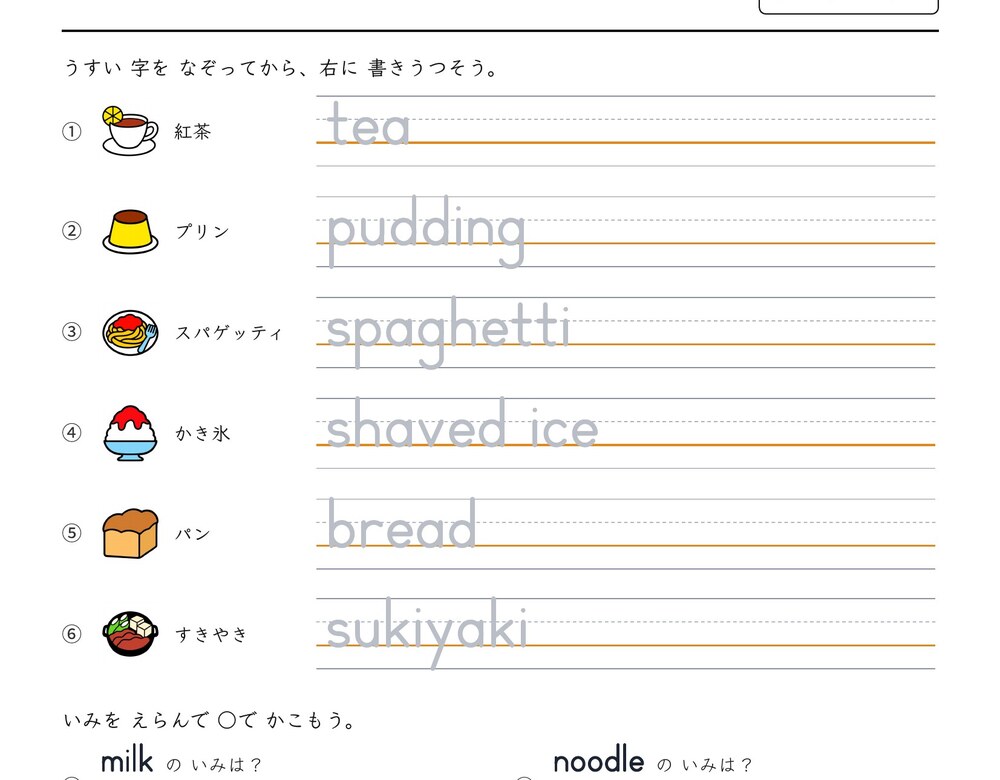
- All 1,026 elementary school kanji, and 1,037 English words with picturesKanji worksheets practice reading, writing and okurigana grade by grade. Okurigana problems include a usage example such as “(ともだちに あう。)” so that children do not confuse characters with the same reading. For English, color pictures were added to 699 of the words taught in grades 3–6. The pictures are drawn simply so that they remain clear even when printing quality is poor.
- Linked to Manabi Lab's explanationsEach level page links to the matching unit in “Elementary School Study.” If children get stuck on a worksheet, they can review it with videos and diagrams.
How the Content Is Checked
Arithmetic problems and answers are generated by a program, and a separate program checks every problem. The published worksheets contain 234,000 problems in total. With every release, three times as many, about 700,000 problems (702,000), are built and checked inside the program: each level is generated not only for the published sheets 1–100 but up to sheet 300, and sheets beyond 100 exist only for checking and are not published. Checking more than is published makes rare overlaps and rule violations less likely to slip through, and means that sheets beyond 100 are already checked if they are ever needed. Kanji readings and example sentences, and the meanings of English words, are copied from materials already checked for Manabi Lab's “Elementary School Study.” The English words are those in grade 3–6 English workbooks and in the Ministry of Education's sample annual teaching plans. Meanings follow the workbooks' wording; for words without a meaning in the workbooks, two AIs and a staff member checked them. Two separate AIs also reviewed the problems to find confusing choices and unnatural sentences, which were then fixed. AI is not used to decide the correct answers. All of the English pictures have been checked by a person.
For Parents
If you find a mistake, please let us know through Manabi Lab's report form. We will check and fix it.
Roadmap / What's Next
Junior high school students can study with digital materials in Manabi Lab's “Junior High School Study” (more than 2,500 pages of explanations and practice problems). Printable worksheets for junior high school will be considered based on users' requests. The elementary worksheets will continue to be improved based on reports received and how they are used.
About the Organization
- Name
- NPO Digital Kodomo BASE (特定非営利活動法人デジタルこどもBASE)
- Address
- 3-3-3 Chuo, Ota-ku, Tokyo, Japan
- Representative
- Tomoyuki Urushidani, Chairperson
- Founded
- Activities began in 2024 / Incorporated as an NPO in April 2026
- Corporate Number
- 5010805003266
- Activities
- Free computer, AI and programming education for children; PC distribution; after-school labs; operation of learning websites; certification exams
- URL
- https://digitalkodomo.jp/
Media Contact
NPO Digital Kodomo BASE, Public Relations
E-mail: admin@digitalkodomo.jp
Mainichi Print: https://digitalkodomo.jp/kids-study/drill/
Manabi Lab: https://digitalkodomo.jp/kids-study/
Website: https://digitalkodomo.jp/