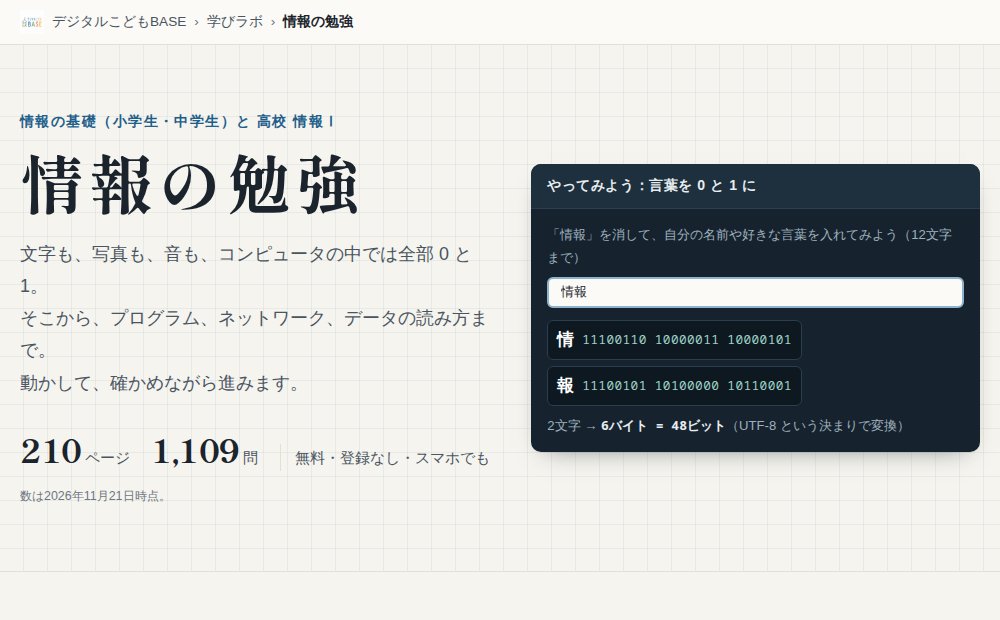
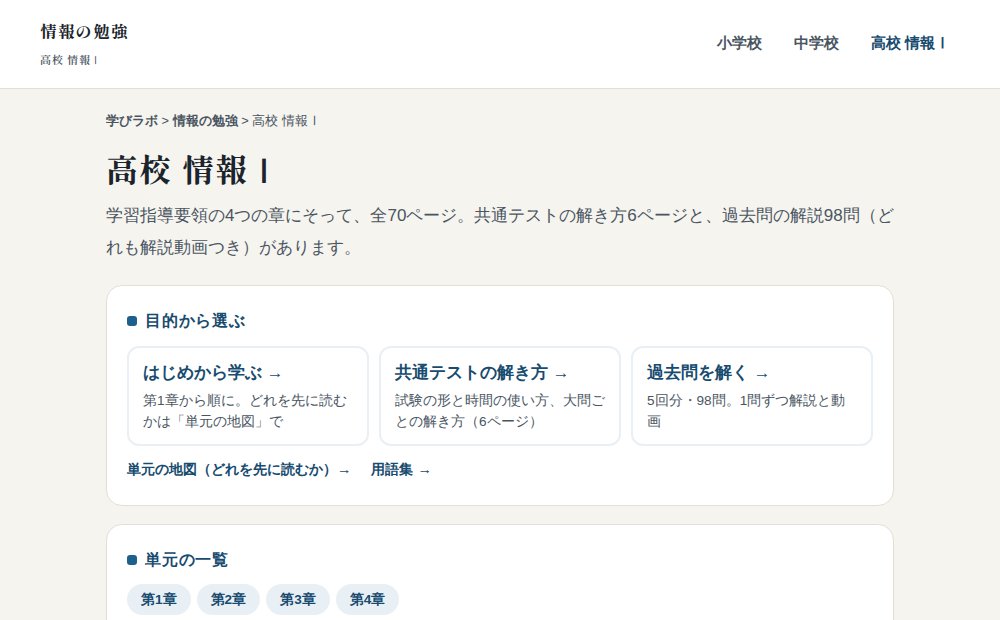
NPO Digital Kodomo BASE (Ota City, Tokyo; Chairperson: Tomoyuki Urushidani) has published every unit of high school Informatics I in “Informatics Study” on its free learning site, Digital Kodomo BASE Manabi Lab. In addition to 70 pages following the four chapters of Japan's national curriculum guidelines, the site offers 6 pages on how to approach the University Entrance Common Test and explanations of 98 past Common Test questions. Every past-question explanation comes with an explainer video.
The organization has also published 30 “Informatics Basics” units for grades 4 through 9 (150 explainer videos). From elementary school through junior high, high school Informatics I and the Common Test, everything is free, requires no sign-up, and works on smartphones.
The site itself is in Japanese.
* Figures as of November 21, 2026.
Background
“Informatics I” became a required subject for all students entering high school in Japan from April 2022. Since the University Entrance Common Test of January 2025, it has also been one of the subjects on the test.
The Common Test in Informatics I lasts 60 minutes, is worth 100 points, and has four main questions. Programming questions are written not in a language such as Python but in a Japanese-based notation defined by the National Center for University Entrance Examinations (the “Common Test program notation”). In all four tests held so far (the main and supplementary tests of 2025 and 2026), Question 3 (programming) and Question 4 (data analysis) together accounted for 50 of the 100 points. Because the subject is new, there are only four sets of actual past tests: the main and supplementary tests of 2025 and 2026. This site explains five sets: those four plus the official prototype test.
Teaching computers, AI and programming to children free of charge is at the core of the organization's work. Its Chairperson is an IT engineer who has worked in networking for nearly 30 years, and informatics is a field the organization places particular emphasis on. The site was built so that children who do not attend cram school, or who are not attending school, can still work through Informatics I and the Common Test on their own at home — with the aim of leaving fewer children stuck.
Informatics I does not start out of nowhere in high school. It builds on the programming children learn in elementary school and on the “information technology” part of junior high Technology and Home Economics. For that reason, the organization also created “Informatics Basics” from grade 4, so that everything connects in a single line.
Overview
| Name | Digital Kodomo BASE Manabi Lab “Informatics Study” |
|---|---|
| URL | https://digitalkodomo.jp/kids-study/jyouhou/ |
| High school Informatics I | https://digitalkodomo.jp/kids-study/jyouhou/koukou/ |
| Informatics Basics | Elementary: https://digitalkodomo.jp/kids-study/jyouhou/shougaku/ Junior high: https://digitalkodomo.jp/kids-study/jyouhou/chuugaku/ |
| For | Grade 4 through high school, Common Test takers (and their parents) |
| Fee | Free, no registration (works on smartphones) |
| Content | Grades | Count | Videos |
|---|---|---|---|
| Informatics Basics (elementary) | 4–6 | 13 units | 65 |
| Informatics Basics (junior high) | 7–9 | 17 units | 85 |
| Informatics I (units) | High school | 70 pages | — |
| How to approach the Common Test | High school | 6 pages | 9 |
| Past Common Test questions | High school | 98 questions | 98 |
| Total | Grade 4 – high school | — | 257 |
Screens and Videos
Key Features
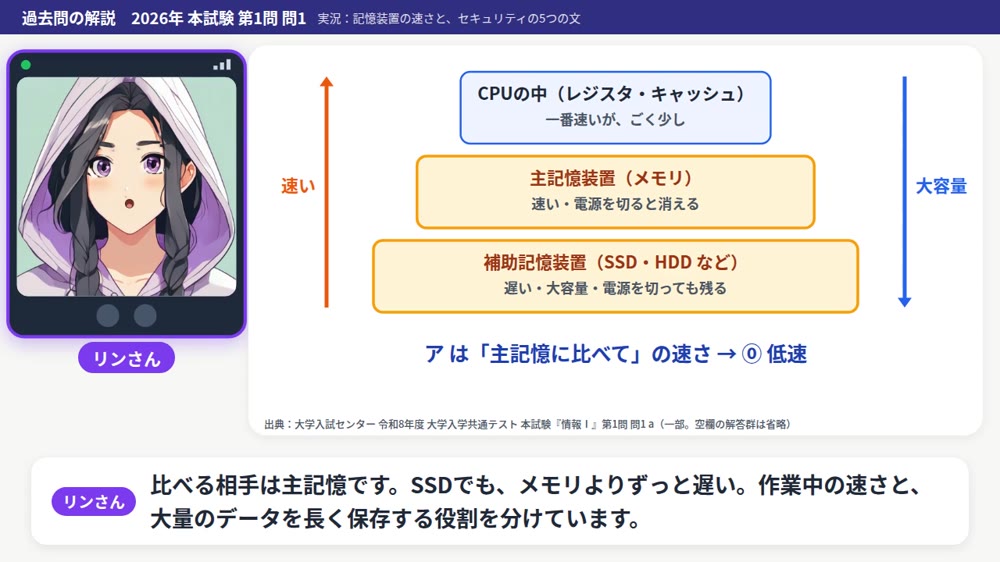
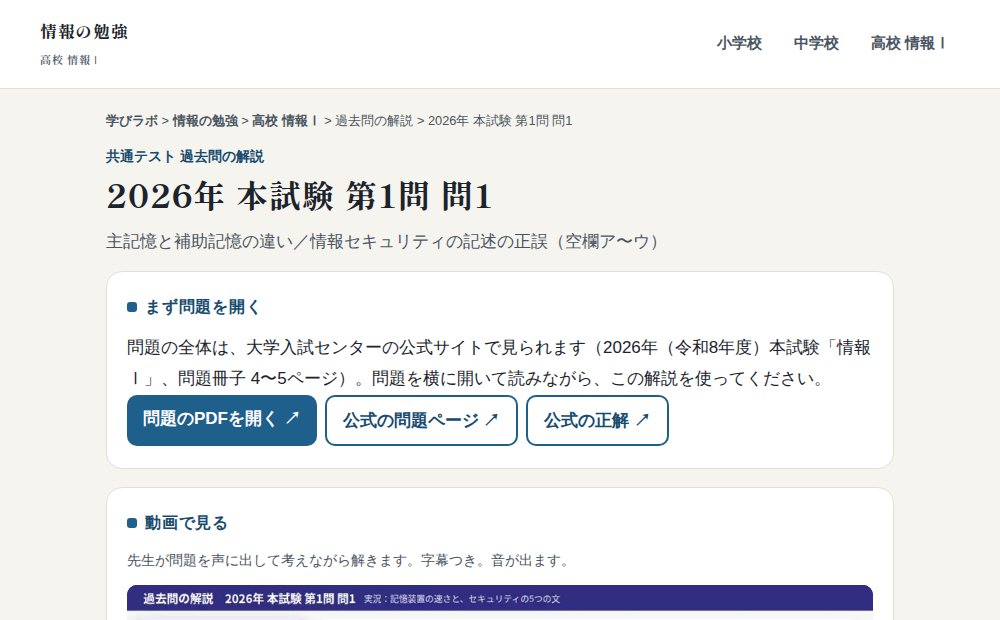
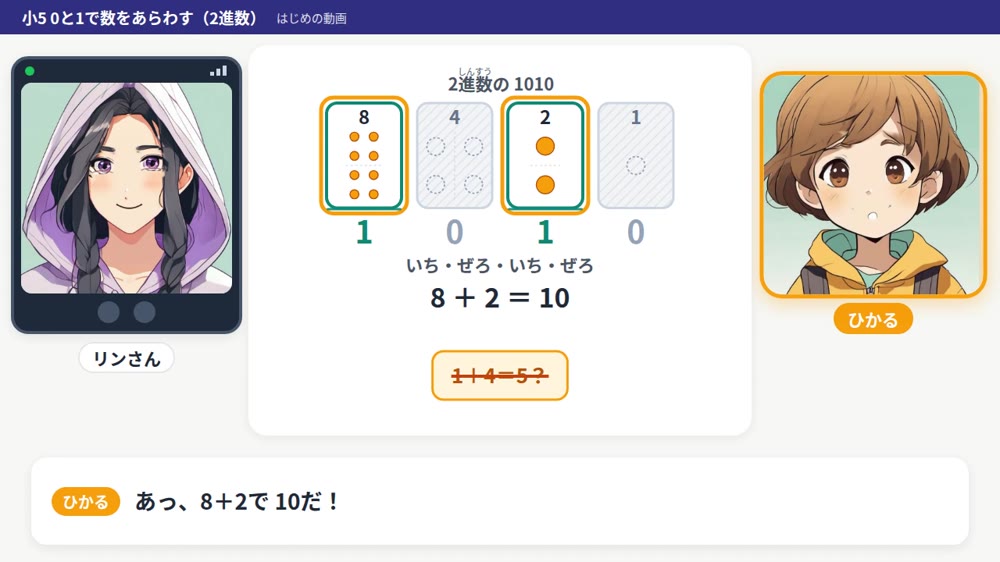
- All 98 past Common Test questions, explained one by one on videoThe site explains, question by question, five sets: the main and supplementary tests of 2026 and 2025, and the prototype test. In each video, the teacher character “Rin” reads the problem aloud and talks through where to look and how to think, step by step. Subtitles are included.
The problems themselves are not reproduced on the site; students open the official PDF from the National Center for University Entrance Examinations alongside the explanation. Where the explanation quotes the problem text, it quotes only the part needed, with the source stated. - 70 pages following the four chapters of the curriculumThe four chapters are “Problem Solving in the Information Society” (14 pages), “Communication and Information Design” (16 pages), “Computers and Programming” (20 pages), and “Information Networks and Using Data” (20 pages). Units that have appeared on every Common Test are marked. A “unit map” shows which pages to read first, and there is a glossary.
- Run Common Test programs line by line on screenCommon Test programs use the National Center's own notation. Programs written in that notation can be run line by line on screen. There is also a quick-reference sheet for the notation, and “How to Approach the Common Test” (6 pages, 9 videos) covering the test format, time management, and how to tackle each main question.
- 30 “Informatics Basics” units for grades 4–9 — move it first, then put it into wordsThere are 30 units from grade 4 through grade 9 (1 in grade 4, 9 in grade 5, 3 in grade 6, 6 in grade 7, 7 in grade 8, 4 in grade 9). Each unit follows the order “try it → explanation → worked example → practice → challenge”: students first move a diagram on screen, then confirm the idea in words. Practice questions are checked on the spot. Each unit has five videos, and every page can be read aloud.
- One line from elementary school to the Common TestThe content runs from “Informatics Basics” in elementary school, through the junior high “information technology” content, to high school Informatics I. If something on a high school page is unclear, a “go back here if you got stuck” link leads to Manabi Lab's junior high math, elementary math, or Informatics Basics units.
How the Content Is Checked
The content is based on the national curriculum guidelines of the Ministry of Education. Answers in the past-question explanations are checked against the official answers published by the National Center for University Entrance Examinations. Every page has a “found a mistake?” report form, and reports are reviewed and corrected.
What's Next
The organization will keep improving the explanations, questions and videos based on reports and how the site is used.
About the Organization
- Name
- NPO Digital Kodomo BASE (特定非営利活動法人デジタルこどもBASE)
- Address
- 3-3-3 Chuo, Ota-ku, Tokyo, Japan
- Representative
- Tomoyuki Urushidani, Chairperson
- Founded
- Activities began in 2024 / Incorporated as an NPO in April 2026
- Corporate Number
- 5010805003266
- Activities
- Free computer, AI and programming education for children; PC distribution; after-school labs; operation of learning websites; certification exams
- URL
- https://digitalkodomo.jp/
Media Contact
NPO Digital Kodomo BASE, Public Relations
E-mail: admin@digitalkodomo.jp
Informatics Study: https://digitalkodomo.jp/kids-study/jyouhou/
Manabi Lab: https://digitalkodomo.jp/kids-study/
Website: https://digitalkodomo.jp/