When a child starts to resist going to school, what should a parent do first? Talking to the homeroom teacher comes to mind. But after that, many don't know where to turn.
Through our activities, including Furatto Lab, I have heard this from parents of children who find it hard to go to school: "I just can't find information on where to get help or what support there is." Behind those words was real anxiety about not being able to find it.
The information exists, but it's hard to find
When you look into it, the information itself is not missing. The national government, prefectures, and cities, towns, and villages all publish information on counseling services and support.
The problem is that it is scattered in many places. The board of education's counseling service, educational support centers, child and family departments, developmental consultation offices. Help is spread across several departments, and the names and systems differ from one municipality to the next.
When your mind is full of worry about your child, opening one government website after another and working out which office applies to your family is far harder than it sounds. Not finding the information is not a sign that parents aren't trying hard enough.
From Ota City, to Tokyo's 23 wards, to all of Japan
So we decided to build a guide that gathers these resources area by area.
At first, I only meant to cover our home, Ota City. I planned to publish once the Ota City page was done.
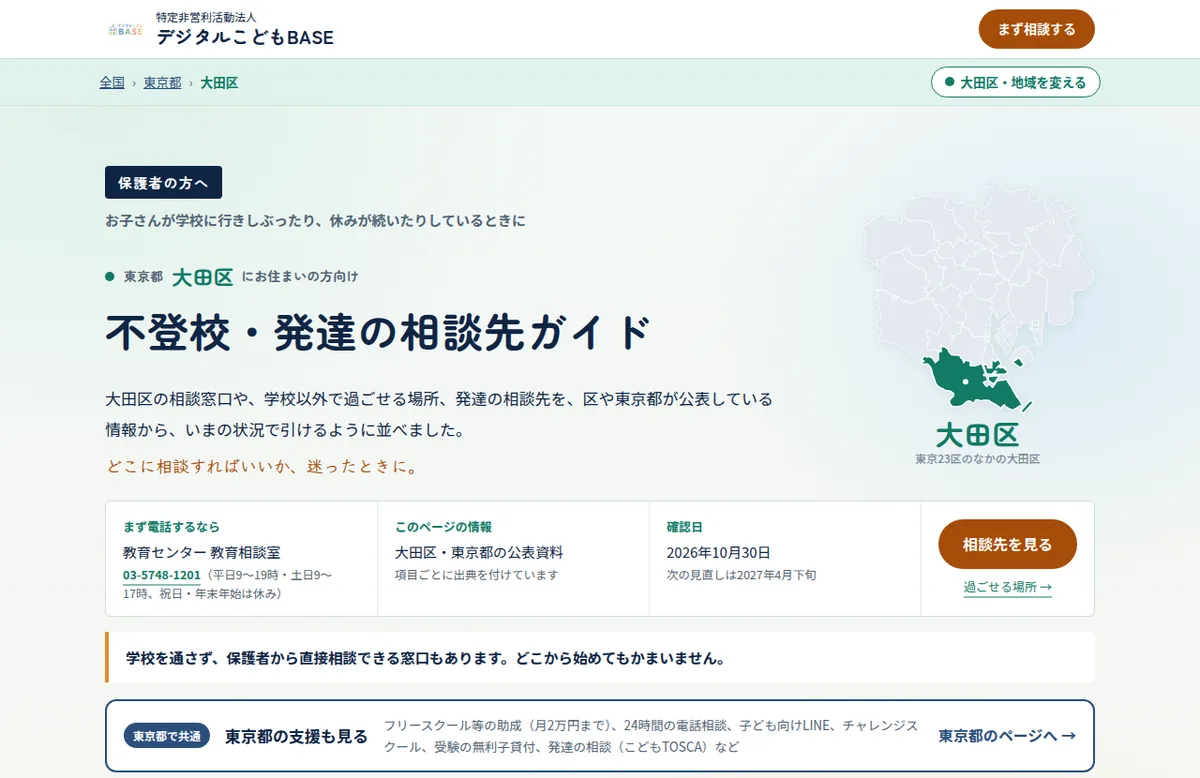
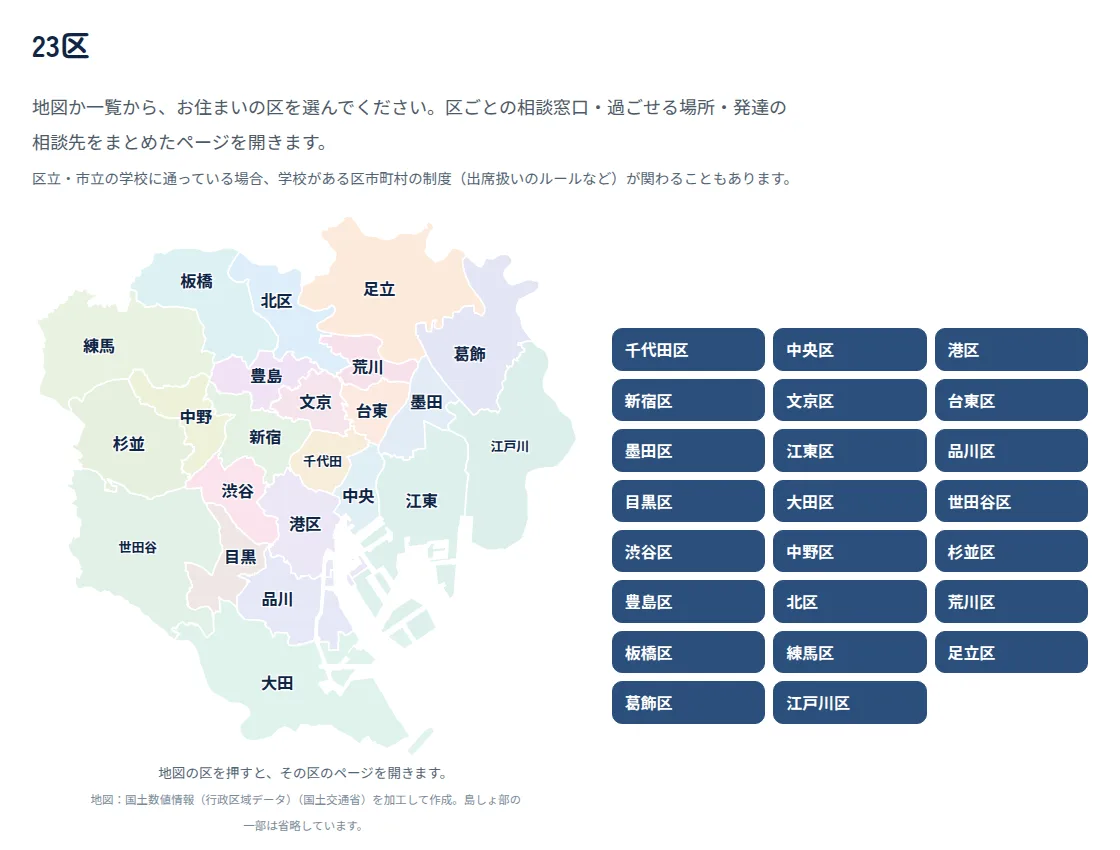
But lately we had been getting more inquiries from other wards. So we expanded to all 23 wards of Tokyo. On the 23-ward page, you can also compare wards’ systems side by side under the same headings, such as educational support centers, attendance recognition guidelines and subsidies for free schools.
Having come this far, why not cover the whole country? Looking back, that was a casual decision. Japan has more than 1,700 municipalities. Each has its own website layout and its own names for its offices, so the only way was to check them one by one. It took far longer than I imagined.
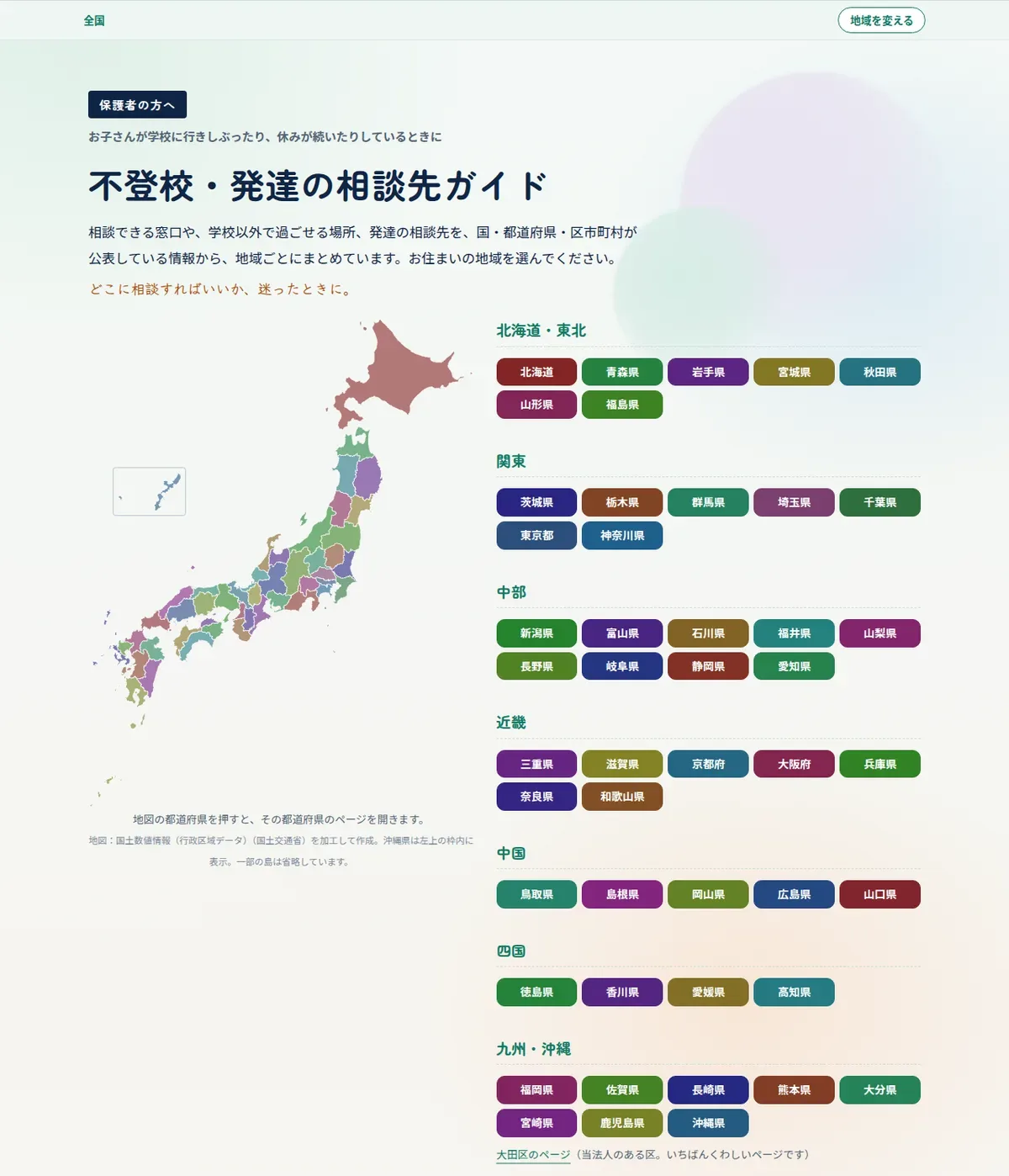
The result is the Guide to Consultation Services for School Absence and Development (in Japanese). It has pages for all 47 prefectures and more than 1,700 municipalities. Choose your area, and you will see where to consult first, places to spend time outside school, developmental support, attendance recognition, financial assistance and more, by category.
It covers more than school absence. Child and family support centers where you can talk about parenting and home life, developmental support, parent groups, information on next steps after school: the guide gathers a wide range of support for children and families, area by area.
We set two rules when building it. First, list only information published by the national and local governments. Each item shows its source and the date it was checked, so you can trace the original material. Second, stay neutral. The guide does not introduce or compare individual private facilities, and our own programs are not listed among each area's resources.
Pages children can read themselves
We also cared about pages that children can read on their own.
School, home, friends. Some things are hard to tell the adults around you. For those times, there are people who will listen by phone, chat, or LINE. On the children's pages, kids can find services through entry points like "I want to talk right now" or "Things at home are hard." Kanji are shown with furigana readings.
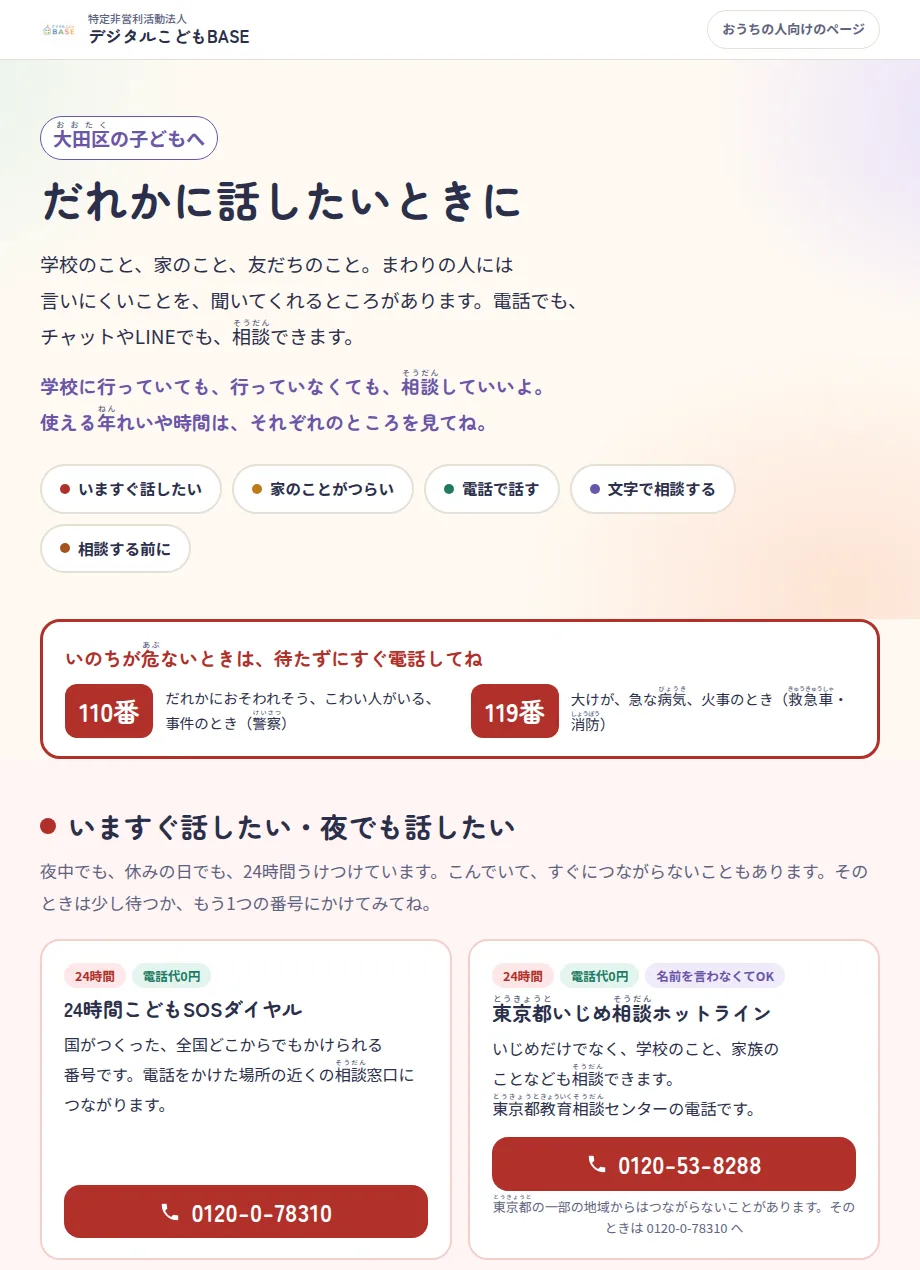
Adults are not the only ones looking for help. That is why we made them.
A book I recommend to parents
On the guide’s top page, I also introduce one book that I found very good.
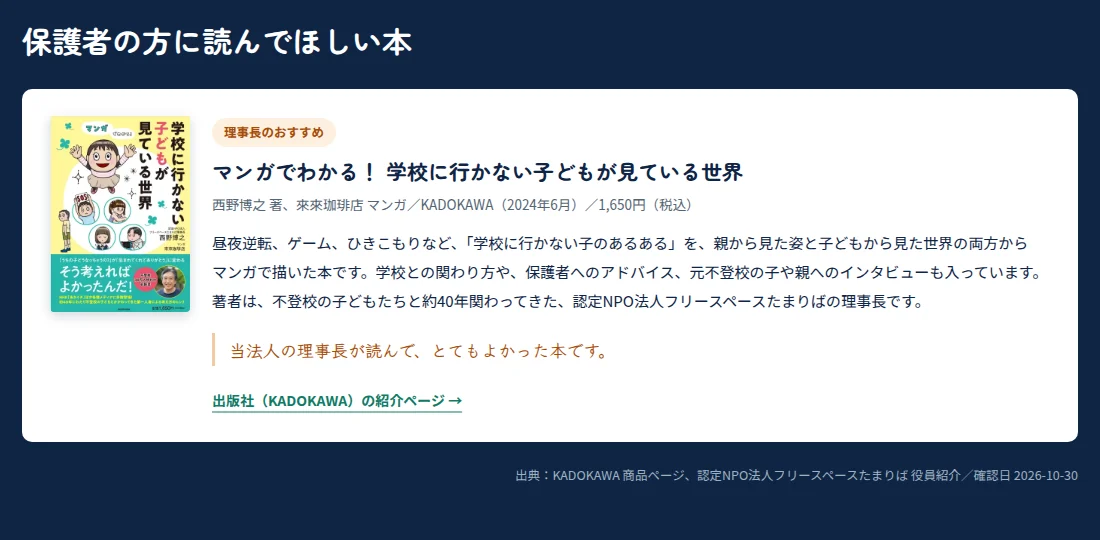
Manga de Wakaru! Gakko ni Ikanai Kodomo ga Mite Iru Sekai (The World Seen by Children Who Don’t Go to School, Explained in Manga), by Hiroyuki Nishino, manga by Rairai Coffee-ten (KADOKAWA, in Japanese).
In manga form, it shows common situations with children who don’t go to school, such as day-night reversal, games and staying shut in, both as parents see them and as children experience them. The author is the chair of the certified NPO Free Space Tamariba and has worked with children who don’t go to school for about 40 years. The manga itself has a lot of charm, too.
For the first step
This guide will not solve everything. Still, I hope it can shorten the time parents spend stuck at "I don't know where to ask."
Phone numbers and hours may change. Please check the latest information with each local government.
Guide to Consultation Services for School Absence and Development: https://digitalkodomo.jp/futoko/
Press release: https://digitalkodomo.jp/news/2026-11-02-futoko-guide-launch_en.html
*
Digital Kodomo BASE runs Furatto Lab, a monthly program in Ota City, Tokyo, for elementary and junior high school students who find it hard to go to school. It is free, and we provide a computer for every child. The next session is Monday, November 16, from 1 p.m.