Open a high school guidebook in Japan, and the first thing you see is the deviation score. Then university placement records, clubs, uniforms. All of it matters, but what parents of children who find school hard really want to know is usually not there.
If a child missed a lot of junior high, how will that be treated in the entrance exam? Is there somewhere to rest on days they cannot go into the classroom? Can they ask for reading and writing accommodations during the exam?
Recently, we have been getting more consultations about junior high school students who do not attend school or have developmental disabilities. What both have in common is the question of what to do about high school. When I heard that finding a high school with accommodations was hard, I decided to put the information together.
The more detail we wrote, the harder it was to find anything
After launching the “Consultation Guide for Non-Attendance and Development,” which lists support services nationwide, the next thing we took on was this High School Finder. The first prototype was for our home, Tokyo, letting parents search high schools by “support for non-attendance and developmental disabilities.”
To be honest, the first prototype was hard to use. Cards for about 460 Tokyo high schools were filled with long quotations from school documents and notes saying “not mentioned.” The more carefully we wrote, trying to avoid any mistake, the harder it became for parents to find what they needed.
So we changed course. We are not making a dictionary. Fine print went into one place, each school’s description became short, and parents can now narrow down by conditions. “Mornings are hard (want to attend from the afternoon or evening).” “Cannot attend every day.” “A separate room when entering the classroom is hard.” Families can search by the things they actually worry about.
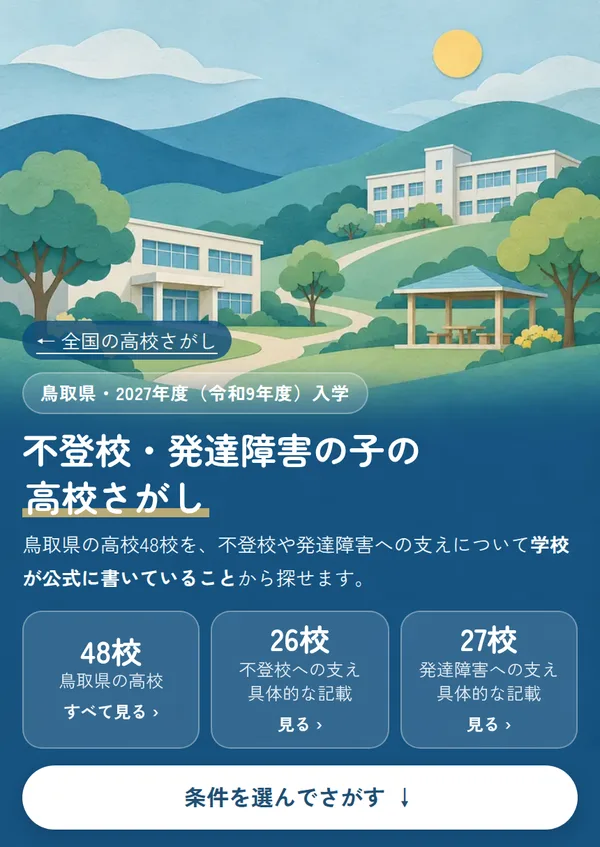
There was one more thing I kept reminding myself. This is a site for children who do not attend school and children with developmental disabilities. Trying to cover everything pulls you toward an ordinary exam guide. No deviation scores, no placement records, no clubs. What we include is how absences are treated, exam accommodations, support after enrollment, and how easy the school is to attend. We decided what to include by whether it helps those children.
Other sites are only leads
Everything about schools on the site was confirmed in official school, prefectural or national documents.
Search online and you will find many sites comparing correspondence high schools and others. They can be useful, but often give no sources or are out of date. One site we checked was missing two of Tokyo’s seven “Challenge Schools.”
So we used information from other sites only as leads. If we found it in a school’s official documents, we listed it with the source. If not, we left it out. We never write “according to another site.” It is unglamorous, but this was the one thing we would not compromise on.
So different from prefecture to prefecture
We first published the detailed Tokyo edition and the national page, then added detailed editions one prefecture at a time. Public and private schools, campuses of correspondence schools approved in other prefectures: reading every school’s documents one by one. An overwhelming amount.
What surprised me, going prefecture by prefecture, was that the treatment of absences is completely different depending on the prefecture.
In Fukui, the attendance section has been removed from the documents submitted for prefectural high school entrance exams, and attendance is explained as not being evaluated. In Hokkaido’s prefectural high school exams, attendance records in the school report are not used for selection. In Tottori, students who were absent in principle 50 days or more in the third year of junior high, among others, can submit a “self-report” describing why they could not go to school and what they want to learn in high school. In Kyoto, four prefectural schools, Suzaku, Otokuni, Joyo and Nishi-Maizuru (full-time general course), have a special admission route for students absent 30 or more days in any year of junior high. In Miyagi, the prefectural Hirose ideal High School opens in April 2027, aiming to welcome students who want to learn at their own pace, including those who struggle with group life or feel anxious about relationships.
Move to the next prefecture, and the exam rules change. That is how big the differences are. Whether you know your prefecture’s system can change the paths open to your child.
Until all 47 prefectures were in place
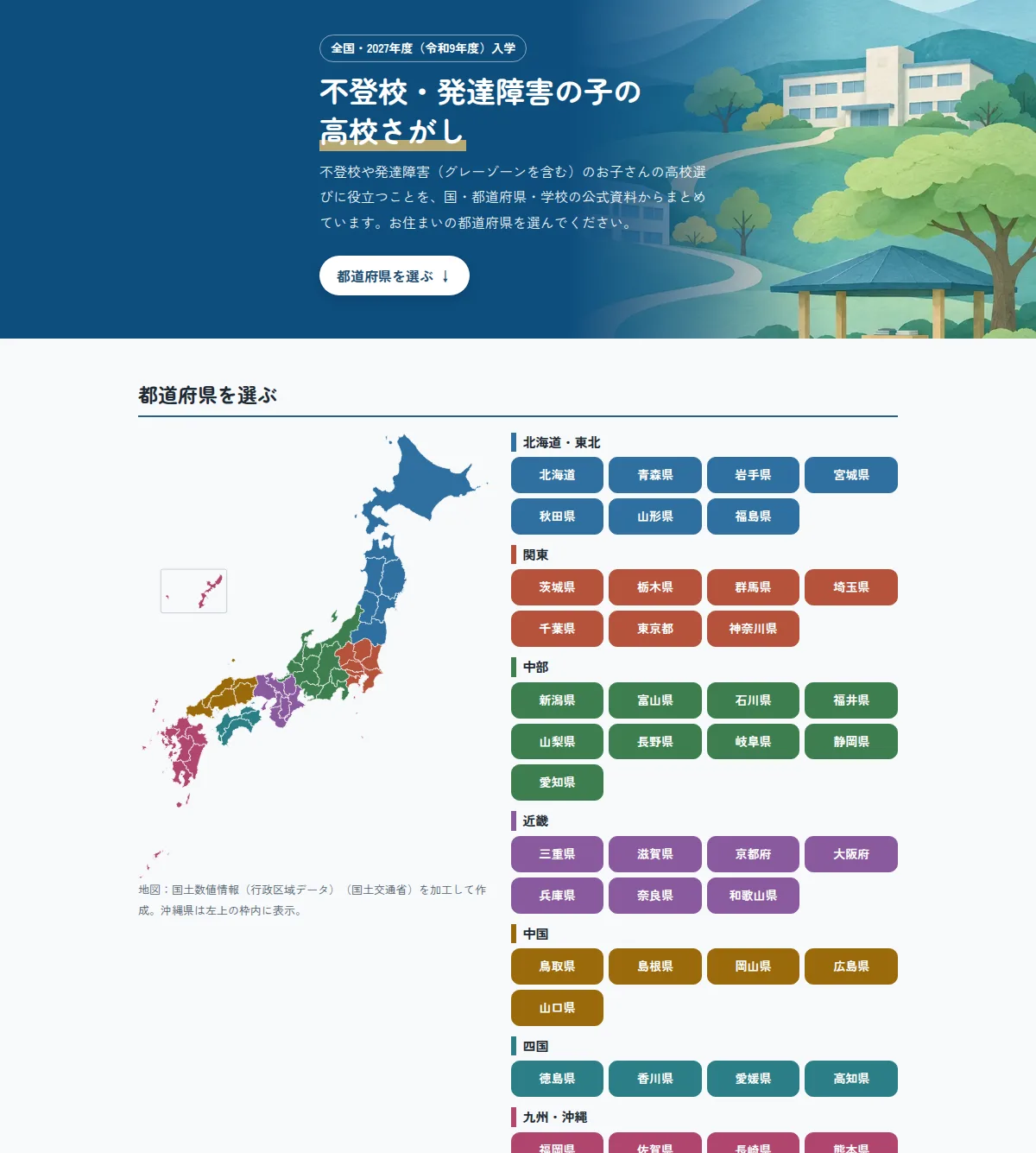
And with the last prefecture, Miyazaki, published, all 47 prefectures were finally in place.
The site now lists 6,301 high schools nationwide (counting correspondence schools in each prefecture where they have campuses). Of these, 1,823 listings had specific descriptions of support for non-attendance in official documents, and 1,744 had specific descriptions of support for developmental disabilities.
A system that processes up to 40 groups in parallel
Reading this much, school by school, was possible thanks to AI.
Dividing the schools into groups of about nine gave more than 640 groups, even excluding Tokyo. For each group, an AI agent reads and summarizes the schools’ official documents, and a different AI checks the result against the original sources. A program automatically checks that quotations match the original word for word. If something needs fixing, it is revised and checked again. Then another pass looks for anything that was missed. We built a system that can run this process for up to 40 groups in parallel. Counting only what can be counted, more than 2,000 tasks were run by AI agents.
The first check found something to fix in 312 of the 640-plus groups, about half. Instead of leaving everything to one AI, a different AI finds the errors and they get fixed. Without this system, that many errors might have remained.
We also kept the bar for “support” high. A school whose anti-bullying committee merely lists a school counselor, that only says a committee “will consider” something, or that offered resource-room instruction only in a past year, does not get a support label.
We used four AIs: Claude, Codex (OpenAI), Gemini and Grok. As a rule, the AI that checks is different from the AI that researched, because two of the same AI might miss the same things. Remaining issues and the final check before publication were handled by a coordinating AI (Claude), following criteria I set. Before publishing, we also opened the live pages in a real browser to check every school’s display and how it looks on a phone.
More than 36,000 excerpts of official documents were saved as evidence. The site links to more than 12,900 unique official sources.
The AI “brains” are in the cloud. All we have on hand is a single server running 4 cores of a server CPU (Intel Xeon Gold 6252N) with 32 GB of memory. That server handled coordination, collecting documents from school websites, and checking that quotations match the original documents word for word. At the busiest point, CPU usage was close to 100% (98.8% as a 10-minute average across 4 cores, for the whole machine), and the load average rose to about 22. Collected school pages, evidence documents, records of exchanges with the AIs and more added up to about 80 GB of working data (including intermediate files).
As an organization that teaches children how to use AI, we built this site by using AI to the fullest ourselves. Even so, AI can misread. That is exactly why every entry links to its source, so anyone can trace it back to the original document.
Not written does not mean not there
There is one thing to keep in mind when using the site.
A school marked “no description found” may still offer support. Often it simply is not written in their documents. Conversely, a description does not mean the support is extensive. Whether support is actually available needs to be discussed with each school.
If it is hard for your child to attend an information session, ask whether parents can consult on their own or arrange an individual visit.
Admission rules and school support change every year. Before applying, always confirm with the official documents of the school and the prefecture.
In Tokyo, if you want testing accommodations for a Tokyo metropolitan high school exam, you apply through the junior high school by Friday, December 18. Some private schools have earlier deadlines. Please talk to the junior high school teacher early.
Just knowing there are choices
This site will not decide which school a child goes to. Still, I hope it helps families who assumed there was no high school their child could attend because of absences discover that there are more choices than they thought.
High School Finder (Japanese): https://digitalkodomo.jp/koukou/
Press release: https://digitalkodomo.jp/news/2026-11-07-koukou-launch_en.html
Consultation Guide for Non-Attendance and Development (Japanese): https://digitalkodomo.jp/futoko/
*
Digital Kodomo BASE runs “Furatto Lab,” a monthly gathering in Ota City for elementary and junior high school students who find it hard to go to school. It is free, and a computer is provided for each child. The next session is Monday, November 16, from 1:00 p.m.