For parents of children who find school hard or have developmental differences
Digital Kodomo BASEA Place for Children
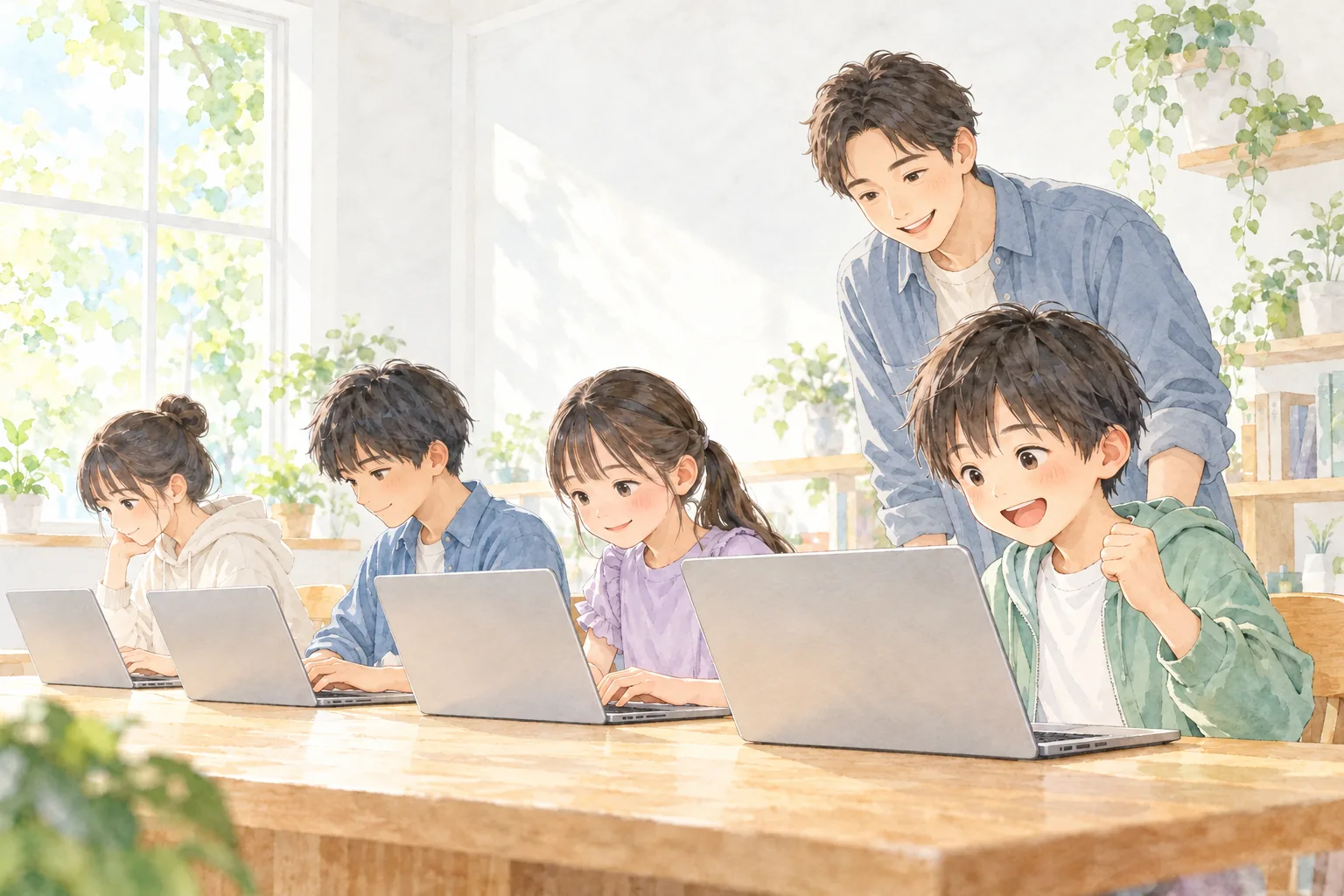
At Digital Kodomo BASE in Ota City, Tokyo, children who are not attending school, children with developmental differences, and children described as "gray zone" all take part. With a computer for every child, they can build serious digital skills, from AI and programming to game making.
With digital skills, you can open up your own future.
- Who
- Elementary to high schoolNo diagnosis required
- What they learn
- AI, programming, game makingTyping and video making too
- Cost
- FreeA computer for every child
At Digital Kodomo BASE in Ota City, Tokyo, children who are not attending school, children with developmental differences, and children described as "gray zone" all take part. With a computer for every child, they can build serious digital skills, from AI and programming to game making.
Are you worried about any of these?
- My child can't go to school and spends long days at home
- My child finds people hard and has nowhere to go
- Group activities don't suit my child, so classes don't last
- My child loves something but has nowhere to use it
- The places my child used to go have been disappearing
- I want to talk with parents in a similar situation
- I want a place where my child can feel safe and also dive into what they love
- I want my child to gain skills that lead to the future
Children like these come here.
"Can a child who finds school hard take part?" "Is it OK if my child has developmental differences?" We receive many questions like these from parents. Children who have never used a computer come, and so do children who love games. No diagnosis or computer experience is needed.
Two places at Digital Kodomo BASE
Choose based on your child and the days and times you can come. Both are free, and we provide the computers. Each child decides what to do and how far to go. Everyone faces a screen, so no one has to talk.
Houkago Lab
Every Wednesday, 16:00–18:00
Imoya Ponpoko (4-32-8 Chuo, Ota City)
For elementary and junior high students. Up to 16 children, with members changing every six months. The second term is currently full, so we are accepting visits and waitlist sign-ups.
Furatto Lab
Monthly to start · weekdays 13:00–15:00
Digital Kodomo BASE (3-3-3 Chuo, Ota City)
A place for elementary and junior high students who find school hard, and their parents. High school students are welcome to ask. Small groups, with a separate room where parents can talk. The next session is Monday, November 16.
Applications are required in advance. If many apply, places are drawn by lottery.
Voices from parents
"My child looked forward to it all week and was full of energy that morning. For a child who finds school hard, it seems to have become a new place to belong."
"The small group made it comfortable for my child. I could listen to staff in a separate room, and having other parents in a similar situation was reassuring. The places we used to go have been disappearing, so we'd be grateful for more places like this."
"It was my child's first time making a game with AI, and on the way home they told me one thing after another: 'I worked on this part,' 'This went wrong.'"
Read more voices from parents →
These are based on comments we received, with some wording changed so that children and families cannot be identified.
Four things you'll find only here
On a foundation of feeling safe, children at Digital Kodomo BASE can build serious digital skills they will use as adults.
Real equipment
A computer for every child. Our facility also has high-end PCs for 3D games and advanced creative work.
From play to real skills
Starting from Minecraft and Roblox, children move on to programming (Scratch, Python), making games with AI, and video production.
Materials to keep going at home
Our free materials include the Skillup Dojo for typing, Linux, Python and AI literacy (Japanese), and Kids' IT Lab explaining IT topics (Japanese).
Skills that leave a mark
Games children make can be published on the AI Game Plaza. Passing our certification exams in AI use and information literacy earns a certificate (levels 5 and 4 are free for Furatto Lab participants).
Our materials and activities are designed by our president, who has worked in IT for more than 25 years. About our president →
How skills grow
It's fine if your child has never touched a computer. Each child moves forward at their own pace.
- STEP 1Try itGet used to computers through favorite games and videos
- STEP 2Hands get used to itTyping and using a mouse become natural
- STEP 3Make somethingMake your own games and works with Minecraft, Scratch and AI
- STEP 4Give it shapePublish your work or pass a certification exam, and turn it into confidence
This is one example of how children engage. Each child decides what to do and how far to go.
Why computers?
Even when children start with favorite games or making videos, skills they will use as adults build up little by little as they work with their hands.
Expressing ideas without handwriting
Children who find writing with a pencil painful can sometimes put their thoughts into words on a keyboard. Text-to-speech, voice input and AI can also help with what they find hard.
Try again as often as you like
Mistakes can be erased and redone. When children find and fix what isn't working on their own, that "I did it" becomes material for confidence.
What you make stays with you
Games, videos and programs take shape and remain. Children can see for themselves: "Today I made this."
Used every day as adults
Typing, documents and spreadsheets, and using AI are skills people keep using in further study and at work. Time spent on what they love can build up at each child's own pace.
The real test comes in adulthood. We want to raise adults who can still use their abilities in their 40s and 50s.
See Digital Kodomo BASE in a video
Introduction video (about 1 min 30 sec, Japanese) | Watch on YouTube
More voices from parents
From parents of children who find school hard or have developmental differences
"My child finds it hard to be with people for long, yet enjoyed it so much they said they wanted to stay longer. They spend a lot of time at home now, so I hope this becomes a way to get out."
"Right now, partly because of developmental differences, going to school is difficult. Meeting adults who know a lot about computers and AI gave my child a reason to go out and meet people."
"My child gets anxious easily, but through a favorite game they seemed much calmer."
"Though my child said they didn't want to go, they stayed to the end and went up to collect their certificate on their own. They proudly explained it to the family at home, and I think it built their confidence. Staff were also considerate of how hard it is for my child to eat in front of others."
"My child is usually at home, so it was good that they could talk with the staff and other children."
From parents of shy children or children who had lost confidence
"My child is shy and usually hesitates to join events, but after coming once keeps asking, 'When's the next one?' They love that older children teach them kindly."
"My child couldn't keep up with programming at school, and we were stuck even after searching together. Here, they're happy that 'I could do it too' when they see what other children are doing."
"My child usually finds everything 'too much bother,' yet joined in eagerly and even asked, 'Can I make this a regular class? I'll come however far it is.' I was surprised."
"It was a new place, but an older volunteer welcomed us with a smile, so I felt safe leaving my child there."
"My child was starting to feel bad at computers, but learning in a fun way seems to have given them confidence."
On the joy of making things
"We have no computer at home, and my child had avoided programming, but came home saying, 'That was so much fun.'"
"Playing a game they made themselves seems to have been a big inspiration for my child."
"Time to play face to face with friends in the same place feels precious for children today."
From learning to teaching
Junior high and high school students can also join as volunteers. Being relied on by younger children can help them grow a great deal.
A junior high student who volunteers at Houkago Lab was not, at first, the type who enjoyed looking after younger children. Week after week, younger children asked, "How do you do this?" Over time, this student went as far as building a Minecraft world for everyone to play in and showing it to the group.
"Since early childhood, we worked with my child's developmental differences and received many kinds of support, but not much changed. After starting to volunteer at Digital Kodomo BASE in junior high and being looked up to by the younger children, I feel my child has become able to think about how others feel."
Read more in our president's column, "Children Grow When They Have a Place."
Being useful to someone
is also material for believing in yourself.
For teens who find school hard, moving to the teaching side may become another place to belong. To ask about volunteering, please email admin@digitalkodomo.jp.
Questions parents often ask
Is there a fee?
Both Houkago Lab and Furatto Lab are free, and we provide the computers. Our activities are supported by donations.
Is it OK if my child finds talking hard?
Everyone works at a screen, so children can be here without talking. Most settle in gradually, at their own pace.
Can my child leave partway through?
Yes, at both Houkago Lab and Furatto Lab. For Furatto Lab, if this month is hard, next month is fine.
Can parents stay?
At Furatto Lab, parents can stay. There is also a separate room where parents can talk.
Can you accommodate developmental differences?
We are not a medical or therapy facility, but we do what we can so that each child feels safe. Please talk to us about any concerns when you visit.
Who runs this
NPO Digital Kodomo BASE (Ota City, Tokyo) brings computers, AI and programming to children for free. All programs are free, supported by donations.
Getting started
Read the pages
Check the dates and places on the Houkago Lab and Furatto Lab pages.
Apply or visit
Apply for Furatto Lab by email. Houkago Lab is accepting visits and waitlist sign-ups.
Come on the day
No computer or belongings needed. If it doesn't suit your child, you can leave partway through.
Please come and see what it's like.
For questions, email admin@digitalkodomo.jp.Related articles
Our places
Children who find school hard, and digital
Confidence and "I did it"
For worries about school and learning, public services such as the Ota City Education Center (03-5748-1201, Japanese) are also available.