Digital Kodomo BASE, a certified non-profit organisation based in Ota City, Tokyo (Chair: Tomoyuki Urushitani), today releases 10,765 teaching materials on AI and digital citizenship for children, free of charge. Illustrations, worksheets, posters and card games are all included, and anyone running non-profit activities with children may use them without applying — schools, after-school clubs, children's associations, NPOs, libraries, community groups and families.
Available at https://digitalkodomo.jp/kyozai-sozai/
Not keeping what we made to ourselves
Children meet smartphones and generative AI at an ever younger age. Yet the material needed to sit down with a child and think through "how should I take this AI answer?" or "what should I not post?" is not always within reach of the people who need it.
During 2026 the organisation produced and published, free of charge, 340 four-panel comics on digital citizenship and 355 articles in its Kids Future Notes series. What is released today is the original artwork created along the way. Rather than keeping it inside the organisation, it is being opened up for anyone involved in children's learning and activities.
Until now the library had been shared privately, pointed out to individual educators on request. As several of them wrote asking to use the materials in their teaching, we concluded that opening it up would serve people better than handing it out case by case. Today's release is a response to those requests.
What is included
| Type | Files | Contents |
|---|---|---|
| Illustrations | 4,423 | 1,624 distinct items. Characters, people, backgrounds, objects, pictograms, speech bubbles, stamps, colouring pages, good-example/bad-example pairs |
| Scene artwork | 4,110 | 1,370 distinct items. Passwords, social media, in-game spending, AI, late-night screen time — the original comic artwork without dialogue |
| Worksheets | 2,128 | 1,064 sheets. "Write the dialogue" 340 / "Draw the fourth panel" 340 / "Put them in order" 340 / "Which is better?" 44. Print-ready PDF with sample answers |
| Posters | 90 | 15 designs. A4 and A3, with and without reading aids |
| Card games | 14 | 7 sets. Sorting cards, IT vocabulary cards, digital-citizenship board games |
| Total | 10,765 | Includes greyscale, transparent-background, mirrored and 16:9 variants |
Because each picture is offered in several versions — greyscale for printing, transparent background, mirrored, and 16:9 for slides — the library comes to 10,765 files. Counted as distinct items, that is 4,080 materials.
Figures are as of 28 September 2026. For the current totals, please see the illustration library.
The 340 four-panel comics (each with a narrated video) and the 355 Kids Future Notes articles remain free to use as well.
What the materials look like
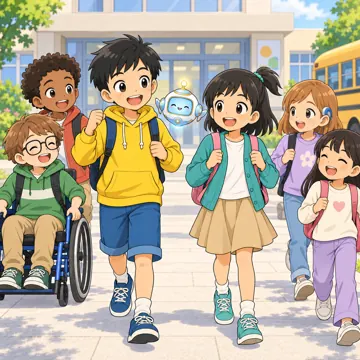
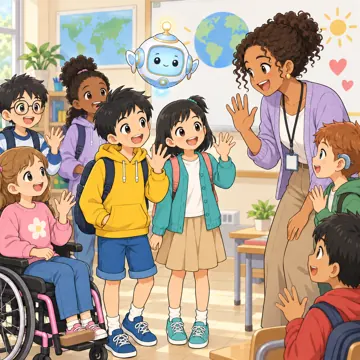
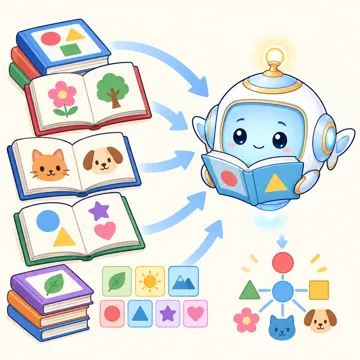
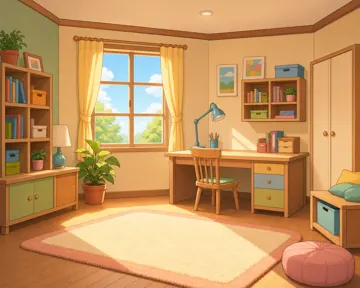
A small selection. Everything shares one visual style, so the pieces combine well.
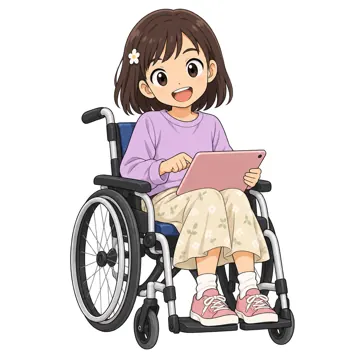
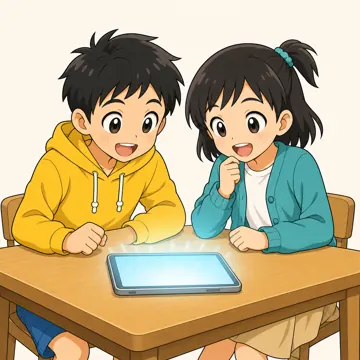
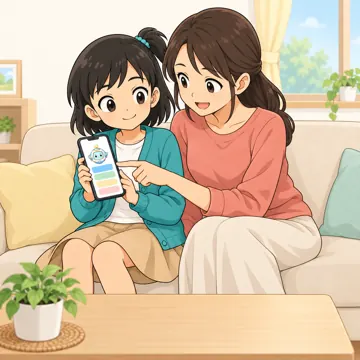
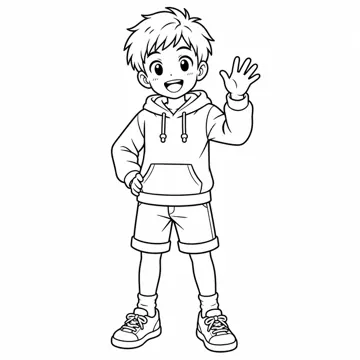



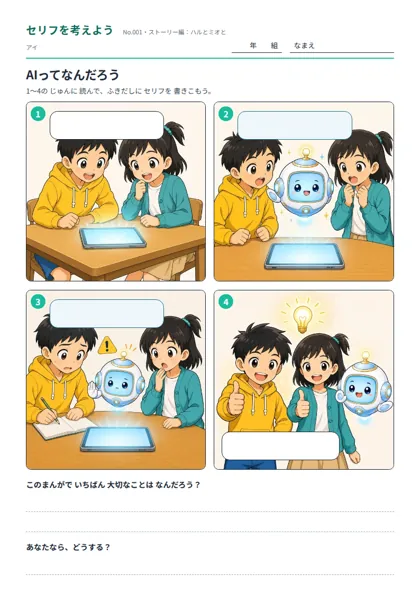
The rest can be browsed on the illustration library page.
Three things that set these apart
1. Built to be modified
Each image comes in several versions: transparent background, greyscale for printing, mirrored, and 16:9 for slides. Cropping, recolouring and adding text are all permitted.
2. An organisation that teaches AI literacy made its materials with AI
The materials were produced with the help of AI. This is stated openly on the site. As an organisation that tells children how to work with AI, it chose not to hide how its own work is made.
3. Many kinds of children appear
Children who wear glasses, use wheelchairs or hearing aids, and children of varied backgrounds are included, so that wherever the materials are used, the child in the room can find themselves in them.
Making one picture and building a library people can use are different jobs
Anyone can make a picture with AI now. It is enjoyable, and it is the right place to start.
Something you hand to other people to use is another matter. One consistent style. Hands and bodies that hold together. No garbled text. Backgrounds that cut cleanly. Artwork that still looks right in print. Between "one picture for fun" and "ten thousand fit to give away" lies a gap, and the gap is skill. Here is what the work actually involved.
- Saying what you mean — "a classroom" is not enough. Who is there, where, doing what, with what behind them. The ability to put it into words becomes the quality of the picture
- Holding the style steady — ten thousand mismatched pictures are not a library. We built patterns for the instructions and repaired them when they drifted
- Doubting the result — the number of fingers, where a wheelchair footrest sits, how a white cane is held. AI gets things wrong in convincing ways. You cannot take what comes out at face value
- Fixing and redoing — when the result is not right, you discard it and rewrite the instruction. This time we found artwork where a white shirt had been treated as background and made transparent, and remade it
- Preparing it for use — removing backgrounds, producing greyscale, fitting print and slide sizes
In short, working with AI means asking well, doubting well, and fixing well. None of it is a special talent; it comes with practice.
We built the tools before building the library
Neither the ten thousand materials nor the 340 four-panel comics were gathered one request at a time. We built the machinery for making them.
- Keeping the plan in text — who appears in which story, how many panels, what happens in each. One file drives both the generation and the assembly
- Holding the characters steady — the same reference images go in every time, so a child looks like the same child from story to story
- Never drawing the dialogue into the picture — speech bubbles are layered on in the web page afterwards. The text never breaks, and rewording takes seconds
- Redrawing only the panel that failed — not the whole strip
- Letting machines do the checking — missing images, broken links, missing descriptions. People spend their time looking at the artwork itself
- Automating the narrated videos — speech synthesis and video assembly are joined up, so all 340 comics have one
This business of "building the way you build" looks unglamorous, but it is where the most learning happens. The same habit of mind carries over into programming, into research, into writing.
Passing these skills on to children
This is exactly what Digital Kodomo BASE teaches. We want children to see AI not as a machine that hands over answers, but as a tool for getting closer to what they want to make.
- After-School Lab — a free learning space every Wednesday, one computer per child, for AI game-making and programming
- Furatto Lab — a free space for children who find school hard, and for their parents, with a separate room for guardians
- Comics on AI and digital literacy / Kids Future Notes — free reading for home
- Digital Kodomo BASE certification — a way to keep a record of what has been learned
We also give and lend computers so that children can start even when there is no computer at home. Reducing the number of children who grow up never having touched one is where this organisation began.
You are welcome to ask about visiting or joining, or to read more about what we do.
We have written about this at more length in the column “Using AI by chance, or by design”.
Terms of use
- Free and with no application required for non-profit education and activities with children (schools, after-school clubs, children's associations, NPOs, libraries, community groups, families)
- Modification is free: crop, recolour, add text
- Commercial use — paid services such as cram schools and private lesson providers, paid teaching materials, publications, advertising or merchandise — is not permitted. Please get in touch if you are unsure
- Please do not redistribute or sell the materials themselves (bundling them as a library, republishing them for download, and so on)
- Credit is optional ("Illustrations: Digital Kodomo BASE" is appreciated)
Next
An English edition of the library and further additions to the collection are planned. Requests for specific materials are welcome.
About the organisation
| Name | Digital Kodomo BASE (certified non-profit organisation) |
|---|---|
| Corporate number | 5010805003266 |
| Address | 3-3-3 Chuo, Ota City, Tokyo 143-0024, Japan |
| Chair | Tomoyuki Urushitani |
| Website | https://digitalkodomo.jp/ |
Digital Kodomo BASE works to widen the opportunities for children to touch computers, AI and programming — to look things up, make things and present them — regardless of their family circumstances.
Contact
Digital Kodomo BASE
Email: admin@digitalkodomo.jp
Enquiries about coverage, materials and use are welcome by email.